The 2021 book Abortion and Mothering, edited by pro-abortion authors Jessica Shaw and Heather Jackson, is a collection of pro-choice essays.
One chapter has interviews with abortionists who are also mothers. There is a lot to unpack in that chapter, and I’ll be writing more about it soon. For now, I’d like to focus on one abortion doctor whom Shaw identifies only as “Sally.”
Few Doctors Kept Doing Abortions
Sally trains other doctors to be abortionists. In fact, she says she has trained a “tremendous number” of them. But she complains that few of those doctors end up becoming career abortionists. Most of them do abortions for a little while, then stop.
She speculates about why this is:
[That so many abortionists quit] has made me wonder: Why can some people become abortion providers, and others who might be pro-choice don’t want to do it? Why is it that some people do it for a while and then burn out and don’t want to do it anymore?…
HELP LIFENEWS SAVE BABIES FROM ABORTION! Please help LifeNews.com with a donation!
I’ve seen some doctors who are providers and then just quit because there is social disapproval of them in their communities for being abortion providers.
I have had a couple of colleagues who quit, I think, because they are just not clear in their minds that this is the right thing. They thought for a while that this might be okay to do, but then they have been told that the community looks down on them.1.
Other abortionists have talked about the stigma of providing abortions.
Abortionist Dr. Pratima Gupta wrote in 2017, “When I was first hired [to do abortions], I felt like I had a scarlet letter, a big A on my face, the ‘A’ being for Abortion Provider, not for Adulteress.”
And another abortionist interviewed by Shaw in the same chapter admits she hasn’t told most of her friends that she does abortions.
Older Quotes About Abortion Stigma
Other quotes by abortion providers are older.
Abortionist Don Sloan, who at the time had done over 20,000 abortions, wrote in 1999 that “The term ‘abortionist’ still carries with it a heavy weight. We’ve made [abortion] legal, but we haven’t made it respectable—not quite.”2
In 2013, late-term abortionist Susan Robinson said in an interview that abortion stigma isn’t limited to the public but also exists among doctors:
If you do abortions, it is very hard to get the privilege to work in a hospital, because they don’t like abortion providers…. Being an abortion provider is very stigmatized. Other doctors look down on you and think of you as like the lowest of the low.3.
Pro-choice author Carole Joffe interviewed abortion doctors for her 1995 book. She quotes one saying:
Well, you know, every now and then you get labeled an ‘abortionist,’ which is a term I don’t really enjoy… ‘Abortionist’ carries a still unpleasant connotation. It carries the connotation of a sleaze.4.
And way back in 1984, late-term abortionist Warren Hern wrote:
Abortion has been stigmatized in the medical profession… Communities do not like to be reminded that abortions are occurring within their boundaries …
Candor invites both criticism and harassment; very few abortion clinics or physicians providing abortion services include the word abortion in the title identifying the activity.5.
It’s striking that so little has changed in the last forty years.
But Why is Abortion Stigmatized?
Stigma exists even though, in 2022, 61-62% of Americans polled said that abortion should be legal in all or most circumstances.
It’s easy to see why pro-lifers would view abortion negatively. But why would people who support legal abortion also look down on providers? I obviously can’t speak for them, but I can’t help but wonder if many of them feel, deep down, that abortion is a bad thing.
And that raises the question. Why would it be a bad thing? If abortion is only the removal of tissue or cells, or the “products of conception,” what would be bad about it?
Stigma against abortion suggests that many people, deep down, know that abortion is more than this. That it is the killing of a human being in an early stage of development.
Abortionists Who Quit When They Become Mothers
Sally also says that many female abortionists quit when they have children. She speculates, “I guess that is about buying into this idea that somehow abortion isn’t as pure as having babies.”6
Motherhood didn’t affect her the same way, though. She says that when she was training to do late-term abortions with Canadian abortionist Henry Morgantaler, she was over eight months pregnant. This led to “some interesting conversations,” she said.7.
Sally wasn’t moved because she was nurturing a preborn baby of her own.
The “Emotional Toll” of Abortion
She admits there may be another reason abortion doctors stop doing abortions when they become mothers. She says, “[M]aybe it is hard to look at the fetus while you are mothering.”8.
Looking at an aborted baby doesn’t bother Sally, even though she’s a mother. She says:
I look at a fetus, and I don’t think of it as a piece of junk. There are cells, and they are reproducing, and if you let them reproduce long enough, they will produce a human being. But I don’t have any connection to it emotionally.9..
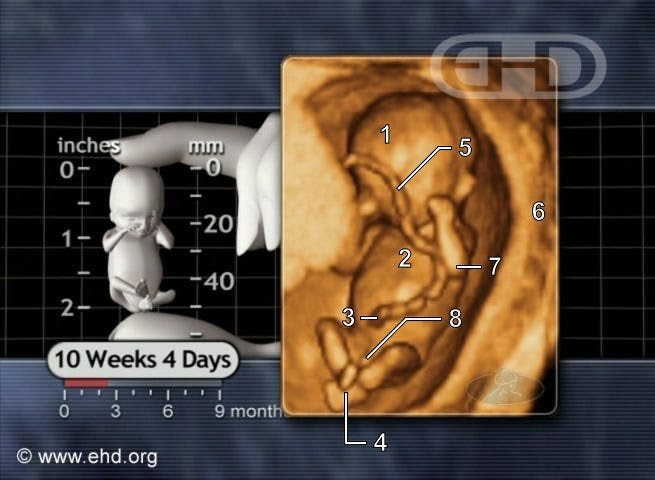
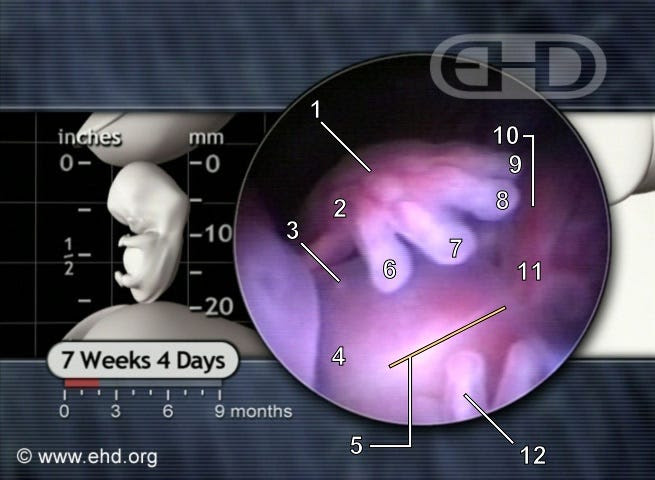
Somehow, Sally sees aborted babies as “cells”—even though she does late-term abortions. In some abortions she does, those “cells” have arms, legs, fingers, and toes.
For example, here is a sonogram of a preborn baby, a little over ten weeks after conception, or the twelfth week of pregnancy:
 |
And here is a picture of the hands of a preborn baby at just seven and a half weeks after conception:
 |
Partway through the first trimester, the abortionist can clearly see torn off arms and legs in the aftermath of a suction abortion.
One abortionist who worked at Planned Parenthood and had been doing abortions for four years said in an interview:
This can burn you out very, very quickly … not so much by the physical labor as the emotional part of what’s going on.
When you do an ultrasound, particularly if you have children, and you see a fetus there, kicking, moving, living, doing things that your own child does, bringing its thumb to its mouth, and things like that—it’s difficult.
Then, after the procedure, sometimes we have to actually look at the specimen, and you see arms and legs and things like that torn off … It does take an emotional toll.10
Some abortionists can rationalize and cope with the sight of torn fetal bodies, and some can’t.
Despite Sally’s euphemistic description of preborn babies she aborts, she acknowledges that abortions are emotionally hard to do:
Unless you are very firm about what your ethics are, about why you are doing what you are doing, and you have some support from somewhere, it is hard. It is probably very hard for some people, which is why I try so hard to be an upfront public mentor to young physicians who want to do this.11
A “Generational Inspiration”
Sally is firmly pro-abortion and has no problem dehumanizing preborn babies. At the end of her interview, she talks about her career as a tribute to her mother, who was also pro-choice.
She says:
[W]hen you rip off antiabortion posters that have somehow made it up on the staff room bulletin board…you are being the generational inspiration that you admired so much in your mom. 12
Ironically, Sally feels her pro-abortion activism (as well as committing abortions and training doctors to do them) is a tribute to her mother, who chose life for her and carried her in her womb.
I honestly don’t know if there is any way to reach a person like Sally. But I take comfort in the fact that many other doctors can’t silence their consciences the way she did.
Footnotes
1. Jessica Shaw, “Abortion Providers as Mothers, with Mothers” Heather Jackson and Jessica Shaw, eds. Abortion and Mothering: Research, Stories, and Artistic Expressions (Bradford, Ontario: Demeter Press, 2021) 61.
2. Don Sloan, “Basic Issues in the Abortion Debate,” Political Affairs, July 1999.
3. “After Tiller: Meet the only four doctors in the U.S. who still perform third-trimester abortions despite constant threats to their lives,” Mail Online, January 21, 2013.
4. Carole Joffe. Doctors of Conscience: the Struggle to Provide Abortion before and after Roe Versus Wade (Boston, Massachusetts: Beacon Press, 1995) 152-153.
5. Warren Hern, M.D. Abortion Practice (J.B. Lippenott Company, 1984) 317.
6. Jessica Shaw, “Abortion Providers as Mothers…” 60.
7. Ibid.
8. Ibid., 61.
9. Ibid., 61-62.
10.Ibid., 61.
11.Nancy Dey. Abortion: Debating the Issue (New York: Enslow Publishing, 1995) 49.
12. Jessica Shaw, “Abortion Providers as Mothers…” 64.
LifeNews Note: Sarah Terzo covered the abortion issue for over 13 years as a professional journalist. In this capacity, she has written nearly a thousand articles about abortion and read over 850 books on the topic. She has been researching and writing about abortion since attending The College of New Jersey (class of 1997) where she minored in Women’s Studies. This article originally appeared on Sarah Terzo’s Substack. You can read more of her articles here.