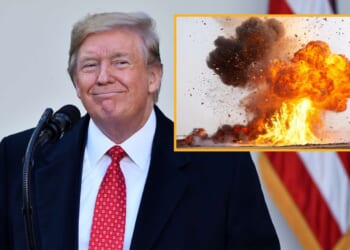
In a decisive step toward prioritizing American sovereignty and public safety, President Donald Trump announced on January 13, 2026, that the federal government will withhold funding from so-called sanctuary cities and states starting February 1.
This policy revives efforts from his first term to crack down on jurisdictions that shield illegal immigrants from federal enforcement, citing threats to national security and local communities burdened by unchecked immigration.
The announcement, made during a speech at the Detroit Economic Club, underscores Trump’s commitment to enforcing immigration laws amid rising concerns over border security. He accused these areas of harboring criminals and undermining American workers, reiterating on Truth Social on January 14 that, “Effective February first, no more payments will be made by the federal government to states for their corrupt criminal protection centers.” This move targets billions in federal grants, potentially affecting programs in housing, transportation, and law enforcement.
The Danger of Sanctuary Policies
Sanctuary policies, adopted by various municipalities, limit cooperation with Immigration and Customs Enforcement (ICE) by refusing to honor detainers or share information on illegal aliens. Critics argue these policies create safe havens for criminal activity, draining taxpayer resources and endangering citizens. According to the Center for Immigration Studies, there are hundreds of such jurisdictions across the United States, including major cities such as Chicago, New York, and Los Angeles, as well as entire states such as California and Illinois. The Department of Justice’s updated list from August 2025 highlights places such as Albuquerque, New Mexico; Berkeley, California; and Boston, Massachusetts, as being noncompliant.
Proponents of defunding point to real-world impacts. In Minnesota, for instance, investigations have exposed massive Social Security fraud linked to immigrant communities in sanctuary areas, costing taxpayers millions. There are obvious merits, therefore, in cleaning up this level of corruption.
Unconstitutional Technology?
On the negative side of the balance sheet, however, are constitutionalists who fear that (in a government that often stacks functions) an ulterior motive might be in play. That is to say, ICE has deployed advanced mobile surveillance technology to track and locate illegal immigrants, raising alarms about current activities being a mere beta test for technologies that may be later used on American citizens. Known as Stingrays or IMSI-catchers (International Mobile Subscriber Identity), these devices are mounted in vans and mimic legitimate cellphone towers to intercept signals from nearby mobile phones. By tricking phones into connecting to the van’s signal instead of a real tower, authorities can pinpoint a target’s location, capture unique device identifiers, and even intercept communications data — all without traditional warrants in many cases.
This technology, originally developed for military and intelligence purposes, has become a tool in domestic immigration enforcement. In October 2025, reports revealed that ICE spent $825,000 on specialized vans equipped with cell-site simulators, enabling real-time tracking of suspects’ phones. These vans operate covertly, often in urban areas, where they broadcast a stronger signal to force phones to “lock on” to the fake tower. Once connected, the device collects IMSI numbers — unique codes tied to SIM cards — allowing agents to identify and locate individuals. This method has been used to facilitate deportations, with ICE confirming its deployment in operations targeting undocumented immigrants.
Sweeping Up Information From Citizens
The process is insidious in its indiscriminateness. Unlike targeted wiretaps, Stingrays sweep up data from all phones within range, which can span several blocks or even kilometers depending on the device’s power and environment. In one documented instance, similar to reports of broad-area surveillance, devices have affected everyone in a vicinity equivalent to a 30-block radius in dense urban settings, switching their phones to the van’s signal and exposing innocent bystanders’ data. Critics highlight how these simulators vacuum up information from non-targets, including U.S. citizens, during ICE raids or stakeouts.
How that extraneous information is being used is anyone’s guess, especially given the fact that ICE has information exchanges with Israel (its agents are trained in part by the Israel Defense Forces). Legal battles loom, with suits already filed by the ACLU and others.
As February 1 approaches, the debate intensifies: Is this federal overreach, or necessary defense of American interests? In the end, the president’s supporters hope that this action will reaffirm a core principle: Federal dollars should not subsidize lawlessness. But looming behind that hope is the specter of a concern, embodied by the Roman writer Juvenal, who said, “Quis custodiet ipsos custodes?” Translation: Who will watch the watchmen?
This article is part of The New American’s weekly online newsletter Insider Report, which is emailed to TNA subscribers each week. Click here to subscribe to The New American to receive the Insider Report and access exclusive content.