President Donald Trump has formally populated his President’s Council of Advisors on Science and Technology (PCAST), a body created by executive order just days into his second term. The names now attached to it represent a tightly interconnected network of global tech power long associated with the most nefarious elements of the globalist agenda, technocratic thinking, transhumanist ambitions, disdain for constitutional norms, and having extensive ties to the Deep State and entities such as the World Economic Forum (WEF).
The council will be advising the president on everything from the economy and education to national security.
The public reaction was immediate. “Is Bill Gates next for being rewarded?” is one of the most widely shared reactions, capturing the outrage surrounding the appointments.
The Council
Trump signed the order establishing PCAST early in his second term. The document framed technological dominance as a national-security imperative.
It states that emerging technologies such as artificial intelligence (AI), quantum computing, and biotechnology “have the potential to reshape the global balance of power.” It calls for “unquestioned and unchallenged global technological dominance.”
The order warns that science has been corrupted by “ideological dogmas” and calls for restoring a “pursuit of truth.” That mandate, apparently, will be carried out by a council drawn heavily from the same corporate and technological structures that already shape public reality, and whose leading figures openly promote their own ideological dogmas rooted in the technocratic model of governance by “experts.” In practice, this concentrates decision-making power among a small oligarchic group controlling the digital systems that organize modern life and, by extension, the behavior of the masses. (The ideology is also referred to as “Dark Enlightenment.”)
The structure of the council mirrors the corporate model. The assistant to the president for science and technology (APST) and the special advisor for AI and crypto serve as members and co-chairs. If also serving as director of the Office of Science and Technology Policy, the APST may designate the U.S. chief technology officer (CTO) as a member. The remaining members are appointed by the president from outside the federal government and are described as “distinguished individuals” from industry, academia, and related sectors.
The new technocratic board can include up to 24 members. The scope of their “advice” is broad:
The PCAST shall advise the President on matters involving science, technology, education, and innovation policy. The Council shall also provide the President with scientific and technical information that is needed to inform public policy relating to the American economy, the American worker, national and homeland security, and other topics.
The concept of PCAST is not new. Presidents have convened similar advisory bodies for decades. The structure dates back to Franklin D. Roosevelt’s Science Advisory Board in 1933.
The List
The list of “the Nation’s foremost luminaries in science and technology” who will be advising the president includes:
- Marc Andreessen
- Sergey Brin
- Safra Catz
- Michael Dell
- Jacob DeWitte
- Fred Ehrsam
- Larry Ellison
- David Friedberg
- Jensen Huang
- John Martinis
- Bob Mumgaard
- Lisa Su
- Mark Zuckerberg
Each has played a defining role in building the digital systems that now underpin communication, commerce, and governance.
The Techies
Meta
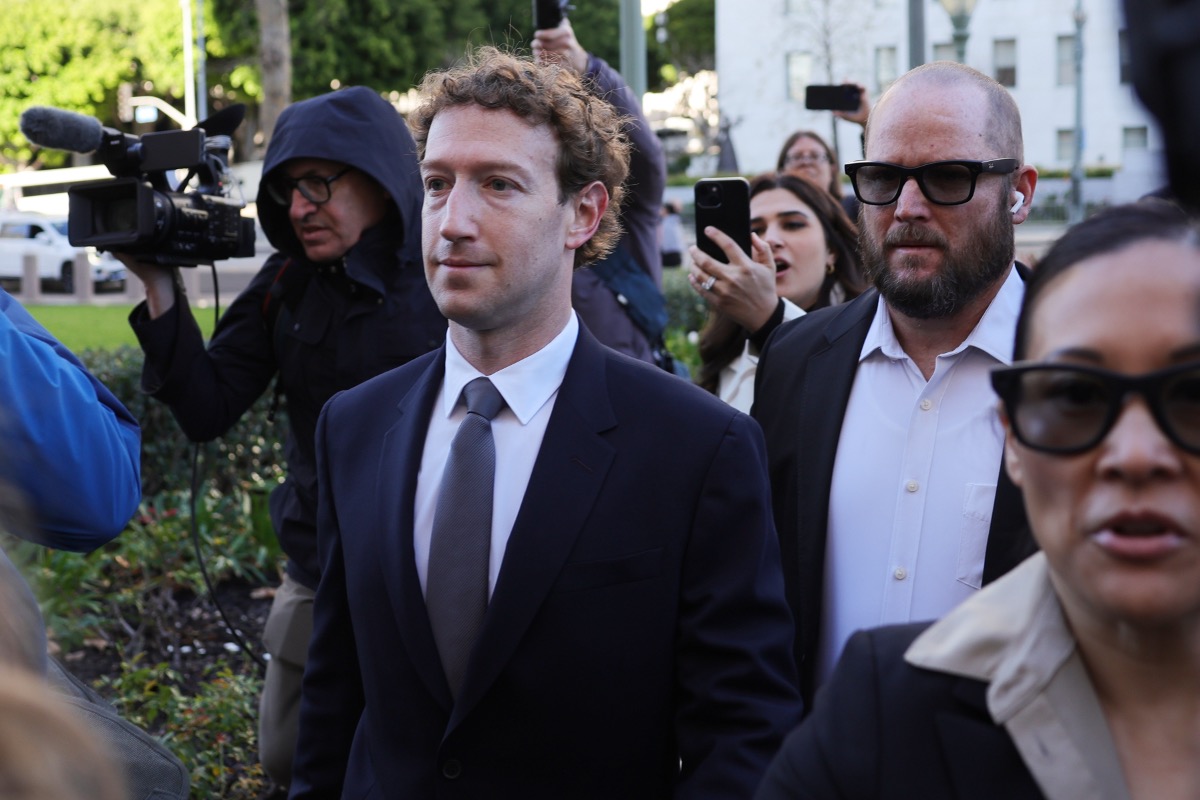
On social media, the most discussed figure on the list so far is Mark Zuckerberg. In 2024, Trump suggested that the Meta CEO should “spend the rest of his life in prison.” That statement came amid tensions over Zuckerberg’s well-documented record of election meddling and platform censorship in 2020.
Since then, Meta has faced escalating legal scrutiny over other matters. Just days ago, juries delivered a landmark verdict finding that the company’s platforms harmed minors and violated consumer protection law, ordering $375 million in penalties. The ruling adds to a growing wave of lawsuits targeting social media companies over addiction, mental health harm, and design practices.
Meta’s role during the Covid pandemic remains another flashpoint. On behalf of Joe Biden’s administration, the company enforced aggressive censorship policies on vaccine and treatment-related information. Critics, including front-line doctors, argued that suppressing dissenting views carried tragic real-world consequences for patients.
In 2023, the European Union fined Meta’s subsidiary for $1.3 billion for facilitating the U.S. National Security Agency’s surveillance.
Then there’s Sergey Brin. A co-founder of Google, he helped build the world’s dominant search engine and one of the most extensive data-collection systems ever created. The company’s early development was supported in major part by intelligence-linked “research” funding of mass surveillance. Over time, Google has become notorious for shaping information flows, filtering search results, and aligning government priorities on content moderation. This magazine has extensively documented this record.
Oracle
Oracle’s Larry Ellison has positioned his company as a central player in government data infrastructure, including health and surveillance-related systems. In September 2024, he openly praised AI-driven surveillance through dense camera networks as a way to ensure what he described as “citizens’ best behavior.”
Perhaps not surprisingly, Oracle is also tied to the CIA. According to Surveillance Watch:
Oracle’s CEO and longtime executive, Safra A. Catz [one of the PCAST members]– is on the Board of Trustees of In-Q-Tel, a venture capital firm funded by the CIA, and which invests in social media monitoring and surveillance tools to support U.S. intelligence operations.
The company is also backed by major institutional investors, including Vanguard, BlackRock, State Street, and Fidelity, linking it to the core of global financial power.
More recently, Ellison has expanded into media and social media ownership and influence, further consolidating control across both data and narrative layers.
Nvidia
Jensen Huang leads Nvidia, the company at the core of the global AI boom. Its chips power many of the most advanced AI systems in operation today. Huang, alongside Ellison, is a part of large-scale data-center initiatives such as Stargate, designed to expand the computational backbone required for next-generation AI systems.
Andreessen Horowitz
Topping the list is Marc Andreessen, Trump’s megadonor and co-founder of Andreessen Horowitz (aka a16z), a venture-capital giant with more than $90 billion under management and major stakes in AI, crypto, infrastructure, and defense tech.
His firm operates at the intersection of private capital and state priorities. Through its “American Dynamism” arm, Andreessen Horowitz invests in companies that “support the national interest,” including aerospace, defense, public safety, supply chains, and industrial systems. These companies, by the firm’s own definition, view the government as a “customer, competitor, or key stakeholder.”
In 2025, the firm hosted high-profile policy and technology discussions in Washington, including appearances by Vice President J.D. Vance and other senior officials, underscoring its growing role as a bridge between Silicon Valley capital and federal power.
Andreessen expressed his philosophy in his “Techno-Optimist Manifesto,” arguing that technological progress should be accelerated without constraint. He maintains that innovation and aggressive growth are moral goods, as is “becoming technological supermen” — i.e., humans augmented by “intelligent machines.” According to Andreessen, anyone attempting to slow down AI is guilty of “a form of murder.”
Finance and Crypto
Cryptocurrency is another crucial part of Trump’s agenda.
The council includes Fred Ehrsam, co-founder of the cryptocurrency exchange Coinbase.
Crypto platforms were originally positioned as alternatives to traditional finance. Today, they increasingly intersect with regulatory frameworks and state interests. This dual role suggests that, rather than decentralizing financial power, they may ultimately reinforce it.
That convergence is reinforced at the leadership level. David Sacks, serving as Trump’s “crypto czar,” will co-chair PCAST. He comes from the same PayPal-era network that shaped much of the modern tech and finance landscape. A close associate of Peter Thiel — a major donor to both Trump and J.D. Vance and co-founder of Palantir — as well as Elon Musk, Sacks has been a leading voice in digital financial systems. He has advocated for their expansion while also helping shape the policy environment around them. And he co-founded Craft Ventures, which has invested in companies such as Facebook, SpaceX, and Palantir Technologies.
Michael Kratsios, the council’s other co-chair, further bridges these domains. A former chief technology officer at the Department of Defense (DOD), he led national efforts to accelerate deployment of 5G. He later joined Scale AI, a company deeply involved in defense and government AI infrastructure, supporting next-generation military and intelligence capabilities.
The bottom line is that Trump’s new techno board empowers the very forces long instrumental in the Deep State agenda that many Americans believed he would dismantle.