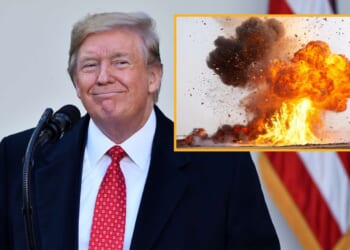
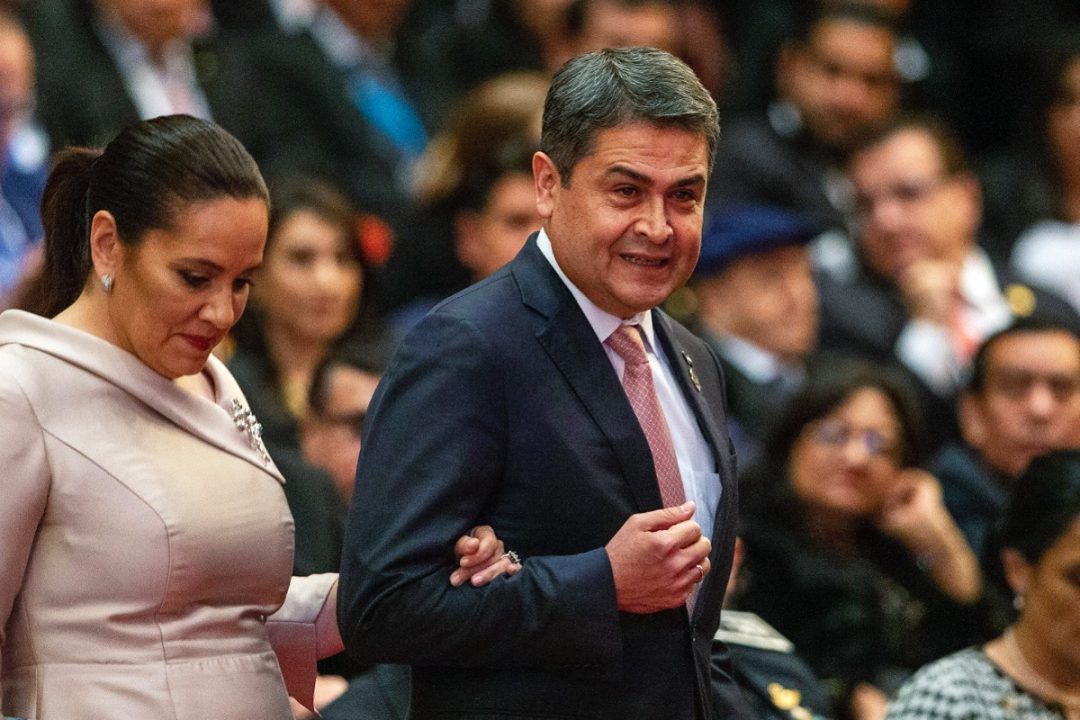
President Donald Trump announced that he will pardon former Honduran president and convicted drug trafficker Juan Orlando Hernández (JOH). The declaration came packaged with “instructions” for Sunday’s Honduran election. Trump warned that U.S. support would dry up if National Party candidate Nasry “Tito” Asfura fails to win.
The timing is hard to miss. The administration is already conducting what many describe as extrajudicial killings of alleged drug smugglers abroad, and Trump is now mounting military pressure on Venezuela — officially, over its role in narcotrafficking. In this context, a pardon for a man convicted of moving hundreds of tons of cocaine into the United States offers a clearer view of the administration’s underlying priorities.
Across the region, the announcement triggered alarm. It also revived a familiar question that never quite goes away: Just how far does Washington believe its authority reaches, and how bluntly does it intend to exercise it this time?
The Announcement
Trump’s Friday post read like a campaign blast for a foreign election and a preemptive pardon rolled into one. He tied both threads together with trademark certainty.
If Asfura wins the Honduran presidency, Trump wrote, the United States has “so much confidence in him, his Policies, and what he will do for the Great People of Honduras” that Washington “will be very supportive.” If Asfura loses, the United States “will not be throwing good money after bad.” A wrong leader, Trump warned, brings “catastrophic results.” Tito, by contrast, “will be a Great President.”
Then came the pledge. Trump promised a “Full and Complete Pardon” for former Honduran president Hernández, claiming he had been “treated very harshly and unfairly.” Such treatment “cannot be allowed to happen,” he added, especially once Asfura wins and Honduras heads toward “Great Political and Financial Success.”
He closed with:
VOTE FOR TITO ASFURA FOR PRESIDENT, AND CONGRATULATIONS TO JUAN ORLANDO HERNANDEZ ON YOUR UPCOMING PARDON.
The message was not new. Two days earlier, Trump, perhaps a bit ironically, had already framed the Honduran election as a battle between “Freedom” and “Narcocommunists.”
Reporters pressed Trump on the pardon while aboard Air Force One. “You want to keep drugs out of the U.S.,” one asked. “Why pardon a notorious drug trafficker?”
Trump replied, “I don’t know who you are talking about. Which one?” After hearing it was Hernández, he blamed a “Biden setup,” yet offered no evidence. Instead, he pivoted: “If somebody sells drugs in that country, that doesn’t mean you arrest the president and put him in jail for the rest of his life.”
Hernández’s conviction, however, tells a different story.
The Narco-state President
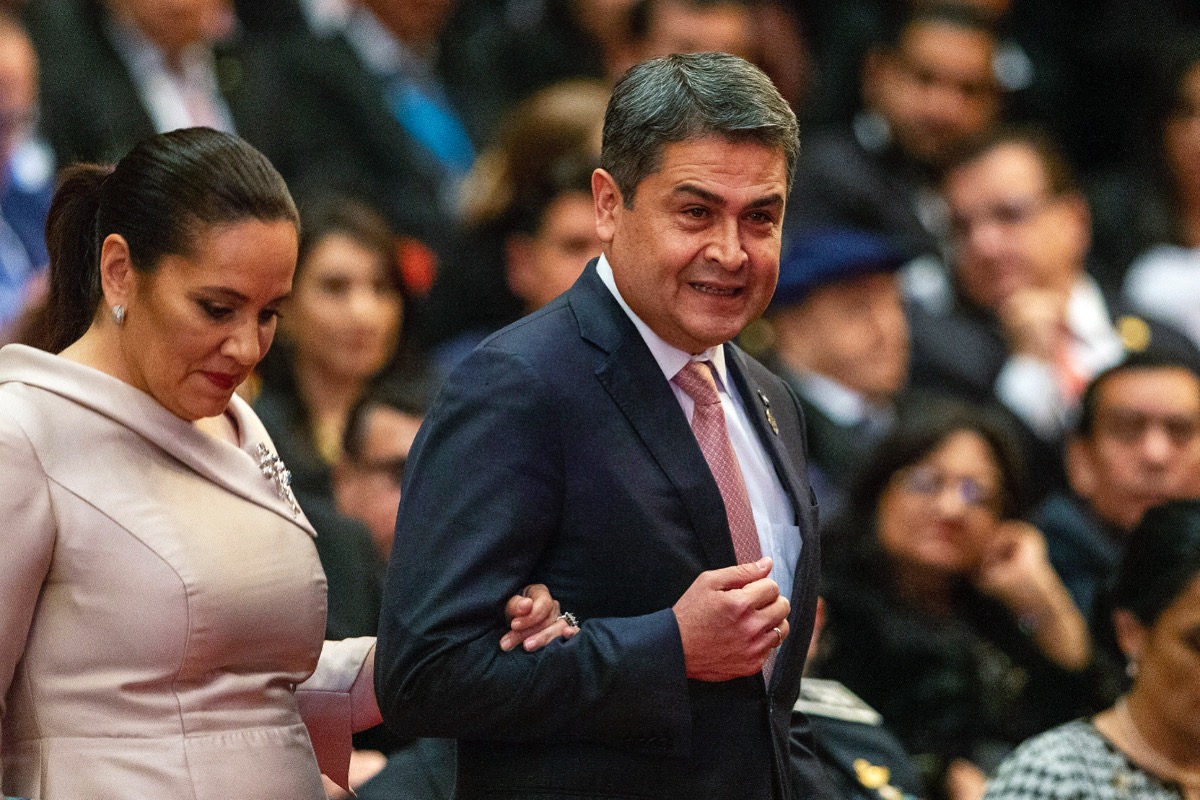
The Justice Department’s (DOJ) account of JOH is blunt. In 2024, a federal jury convicted him “on all three counts in the indictment, which included cocaine-importation and weapons offenses.” Attorney General Merrick Garland said Hernández “abused his position as President of Honduras to operate the country as a narco-state,” where major traffickers operated with “virtual impunity.”
DEA Administrator Anne Milgram noted that Hernández worked “hand-in-hand” with the Sinaloa Cartel “to send deadly drugs into American communities.” U.S. Attorney Damian Williams said Hernández “chose to abuse his office and country for his own personal gain” and partnered with “some of the largest and most violent drug trafficking organizations in the world.”
According to the DOJ, from “at least in or about 2004” through “in or about 2022,” Hernández sat at “the center” of one of the largest cocaine-trafficking conspiracies in the world.
Prosecutors state that Hernández and his co-conspirators “abused Honduran institutions, including the Honduran National Police and Honduran Army, to protect and grow their conspiracy.” Members of the network used heavily armed police units to guard cocaine shipments, attacked rivals, and committed murders to maintain control of the trade.
Several conspirators had already been convicted. They included Geovanny Fuentes Ramirez, sentenced to life, and Juan Carlos “El Tigre” Bonilla Valladares, the former national police chief who pleaded guilty to assisting the trafficking network. Another prominent conspirator was JOH’s brother, Juan Antonio “Tony” Hernández Alvarado. He was convicted during Trump’s first term and sentenced to life in federal prison for trafficking multi-ton loads of cocaine while using military-grade weapons.
Prosecutors concluded:
In total, Hernández and his co-conspirators trafficked … more than 400 tons of U.S.-bound cocaine through Honduras during Hernández’s tenure in the Honduran government.
He was sentenced to 45 years in federal prison.
Old Allies
JOH’s record now hangs over the country’s politics, because the man Trump is endorsing comes from the very same political machine that once enabled Hernández’s rise. Nasry Asfura leads the National Party that Hernández controlled for years. As Wyatt Reed of The Grayzone reported, Trump’s promise of a pardon fits into a wider push to “rig” the Honduran election, including threats to devastate Honduras’ economy if Asfura loses.
The details are stark. Hernández held power with the steady support of Washington, and during his tenure he signed contracts worth more than half a million dollars with the Republican lobbying firm BGR Group. The firm later donated tens of thousands of dollars to Marco Rubio, who now serves as Trump’s secretary of state.
When Honduras announced that the domestic investigation into Hernández remains open, the message was clear. He may be pardoned in the United States. He is not forgiven at home.
The National Party’s history offers more context. It came to power after the 2009 U.S.-backed coup. It stayed in power through manipulation, fear, and a carefully tended network of donors, banks, and foreign partners, per Reed. Hernández’s 2017 reelection came after a mysterious blackout at the vote-tallying center. He went from losing by a wide margin to winning outright. The Trump administration moved quickly to bless the result.
Reed’s reporting also showed how Washington tried to manipulate the preliminary vote count this year. Leaked recordings revealed a plan to delay and distort ballot transmission. The goal was simple. Fabricate doubt, blame the ruling Libre party, spark a crisis, then demand a new election. Once exposed, the plot collapsed; Trump stepped in with an explicit pressure instead.
Globalists and Technocrats
Asfura is more than the product of an old political regime. He is a director of CC35 Capital Cities Secretariat, Inc. That is a regional branch of CC35, a climate-governance transnational network that investigative journalist Whitney Webb describes as a “globalist NGO” driving a new Inter-American carbon market and a continent-wide “smart grid.” The group’s stated goal is “accelerating the commitment of the Capital Cities of the Americas to face the climate emergency that the Planet is experiencing.”
Webb notes that CC35 is “the Latin American equivalent of Michael Bloomberg’s C40 cities but on steroids.” The network also unites figures who publicly present themselves as ideological opposites. “It is … one of the rare Latin America NGOs where you will have a Nayib Bukele ally and other Trump-backed politicians serving alongside communists in service to the same goal,” she writes.
Webb also reported that CC35’s GREEN+ carbon scheme would rely on Satellogic, an Argentine satellite-imaging firm specializing in high-resolution Earth-observation data. It is tied to Trump’s Commerce Secretary Howard Lutnick and former Treasury Secretary Steve Mnuchin. The company, which has partnered with state-linked Chinese data firms, now sits at the center of an emerging carbon-tracking infrastructure for the Americas.
Hernández operated in similar elite circles, reportedly maintaining connections to figures like Peter Thiel and Marc Andreessen, both Trump megadonors.
Seen through this lens, Trump’s intervention in the Honduran election looks less like a nationalist crusade and more like an effort to keep a friendly node in a wider technocratic grid. In this sense, a “rightward” shift in both of the Americas does not halt the march of global governance. It simply repackages it for a conservative audience that would otherwise oppose such initiatives.
As of early Monday morning, Asfura had a slim lead in the national elections.