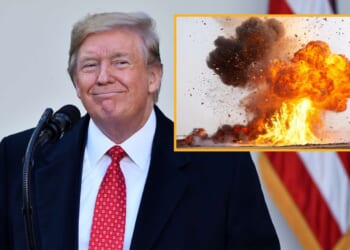
The fog of war rages on. Or perhaps the conflicting messages President Donald Trump and Iran are broadcasting regarding Trump’s announcement that Iran wants a ceasefire is an April Fool’s joke. If so, it’s a cruel prank, given the destruction this war has wrought and continues to bring about.
Trump posted the ceasefire claim on his Truth Social account Wednesday morning. “Iran’s New Regime President, much less Radicalized and far more intelligent than his predecessors, has just asked the United States of America for a CEASEFIRE!” the president wrote. “We will consider when Hormuz Strait is open, free, and clear. Until then, we are blasting Iran into oblivion or, as they say, back to the Stone Ages!!!”
Iran doesn’t have a new president, unless Masoud Pezeshkian’s 2024 election (selection?) is considered breaking news. But the country does have a new supreme leader in Mojtaba Khamenei, the son of the former supreme leader, Ali Khamenei, who was killed on the first day of Operation Epic Fury.
If reports broadcast by Iranian state TV are to be believed, Iran’s foreign ministry spokesperson called Trump’s statement false and baseless. Iranian Foreign Minister Abbas Araghchi told Al Jazeera that “he has no faith in talks with the US, and says that while he has had messages from Washington, no negotiations are under way.”
As for the Strait of Hormuz, which Iran has managed to effectively shutter, Iran’s Islamic Revolutionary Guard Corps (IRGC) reportedly said that it “remains firmly under its control and dismissed what it described as ‘performative actions’ by President Trump.”
Effective Strategy
Iran closing the strait has proven an effective maneuver for a nation that is militarily outmatched. It has sent global gas prices skyrocketing and threatens an international supply-chain crisis if it continues to remain untraversable. This economic warfare move by Iran has also created immense dissatisfaction toward Trump at home. If a number of recent polls are anywhere near accurate, Trump is more unpopular today than he’s been this entire second term of his presidency. The media ecosystem chatter suggests the war will also deliver crushing blows for Republicans in November’s midterm election.
The president knows the shuttered strait is a big problem. That’s why he mentioned it in his recent message. It’s why he has repeatedly lashed out at European leaders for refusing to jump in and help secure it. And Europe’s refusal to do so (so far) is generating the frustration causing Trump to consider withdrawing the United States from the NATO alliance. If that were to happen, it would be among the few silver linings in this war. That said, the best way to exit NATO would be via an act of Congress as opposed to an executive order, which could be reversed by the next president.
The Iranians closing the strait was among the least-surprising developments in this war. For decades, they said they would do exactly that if ever attacked. Even in the leadup to the war, Chairman of the Joint Chiefs of Staff General Dan Caine told the president the Iranians would close the strait if attacked, part of a list of reservations he reportedly had about launching the war. Nevertheless, neither Israel nor the United States had an effective strategy for dealing with it.
Others Jumping in?
Now, however, a number of countries are reportedly meeting to discuss reopening the strait. The British media organ The Guardian reported Wednesday:
The UK will convene 35 countries — excluding the US — to explore ways to reopen the strait of Hormuz, the vital shipping route for oil and gas that has been blocked by Iran. Keir Starmer, the prime minister, said the next phase of discussions in the joint British and French efforts to secure the waterway would be held on Thursday.
The United Arab Emirates is reportedly ready to do what it takes to open the strait as well. It is “preparing to help the U.S. and other allies open the Strait of Hormuz by force, Arab officials said, a move that would make it the first Persian Gulf country to become a combatant.”
Still in the Fight
Despite diminished military capability thanks to more than four weeks of relentless American and Israeli bombardment, and contrary to multiple statements from Trump declaring its missile stockpiles nearly wiped out, Iran continues to launch volleys of missiles at its neighbors on a daily basis. On Wednesday, The Times of Israel reported that Iran fired the “largest missile barrage in weeks.” They’ve also been hitting Israel with cluster bombs for weeks.
Making matters worse for Israel, Iranian proxy Hezbollah is launching rockets into Israel from neighboring Lebanon. Israel has already deployed ground forces into Lebanon. Officials say the plan is to permanently occupy southern Lebanon, which would make it a forcible annexation, an illegal act in the eyes of international law.
Trump’s Address
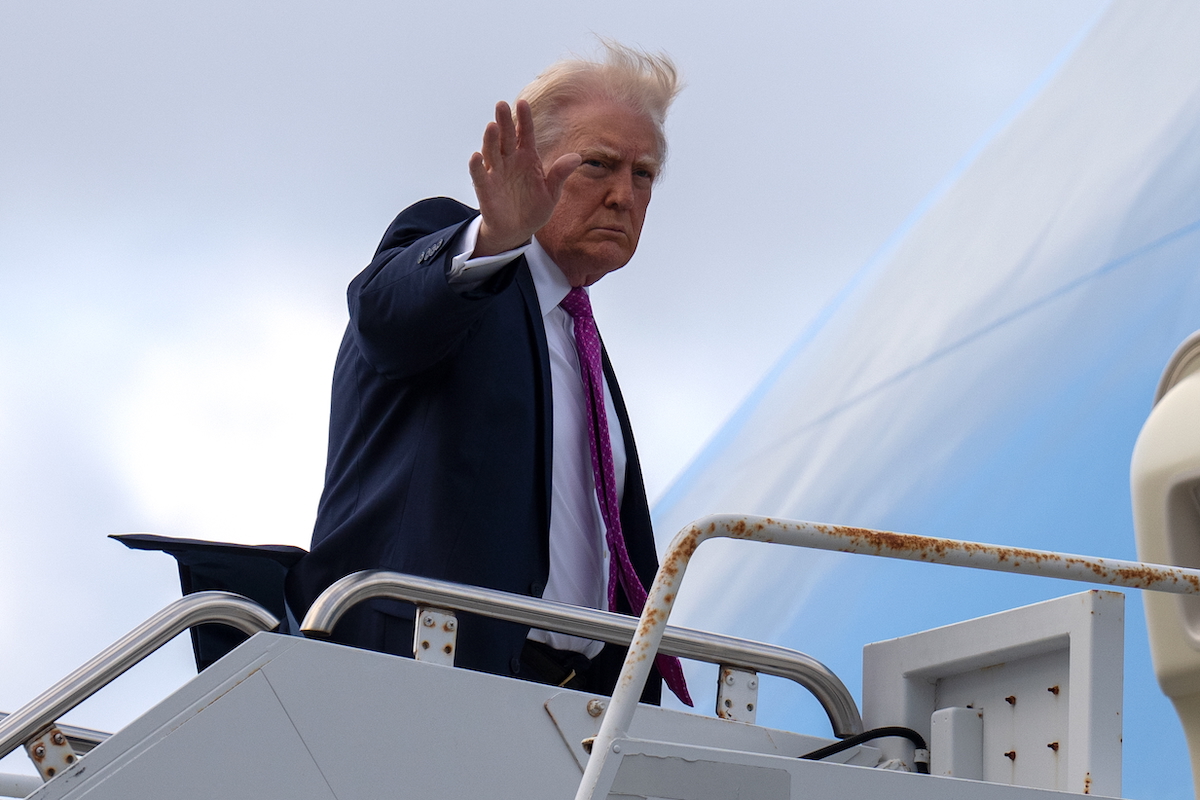
Trump is scheduled to give an address to the American people about Iran on Wednesday night. It’s difficult to anticipate what he’ll say and equally arduous to interpret the meaning of what he’ll say. Earlier Wednesday, he said the United States will leave Iran “very soon,” in about two or three weeks. He said the same thing about two or three weeks ago, on March 9. Meanwhile, the Pentagon has sent thousands of additional troops to the region recently, including paratroopers and Marines, suggesting preparation for a ground invasion. So it’s anybody’s guess what happens next, perhaps even Trump’s.
Meanwhile, a recent report says more members of Congress are now interested in performing their constitutional duty to rein in the executive branch’s power to make war. Apparently, they’re concerned the war is getting out of hand, as wars tend to do. This “has caused some of the Democrats who opposed the first war powers resolution to change their tune heading into the second,” according to The Hill. The first resolution, brought to the floor less than a week into the war, failed by a vote of 212-219, with all but two Republicans voting against it.
By refusing to rein in the executive branch, Congress made itself obsolete precisely when the American people need representation most. As Thomas Jefferson put it in a letter to James Madison, “We have already given, in example one effectual check to the Dog of war, by transferring the power of letting him loose from the Executive to the Legislative body, from those who are to spend to those who are to pay.”