President Donald Trump announced the launch of Trump Accounts, a new federally backed investment program for children. The accounts were authorized under the so-called One Big Beautiful Bill (OBBB) and promoted as a bold effort to expand family wealth and long-term financial security.
The administration and its supporters tout the program as a way to build a new “generation of capitalists.” Yet the irony is hard to miss. The federal government will now seed private investment accounts with public money, supplemented by corporate and “philanthropic” contributions. It will also tightly control where that money may be invested and how it may grow. The structure borrows the language of capitalism while operating through centralized design. The design ensures that personal finance is shaped from birth while simultaneously funneling new capital directly into the largest corporations, whose stock is the only option allowed.
Many of those corporations have spent decades as private “partners” of the national security state, federal regulators, and global financial institutions. They are also among the most powerful promoters of the same global agendas that are steadily hollowing out household wealth, weakening local enterprise, and eroding personal self-sufficiency.
What Are the Trump Accounts?
According to the official program site,
Trump Accounts are new investment accounts for children under 18. Families can open accounts in early 2026 and contribute starting July 4, 2026. Eligible children born from 2025 to 2028 may receive a $1,000 pilot deposit from the U.S. Treasury, and all eligible children may receive deposits from employers or major philanthropic contributors.
Trump framed the initiative as a cultural shift in how Americans prepare children for adulthood:
This is a pro-family initiative that will help millions of Americans harness the strength of our economy to lift up the next generation. And they’ll really be getting a big jump on life.
The Treasury emphasizes compounding as the program’s selling point. Treasury Secretary Scott Bessent posted:
“[T]hanks to the power of compounding, even the initial $1,000 alone can grow to over $600,000 by retirement, while additional contributions from families or employers can make the total even higher.”
But the promise of growth comes with a catch.
Where a Child’s First Dollar Is Sent
Trump Accounts allow only one type of investment. By law, funds may flow only into broad U.S. equity index funds such as the S&P 500. They allow no individual stocks, alternative assets, precious metals, real estate, or local businesses. Leverage is banned. Fees are capped at 0.1 percent.
On paper, this looks cautious. In practice, it is highly specific.
The S&P 500 is not just another stock index. It is the core benchmark of American corporatism. It tracks roughly 500 of the largest publicly traded U.S. corporations that represent about 70 to 80 percent of total U.S. stock market capitalization. Money flowing into the S&P 500 concentrates into the same political, financial, technological, and biomedical giants that already dominate national life and are deeply intertwined with the state.
Major defense and national security contractors in the index include Lockheed Martin, Northrop Grumman, Raytheon Technologies, General Dynamics, and Palantir Technologies. In pharmaceuticals and biotechnology, the index includes Pfizer, Merck, Eli Lilly, and Johnson & Johnson. In banking and finance, the backbone consists of JPMorgan Chase, Citigroup, Bank of America, Goldman Sachs, Morgan Stanley, BlackRock, BlackStone, and Visa. Dominating technology and digital infrastructure are Apple, Microsoft, Amazon, Alphabet, Meta, Nvidia, Tesla, and Oracle.
That concentration also extends into the food and beverage industry. The index includes companies such as PepsiCo, Coca-Cola, Kraft Heinz, Mondelez, and Tyson Foods — corporate giants that critics have long accused of engineering ultra-processed food systems tied to chronic illness.
This matters because passive investing now controls the modern market. Trillions of dollars already track this single index through pensions, retirement funds, exchange-traded funds, and sovereign portfolios. By routing every Trump Account into that same structure, the government is not offering neutral market exposure. It is hard-wiring childhood wealth into the most centralized financial bloodstream on Earth.
Who Qualifies, How It Works, and Who Pays
According to the basics of the Trump Accounts, eligibility rules are expansive. Any child under 18 with a valid Social Security number may have an account. Parents or guardians must open and manage it until the child turns 18.
The $1,000 government contribution only applies to children born between 2025 and 2028. The parent must elect to receive it. The benefit does not count toward the $5,000 annual contribution limit. The account must be opened before the child turns 18.
All accounts are initially held by Treasury’s designated financial agent. Families may later transfer the full balance to a private brokerage through a trustee-to-trustee rollover. Contributions begin July 4, 2026. Accounts may be opened through the newly launched IRS Form 4547 or the new TrumpAccounts.gov portal.
Withdrawals before age 18 are almost entirely banned. After 18, the account behaves like a traditional IRA, with standard penalties and exceptions.
A wide range of contributors is allowed. Parents, grandparents, relatives, friends, and employers may all deposit funds. Charities and government entities may fund entire classes of children at once. States and municipalities may also participate.
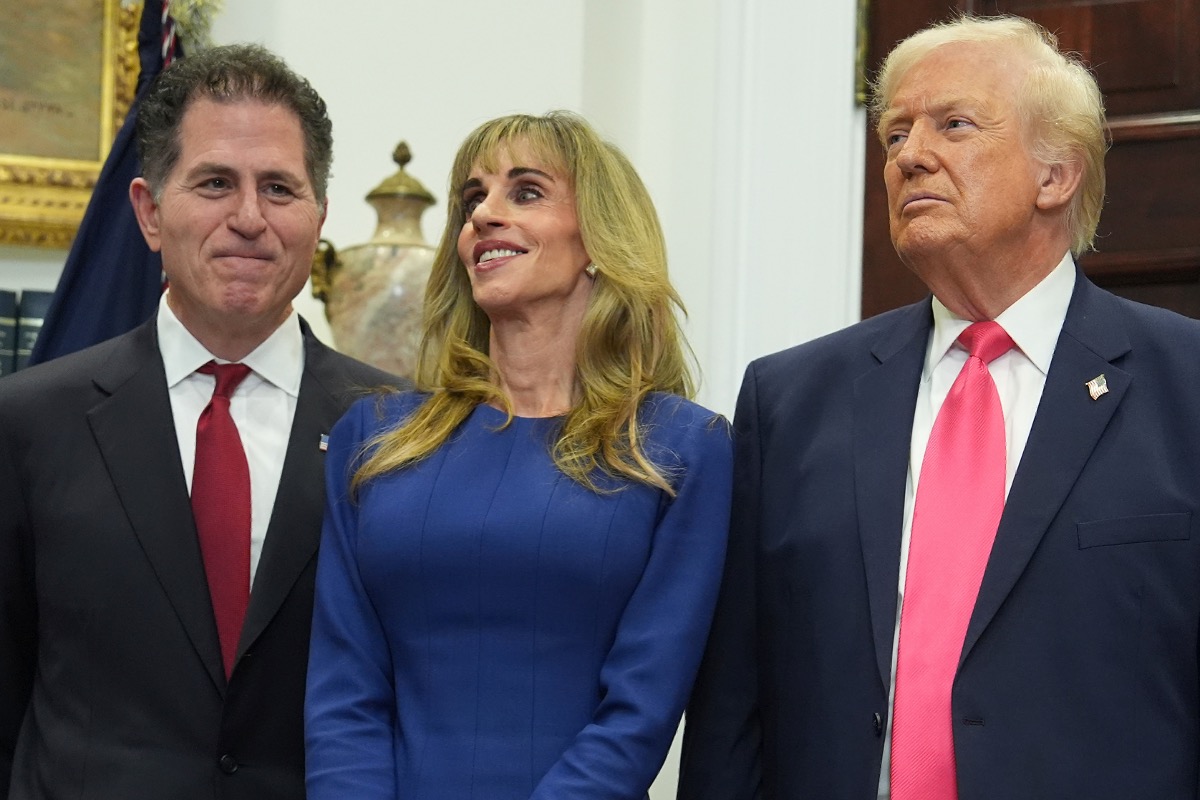
On Tuesday, the Trump Accounts received their first major outside infusion. It came from the billionaire Dell family, which announced a $6.25 billion charitable commitment to support the program nationwide. The White House called the gift a “landmark investment in America’s children” and credited it with “supercharging” the initiative from the start.
The donation instantly transformed Trump Accounts from a government pilot into a hybrid system fueled by both taxpayer money and elite private capital. It also locked the program into the orbit of major philanthropic finance, where large donors often shape public priorities without direct public accountability.
How Is It American?
Trump Accounts raise two basic questions that cut through all projections and promises. Is this constitutional, and is it really a free-market policy?
The Constitution grants Congress specific, enumerated powers. Creating lifelong, government-designed investment accounts for children is not one of them. Nothing in the founding framework authorizes the federal government to initialize market portfolios at birth, lock up funds for years, or steer personal investment behavior by statute.
The free-market question is even simpler. In a genuine free-market system, families choose where to invest. They decide on the risks, timelines, and access. Trump Accounts remove most of those choices.
Of course, the accounts may still generate returns. They may even look successful on paper. But they do so through centralized design, not open-market freedom.
At the same time, as financial life shifts rapidly into fully digital systems, the implications deepen. Trump Accounts build a state-managed investment identity at birth. They embed federal tracking, eligibility rules, and portfolio limits into a child’s financial future before that child can walk, talk, or work. What is sold as opportunity resembles a quiet on-ramp to a universal basic income-style framework. For now, it arrives not through monthly checks, but through state-seeded financial dependency indexed to purely globalist markets.