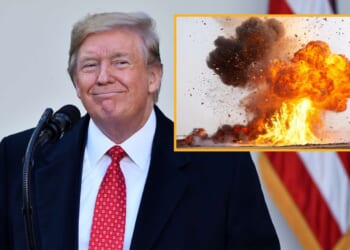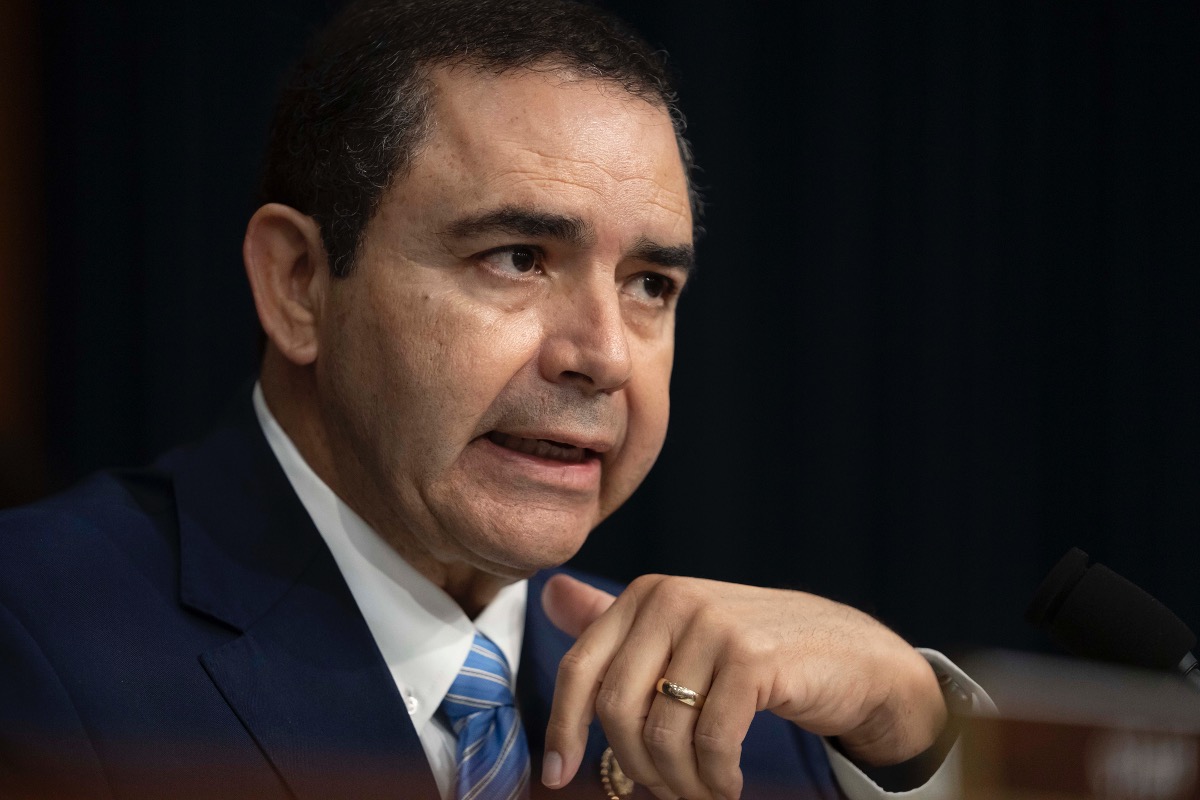
Alongside his recent decision to pardon former Honduran president Juan Orlando Hernández, Donald Trump’s latest acts of clemency reached deeper into U.S. politics and finance. This week, he pardoned Texas Congressman Enrique Roberto “Henry” Cuellar and his wife, Imelda. Both were indicted in a federal corruption case. And in late November, he commuted the sentence of David Gentile, a Wall Street executive found guilty of orchestrating a $1.6 billion fraud that hit more than 10,000 investors.
The Cuellars’ Pardon
On Wednesday, Trump announced on Truth Social that he was issuing a “full and unconditional PARDON” to Congressman Henry Cuellar and his wife.
In the post, Trump accused the Biden administration of weaponizing the justice system to punish Cuellar for opposing border policy and what he called the “Biden Border Catastrophe.”
“Sleepy Joe went after the Congressman, and even the Congressman’s wonderful wife, Imelda, simply for speaking the TRUTH,” Trump wrote. Cuellar, whose district borders Mexico, had become one of the most vocal Democratic critics of the Biden administration’s open-border immigration policy.
The post also included a letter that appeared to be from Cuellar’s daughters. In it, they suggested that their father’s political “independence and honesty may have contributed to how the case began.”
The announcement immediately reframed the prosecution as a political dispute rather than a criminal matter. Trump cast Cuellar as a victim of partisan enforcement and positioned the pardon as a corrective to what he suggested was a corrupt justice system.
Within hours of the announcement, Cuellar filed paperwork to run for reelection as a Democrat. The pardon cleared the legal path for his return to the campaign trail, now without the weight of a looming federal trial.
The Indictment
The case against Henry and Imelda Cuellar formally began in 2024, when federal prosecutors unsealed an indictment in the Southern District of Texas. According to the Department of Justice (DOJ), the couple allegedly accepted “approximately $600,000 in bribes” from two foreign sources between at least December 2014 and November 2021. Those sources included “an oil and gas company wholly owned and controlled by the Government of Azerbaijan, and a bank headquartered in Mexico City.”
Prosecutors said the payments were disguised as consulting fees and routed through what the indictment described as “sham consulting contracts.” The money allegedly moved through a network of front companies and middlemen before landing in shell companies owned by Imelda Cuellar. Court filings stated that she “performed little to no legitimate work under the contracts.”
In exchange for the Azerbaijani payments, prosecutors said Cuellar agreed to use his office to influence U.S. foreign policy in Azerbaijan’s favor. In exchange for payments tied to the Mexican bank, he allegedly agreed to influence legislative activity and pressure senior executive branch officials on the bank’s behalf.
The charging document laid out a sweeping set of counts. Federal prosecutors charged both Henry and Imelda Cuellar with conspiracy to commit bribery, bribery of a federal official, conspiracy to commit honest services wire fraud, violations of the Foreign Agents Registration Act (FARA), conspiracy to commit money laundering, and multiple substantive money laundering counts. Several of the most serious charges carried potential sentences of up to 20 years in prison.
Cuellar denied wrongdoing throughout. In 2024, the congressman’s two political advisors pleaded guilty and admitted they helped move $200,000 of bribe payments from Mexico through shell companies tied to Imelda Cuellar. The court scheduled the trial to begin in April 2026. Trump’s pardon brought the case to an abrupt end.
The David Gentile Commutation
Earlier last week, Trump also drew national attention when he commuted the sentence of mass fraudster David Gentile, the former CEO of GPB Capital.
Reuters reported that shortly after the commutation became public,
a White House official told Reuters the Biden administration’s Ponzi scheme claim was “profoundly undercut by the fact that GPB had explicitly told investors what would happen.
“At trial, the government was unable to tie any supposedly fraudulent representations to Mr. Gentile,” the official said. The official added that Gentile had raised “serious concerns that the government had elicited false testimony and failed to correct such testimony.”
White House press secretary Karoline Leavitt confirmed the commutation on Monday and framed it as part of a broader pattern. The case, she said, was “another example” of “a weaponization of justice from the previous administration.” Leavitt said GPB disclosed to investors that it could fund some distributions with investor capital rather than operating profits.
The Conviction
Gentile was convicted in federal court in Brooklyn in August 2024. A federal jury found him and his co-defendant guilty of conspiracy to commit securities fraud, conspiracy to commit wire fraud, securities fraud, and multiple counts of wire fraud.
In May 2025, a federal judge sentenced Gentile to seven years in prison
for [his role] in a multi-year scheme to defraud more than 10,000 investors by misrepresenting the performance of three GPB Capital private equity funds and the source of funds used to make monthly distribution payments to investors.
At sentencing, federal prosecutors said, “collectively, the GPB funds raised approximately $1.6 billion from investors.”
The human impact came into sharp focus during sentencing. According to a report by The New York Times:
More than 1,000 people submitted statements attesting to their losses, according to prosecutors, who characterized the victims as “hardworking, everyday people,” including small business owners, farmers, veterans, teachers and nurses.
In its sentencing announcement, the DOJ stated that
additional penalties of forfeiture and restitution will be imposed at a later date.
Trump’s commutation erased Gentile’s prison term less than two weeks after he reported to federal custody. And the clemency grant went further. Under the order, Trump relieved Gentile of the $15.5 million in restitution he would otherwise have had to pay.
Law and Order?
Claims of “weaponization” of the justice system have long dominated political discourse. In some cases, selective or politically driven prosecutions by the unconstitutional federal machinery of the DOJ and FBI do raise real concerns. But the Gentile and Cuellar cases pose a different and harder question. What happens when executive power is used not to correct misconduct, but to override the final outcomes of jury verdicts and long-running investigations?
Trump’s messaging has long centered on “law and order.” Yet his latest acts of clemency now sit uneasily beside that slogan.
A broader pattern sharpens that tension. As Forbes recently reported, Trump’s clemency record in his second term has disproportionately benefited political allies, major donors, campaign lawyers, and business figures with direct financial or personal ties to the president. In multiple cases, pardons and commutations followed large donations, business dealings linked to Trump-affiliated ventures, or public demonstrations of loyalty. The cumulative picture is not a series of isolated acts of mercy, but a clemency system that increasingly overlaps with political proximity and financial access.
This pattern, of course, is not exclusive to Trump. Presidents of both parties have used the pardon power broadly. At times, presidents grant clemency preemptively, before trials conclude or even before prosecutors file formal charges.