Last Wednesday, the White House began running taxpayer-funded television ads promoting President Donald Trump. Three spots followed within days. By Monday, the government had spent more than $1.5 million airing them.
The White House calls the videos “public service announcements.” But they advertise no government service, explain no benefit, and ask Americans to take no public action. Instead, they praise Trump, promote his political themes, and, in one case, repurpose a Trump campaign video.
That distinction has triggered bipartisan criticism and raised serious legal questions. Federal appropriations law bars government money from being used for “publicity or propaganda.” To some, the ads appear to cross that line. Richard Painter, the former chief White House ethics lawyer under George W. Bush, has gone further, arguing that knowingly using taxpayer money for such political promotion could constitute an impeachable offense.
“Paid for by the U.S. Government”
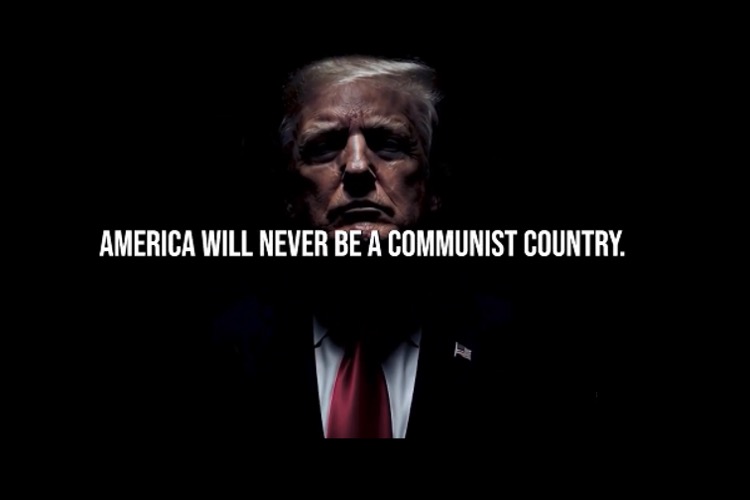
The first 30-second ad opens with Trump declaring that “America will never be a communist country.” It then flashes through images of the president while touting tax cuts, American manufacturing, and support for police. Singer JMSN’s “Love Me” plays in the background. UFC executive Dana White appears near the end, praising Trump as the “toughest, most resilient person” he had ever met.
A second spot appeared two days later. It features Mount Rushmore and excerpts from Trump’s July 3 speech marking the country’s 250th anniversary. Trump describes the occasion as the beginning of a new “Golden Age of America.”
The third ad pushes the line between public information and political promotion even further, attacking the president’s ostensible ideological and political opponents.
It shows Trump walking down a hallway in black and white. The narration warns of a “final battle” against “the deep state” and “warmongers,” even as the unconstitutional U.S. war on Iran enters its seventh month.
It then targets “the globalists, communists, Marxists and fascists” and “the sick political class that hates our country.” The rhetoric lands awkwardly amid continued criticism of the administration’s handling of the Epstein files and broader disputes over policies critics themselves describe as collectivist or globalist.
The ad also attacks “the fake news media” and promises to “liberate America from these villains once and for all.”
The video is virtually identical to material Trump used during his 2024 presidential campaign. That version urged viewers to “Join President Trump’s Fight for America.”
All three spots carry the same disclaimer: “Paid for by the U.S. Government.”
The ads have run across network and cable television, streaming services, NFL broadcasts, college football, and other popular programming. The White House has not disclosed which federal agency or appropriation is paying for them.
Republicans Object
Some of the sharpest objections now come from Republicans.
Senate Majority Leader John Thune of South Dakota said he approved of the anti-Marxist message but not the funding:
It’s a great message. I like the message, but it shouldn’t be paid for by taxpayer dollars.
Senator Mike Rounds, also of South Dakota, stopped short of alleging a legal violation. But he said the spending was not something he would have done personally. Per The Hill,
“I just don’t think it’s right to be using taxpayer money in that way, particularly if it’s tied to political campaigns,” he added. “I think they need to rethink that strategy.”
Senator John Kennedy of Louisiana made the broader principle explicit. The Hill quoted him saying,
I don’t think any public official, including President Trump … should spend public money on private ads for themselves.
Senator John Cornyn of Texas echoed the sentiment.
Senator Thom Tillis of North Carolina has been particularly critical:
It’s inappropriate. It’s not like they need a GoFundMe page to have the dollars to do that sort of ad and they could do it. But using taxpayer dollars, it feels like [Hungarian Prime Minister] Viktor Orban.
Representative Thomas Massie of Kentucky put his objection more sarcastically:
Don’t worry, using taxpayer dollars to run ominous campaign ads of the President has been done before and is completely legal … in banana republics.
The criticism matters because Republicans control Congress. Any congressional investigation into the spending would therefore require, or at least benefit greatly from, support inside Trump’s own party.
The Propaganda Question
The White House insists the spots are legitimate public-service announcements.
Federal law does not prohibit government advertising. Agencies routinely spend money explaining programs, benefits, and policies. But there are limitations. The Government Accountability Office (GAO) explains,
Since 1951, appropriation acts have included provisions precluding the use of the appropriations for “publicity or propaganda.” While Congress has never defined the meaning of publicity or propaganda, GAO has recognized three types of activities that violate the publicity or propaganda prohibitions: self-aggrandizement, covert propaganda, and materials that are purely partisan in nature.
Past administrations have tested that line.
In 2004, GAO approved Bush administration ads promoting the new Medicare prescription-drug benefit because they explained an actual government program. But it later found that Medicare officials violated the law by distributing government-produced news reports without revealing their source.
In 2015, GAO found that the Obama EPA engaged in covert propaganda by using supporters’ social-media accounts to spread agency-created messages without identifying the government as the source.
The Trump ads openly state, “Paid for by the U.S. Government,” largely removing the covert-propaganda issue.
That leaves partisanship and self-promotion.
Kathleen Clark, a legal ethics professor at Washington University in St. Louis, told the Associated Press that previous government ads typically directed people toward identifiable programs or benefits. The Trump spots do not. She argued that they instead promote Trump himself.
Painter was blunter:
You watch all three ads, they’re sheer propaganda.… This is increasingly looking like what authoritarian governments do to promote their leaders.
The former official also called the spending an “abuse of power” and said it could amount to “an impeachable offense.” He urged Congress to demand reimbursement.
No court or GAO ruling has yet found these particular ads illegal.
Democrats Press for an Investigation
Top Democrats on the House and Senate appropriations committees asked the White House to pull the ads and disclose how they were financed. Senators Patty Murray (D-Wash.) and Jack Reed (D-R.I.), along with Representatives Rosa DeLauro (D-Conn.) and Steny Hoyer (D-Md.), called the first spot an “egregious and illegal misuse” of taxpayer money and demanded a full accounting of the funds used to create and air it.
Senate Minority Leader Chuck Schumer (D-N.Y.), also criticized the campaign. The Associated Press reported that Schumer joined Republicans in questioning why public money was paying for advertisements centered on the president.
The White House rejects the criticism. It notes that Trump is not on the ballot this November, and that the ads contain no explicit instruction to vote Republican, stating,
The announcements are a reminder for Americans to love their country and know why it’s worth defending — at home, at the border, and abroad.
It pointed to government advertising under George W. Bush, Barack Obama, and Joe Biden as precedent.
But those comparisons do not resolve the central dispute.
Government advertising is neither unusual nor inherently unlawful. Notices explaining Medicare enrollment, disaster assistance, tax obligations, or where citizens can obtain a government service can serve an identifiable public function.
Of course, that does not make every government-funded persuasion campaign legitimate. The Biden administration’s sprawling Covid-vaccine campaign, for example, drew condemnation over its use of taxpayer money, coordinated messaging, celebrities, private organizations, and other “trusted messengers” to drive uptake of experimental vaccines.
The Trump ads present a different version of the same underlying concern: government using public resources to shape public opinion through coordinated promotional messaging rather than simply provide neutral information about government programs and services.
Indeed, for a growing number of Republicans, the political message is not even the main problem. The source of the money is.