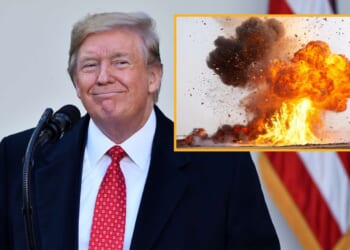
American and Iranian officials met via mediators in Geneva on Thursday, ostensibly to negotiate a deal and avert war. The United States has moved an armada into the Middle East and appears poised to attack if the Iran does not agree to White House demands on its nuclear program.
“The meeting is viewed as one of the last viable chances to prevent a wider regional conflict,” Newsweek noted, a view shared by most everyone watching this play out.
The latest news is that the three-hour morning session was “very serious,” a point of analysis some outlets interpreted optimistically. The two sides are expected to reconvene for later sessions.
The White House sent special envoy to the Middle East Steve Witkoff and President Donald Trump’s son-in-law Jared Kushner. Iranian foreign minister Abbas Araghchi represented the Persians, with Omani Foreign Minister Badr al-Busaidi mediating. Badr al-Busaidi said in a post on social media, “We’ve been exchanging creative and positive ideas in Geneva today.” He said negotiators have shown “unprecedented openness” to new ideas.
Araghchi said “the success of the negotiations depends on the seriousness of the other side and its avoidance of contradictory behavior and positions.”
Iran’s Position
According to Newsweek, Iran will not agree to completely give up nuclear enrichment “but signals willingness to consider concessions on its nuclear program.” Moreover, Iran’s foreign minister says the country will “under no circumstances ever develop a nuclear weapon,” which was hailed as a “historic opportunity.” Iran says it wants to produce limited enrichment without harassment from the United States or Israel.
Iran has consistently argued that, as a sovereign nation, it has a right to develop a civilian nuclear program using an energy source that is highly efficient. But American intelligence has also concluded that in the past Iran enriched to levels far beyond what’s necessary for civilian use, up to 60 percent. The United States has demanded zero enrichment on Iranian soil in the past.
Mixed Messages
Some U.S. officials warn that Iran poses a “very great threat” to the United States, per reports. In an interview broadcast Sunday on Fox News, Witkoff said that Tehran was “probably a week away from having industrial-grade, bomb-making material, and that’s really dangerous,” according to ABC News. The narrative emanating from the White House is that, despite Trump declaring Iran’s nuclear program “obliterated” after U.S. air strikes last summer and decades away from ever becoming a nuclear threat, it has taken Iran only seven months to bring its nuclear program back to the same level it was before the strikes.
Conversely, U.S. Secretary of State Marco Rubio said on Wednesday that Iran is not enriching any uranium, per The Wall Street Journal.
Meanwhile, Israel, whose leaders have been warning about Iran developing nuclear weapons for at least three decades, is insisting that any deal must “include limits on Iran’s missiles and regional proxies, while regional allies fear escalation.”
Military Officials Urging Caution
The negotiations are happening in front of a backdrop of reports saying figures within the Trump administration are urging caution. On Monday, Axios published a report saying that Trump’s top general, Joint Chiefs Chairman General Dan Caine, told the president and top officials “that a military campaign against Iran could carry significant risks, in particular the possibility of becoming entangled in a prolonged conflict.” The sources who spoke to Axios said, “While Caine was all-in on the Venezuela operation, he has been more cautious in the discussions around Iran.” One source described Caine as a “reluctant warrior” on Iran. Caine sees “a greater risk for entanglement and American casualties.”
Vice President JD Vance is also concerned that military action “could draw the United States into a deeper conflict,” per reports.
Tucker’s Efforts
Rumors have circulated that commentator Tucker Carlson met with Trump in an attempt to discourage him from striking Iran. Carlson, who has direct access to the White House, has consistently opposed a war with Iran. He recently suggested that Israel is exerting immense pressure on the United States to strike Iran because it believes this administration is going to be the last one it can manipulate.
Carlson also speculates that the United States is in a tough spot and may have little choice other than to hit Iran on American terms. “The United States may not have a choice about whether this war starts because, of course, the government of Benjamin Netanyahu can always act unilaterally, pre-emptively, against Iran,” Carlson recently said.
If Israel strikes Iran, the Iran would retaliate against U.S. assets in the region as well as against Israel. Iran could also hit energy facilities, Carlson said. All this would leave the United States no choice but to act. “So it’s possible,” Carlson concludes, “that the U.S. government is trying to find a way to contain the behavior of its closest ally, Israel.”
Foreign Entanglement
This is a good time to remind readers that if the U.S. government operated within the parameters of the U.S. Constitution, a decision as consequential as going to war wouldn’t be allowed to be made by one man. The Constitution is blatantly clear that Congress declares war and that the president is only the commander-in-chief once the decision has been made. Unfortunately, the American people have been fooled into conflating precedence with constitutional permission. But just because other presidents have decreed war action without congressional approval doesn’t make it constitutional. Another war would serve as another reminder of the dire consequences of an America that has abandoned its founding principles.