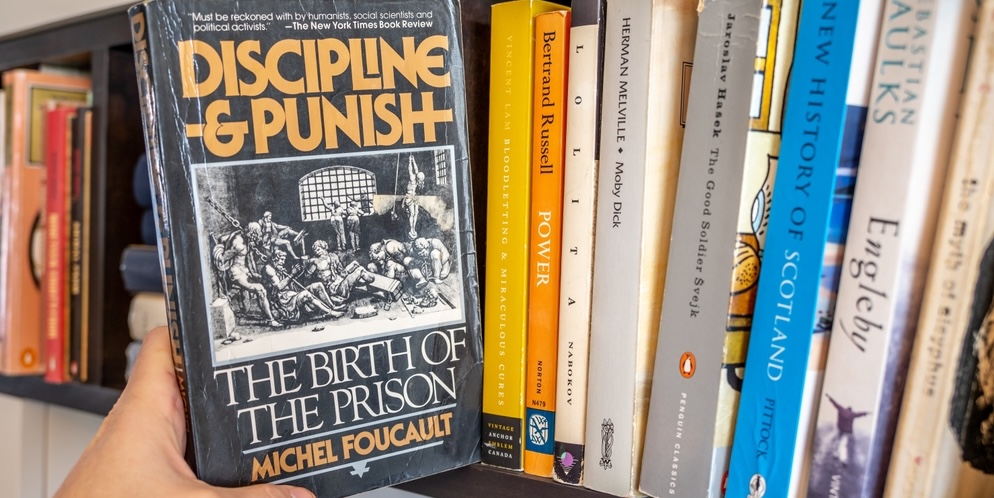
Leftists used to focus on economics, but today they fixate on nonbinary genders, microaggressions, and pronouns. Woke progressivism may seem silly, but Jordan B. Cooper, in his new book, Makers of the Modern Mind: A Guide to the Thinkers Who Formed the Modern Left, shows it has deep roots in modern philosophy. He traces the metastasizing of Marxism into an ideology that reduces pretty much everything—truth, reason, culture, language, science, all human interactions—to the oppressive imposition of power.
Cooper is a Lutheran pastor best known for his Just & Sinner podcasts and YouTube videos on Lutheran apologetics. But his academic specialty is 17th-century Lutheran scholasticism, so he knows his philosophy. To understand Marx, he says, one must understand Hegel, which requires understanding Kant, which requires understanding Descartes. He also moves forward from Marxism to its expansion into cultural criticism, structuralism, post-structuralism, feminism, and critical theory. This is the “tradition” that constitutes today’s intellectual establishment.
Most of the thinkers Cooper treats express themselves in jargon-ridden language that is difficult for nonspecialists to understand. Cooper, however, is lucid and engaging. Though he points out where these ideas go wrong, his tone is not polemical. The polemics in this review are purely my own.
This crash course in modern—that is, post-classical, post-Christian—thought includes an illuminating discussion of Enlightenment thinkers like Hobbes, Locke, and Paine, showing that “liberalism” has both conservative and radical strains. But his treatment of the various strands of “post-Marxism” is especially valuable in explaining what lies behind our current controversies and exploring the assumptions that rule today’s universities.
Karl Marx, with his economic determinism and Hegelian view of history, predicted that the working class would rise up in an inevitable revolution to overthrow bourgeois capitalism, thus ushering in the communist utopia. Unfortunately for his theory, the workers of the world did not rise up. As working conditions improved, the proletariat often staunchly defended the status quo. Even where revolution became reality, in the Soviet Union and China, the state did not wither away as Marx expected.
That workers failed to engage in a global revolution would seem to falsify Marxism. But many of its intellectual adherents refused to accept this evidence. Instead, they tried to find reasons why the proletariat refused to be radicalized. What’s wrong with them?
The basic elements of today’s woke scholarship can be found in the work of Georg Lukács, the Commissar of Culture and Education in communist Hungary. His job was to promote socialist propaganda, fire dissident teachers, and ban “bourgeois” books.
He reasoned that nonrevolutionary workers had a “false consciousness” because the ruling class controlled every aspect of culture, thus constraining how the proletariat thinks. The task of leftist intellectuals was to raise the consciousness of the masses so they will recognize how oppressed they are.
Since the totality of culture is determined by the ruling class, reasoned Lukács, that culture must be thrown down. Intellectuals must critique every facet of cultural life—art, literature, religion, ethics, knowledge—to uncover the implicit oppression that is its foundation.
Art and literature, he said, should reflect the proletariat perspective, while bourgeois work should be suppressed. Mere aesthetic considerations distract the masses to keep them docile. Classic works of the past are propaganda for the ruling class. The value of a work is determined solely by the socio-political views of the artist. As Cultural Commissar, Lukács promoted “social realism,” which dramatized the class struggle, the only artistic style the Soviets permitted.
Reading about Lukács brings back fond memories of my own career as an English professor, watching colleagues in my field “interrogate” authors for their socio-political beliefs (note the police-state metaphor); inserting authors with correct beliefs into the canon regardless of aesthetic merit; and reading oppression into every classic text. Lukács called his totalitarian method simply “theory,” and so did they.
The French semiotician Roland Barthes lived on the other side of the Iron Curtain, but he was arguably even more radical. Barthes insisted that language determines thought. And since the ruling class controls language, it thus controls the masses.
The failure of the revolution to materialize lead Barthes to an extraordinary conclusion. As Cooper explains his reasoning,
If realism were correct, and the realities of the universe could actually be known, this would support the idea that the bourgeoisie are able to rightly reason towards these truths; as a consequence, bourgeoisie values and beliefs must be seriously considered and (if true) adopted by citizens. In order to tear down this pillar upon which the powerful have constructed their authority and privilege, the existence of universal or objective reality must be rejected–at least as accessible to human cognition. In his attack on the bourgeoisie, Barthes aims at nothing less than reality itself.
Barthes, however, was only a structuralist. The post-structuralists took these ideas even further. And they are the primary influences on today’s woke academics.
The structuralists reduced meaning to language, but Jacques Derrida, a post-structuralist, challenged the meaning of language itself, by attacking the notion of “logocentrism.” In classical thought, the Logos was the Word as the ordering principle of reality, making it intelligible to “logic.” In Christianity, the Logos is identified with Jesus Christ. Derrida maintained that thinking in terms of the Logos has caused us to reify objective truth and to believe that language conveys that truth, especially in terms of “binaries”—that is, sets of opposing concepts. Binaries are “hierarchical,” with one assumed to be better than the other: so man is superior to women; civilized is superior to uncivilized; heterosexuality is superior to homosexuality; sanity is superior to madness; good is superior to evil.
This, says Derrida, is the foundation of every oppression. The solution is “deconstruction,” which means taking a “text” (which can be an institution or a custom as well as a written document) and exposing its binaries, subverting them by exalting the “marginalized” pole, thus revealing the text’s internal contradictions.
Concludes Cooper: “Derrida’s approach ultimately leads one to continually challenge every presupposition and instinct that one has about the world. Nearly every idea that is taken for granted or seen as common sense is reframed as arbitrary social bias.”
Judith Butler would adapt Derrida’s binaries to fit her so-called Third Wave Feminism. First Wave Feminism grew out of liberalism, emphasizing freedom and equal rights. The Second Wave Feminism of Simone de Beauvoir grew out of existentialism, emphasizing how women should create their own meaning by rejecting not only social but also biological restraints by refusing marriage and motherhood and embracing abortion. Third Wave Feminism repudiated the very notion of objective sex and gender, insisting that even biology is a social construction. This gave us transgenderism and its plethora of “nonbinary genders.”
Michel Foucault further reduced all culture, all institutions, all art, all history, all religion, all morality, and all interpersonal relationships to power. For Foucault, the ruling class, not content with economic and political power, also desires to exert its power over other people’s bodies (thus the pro-abortion rhetoric). Because the body is the primary site of oppression, it is also the primary site of resistance. Control of the body manifests itself in restrictions on sex, so the path to liberation is sexual freedom (thus the sexual revolution).
Foucault was a gay sadomasochist who died of AIDS. “For Foucault, transgressive sexual acts are a means by which domination can be effectively resisted,” writes Cooper. He “turns deviant sexual acts into instruments of political activism and a fight for justice” (thus the LGBTQ+ movement). He advocated “public displays of sexual deviancy,” continues Cooper, as “resistance to received cultural narratives surrounding sex and marriage” (thus gay pride parades).
Foucault wrote a series of books looking at history in terms of the different power relations in different epochs. His method was to identify the ruling class and then show how it repressed marginalized groups (thus the 1669 Project and much contemporary historical scholarship).
Foucault’s enormously influential “genealogies” purported to show how the ruling class has exerted its control in psychiatry, in medicine, in science, in prisons, and in sex generally. Their social influence can be seen in the closure of mental hospitals, the surge of homelessness, the defund-the-police policies, and the prison-abolition movement. In universities they would give us queer theory and gender theory.
How did these ideas, which seem bizarre in the clear light of day, gain such a hold on American universities? That story begins in 1923 with the founding of the Institute for Social Research in Frankfurt, Germany. This began as a Marxist but non-Leninist conference, which was turned into an organization that would be known as the Frankfurt School.
This purely academic affair published The Journal for Social Research, resulting in scholarly collaborations that revised Marxist doctrine: Socialism would come not from a violent revolution by the working class but by political and cultural means. Now that democracy was becoming widespread, the masses—once they achieved true consciousness—would bring about the revolution by voting (thus democratic socialism).
When Hitler came to power, the Frankfurt School and its faculty were invited to move to Columbia University in New York City. Here, their journal would be translated into English so that it could circulate widely in American universities. After the war, the Frankfurt School moved back to Germany, but the American ties continued. Columbia would give Derrida an honorary doctorate, and later the University of California-Irvine would give him a faculty position.
Cooper discusses the contributions of the various key figures of the Frankfurt School, including Antonio Gramsci and Theodore Adorno, who stressed revolution through cultural influence. The most influential was Herbert Marcuse, who stayed in America to teach at Columbia, Harvard, Brandeis, and the University of California-San Diego. (As I remember from my grad school days, Marcuse and Derrida lectured in universities throughout the country. They became academic celebrities.)
Marcuse expanded the proletariat to include members of the middle class as well. Everyone is oppressed! And he explained the failure of the masses to rise up in revolution by applying Freudian psychology. Everyone is also repressed! (Thus more sexual revolution.)
Marcuse was giddy with the student protests of the 1960s and ’70s, concluding that the true revolutionaries are not to be found among the workers but among intellectuals and young people. The primary site of revolutionary activities will not be the factory floor but the place where intellectuals and young people come together: the university.
But these ideas destroyed the university.
Nothing is left to study. The task of preserving and handing on Western civilization by studying classic authors, acclaimed artists, and great thinkers is ruled out because the heritage of the past consists of nothing more than elitist power and oppression.
What about the pursuit of truth? Barthes, Foucault, and Derrida believed that the only legitimate mode of academic inquiry is to unmask exploitation, not the discovery of truth, which is impossible because it does not exist. To claim otherwise is to serve the ruling class.
What about free academic inquiry? Barthes said there is no need to argue with opposing views. They should simply be dismissed. Marcuse said that freedom of speech perpetuates bourgeois ideals, so the expression of those ideals should not even be tolerated. In faculty lounges, professors often complain about how “fundamentalism,” “creationism,” and “conservatives” stifle academic inquiry, but their own professed philosophy stifles it much, much more.
Cooper’s book shows that the problems of our universities and our intellectual establishment go deeper than most of us realize. This way of thinking, he says, “provides no clear path to move from deconstruction to construction, nor does it even deliver a clear picture of what such a construction should be. Pure critique devoid of teleology is critique for its own sake.” Solving those problems will require a recovery of the Logos.
A major error in these ideologies is reductionism. Yes, power exists. Oppression exists. But those are not the only things that exist. So do mathematics, outer space, playing with your children, watching a sunset, making things, love.
In the universities of the Soviet Empire, such as those overseen by Commissar Lukács, most faculty members kept their heads down, mouthing Party pieties to avoid the gulag and to get on with their work. This is largely the case in American universities today. But the Soviet universities also had dissidents who resisted the commissars, often at great cost. What the academy needs today is more dissidents.
Working through Cooper’s book made me think of what the Lutheran thinker J.G. Hamann said in his “metacriticism” of his friend Immanuel Kant: A philosophy that cannot account for ordinary life is not much help. And a philosophy that denies reality cannot be valid.