I have reached my breaking point. I cannot believe our society has tolerated this hateful, exclusionary garment this long. Someone must finally say it clearly.
For the sake of fairness, unity and true inclusivity, we must ban the ugly Christmas sweater.
I am offended every time I see one of these hideous, woolen micro aggressions. They shout “Christmas” and exclude everyone else. It is unconscionable that this bigoted fashion statement has been able to exist under the radar this long.
Now is the time to act.
The ugly Christmas sweater is a walking billboard for one, and only one, specific holiday. Where is the acknowledgment of Lunar New Year on that sweater? Where is the tiny, crocheted Kwanzaa candle? This year the Winter Solstice shares the National French Fried Shrimp Day, and there is no acknowledgement of this day!
I will not stand for this level of seasonal violence.
A Time for Inclusion
And please do not tell me this is absurd. We all know our recent culture cares deeply about inclusion. So I propose we cancel the “the ugly Christmas sweater” and rename it, “the ugly holiday sweater.”
And to make this holiday attire inclusive, the ugly holiday sweater must reference every holiday, because if Christmas sweaters are exclusionary, then we must take the logic to its proper conclusion.
Which means hundreds of symbols. A menorah. A shamrock. A jack-o-lantern. A red, white and blue firework. Lincoln for Presidents Day. Cupid for Valentine’s Day. A Ramadan crescent moon. A cornucopia for Thanksgiving. A groundhog. A pride rainbow for June. A dove for Pentecost. A dragon for Chinese New Year. And more.
If we are going to require inclusion, then full inclusion is the only option. Who would you argue to exclude off of your ugly sweater? The sweater must represent all. Equally. At the same time. Without understanding the ecological impact on global warming, I propose that any ugly sweater that weighs less than 27 pounds cannot possibly reflect true equity.
A Non-Specific Power That May or May Not Be “Higher”
We are a not a nation of laws anymore, but a nation of social rules. And if the rules are that Christmas language must be neutralized, then we must do this consistently.
We say ‘Happy Halloween’ and ‘Happy Thanksgiving’ freely as specific, independent holidays–immediately transitioning to the vague ‘Happy Holidays’ grouping–only to go back to celebrating a ‘Happy New Year’ all over again on December 26th.”
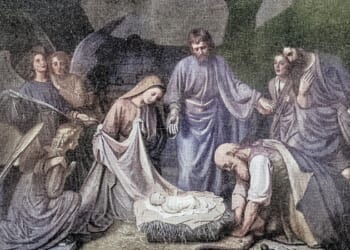
I believe Christmas forces a question, namely, “What exactly are we celebrating?” And the answer is not winter or sentiment. The historical center of this holiday is the birth of Christ. That is why the name Christmas makes modern people uncomfortable. Not because it excludes them, but because it reveals something true that they would rather not discuss.
This is why we blur the name with Happy Holidays. Not to include more holidays. But to avoid one specific one.
And so the satire lands. If we are so offended that we cannot say “Merry Christmas,” then we must be equally offended by sweaters that say it visually. Ban the sweater. Remove it from society. Burn it in the public square. At least then we will be honest about what we are doing.
But here is the non-satirical conclusion. Christmas has a name. And it matters. I do not say “Merry Christmas” to exclude anyone. I say it because I refuse to erase the meaning of the holiday. We have a holiday in December that celebrates the birth of Christ. And if we lose the name Christmas, we lose the right to publicly acknowledge the reason for it.
So yes, the ugly Christmas sweater is “exclusionary.” And I refuse to pretend that is a problem. I will wear mine proudly. And I will say Merry Christmas while I do it.
Peter Demos is the author of three books, including On the Duty of Christian Civil Disobedience and the host of “Uncommon Sense in Current Times.” Demos uses his biblical perspective and insight gained from his own struggles to lead others to truth and authenticity in a broken world.