A civilizational sea change is occurring, an ideological inflection point may be getting closer. Immigration, long considered as American as apple pie, as almost sacrosanct, is being questioned. The belief underlying it, immigrationism, suddenly no longer has the almost universal dogma status it once enjoyed.
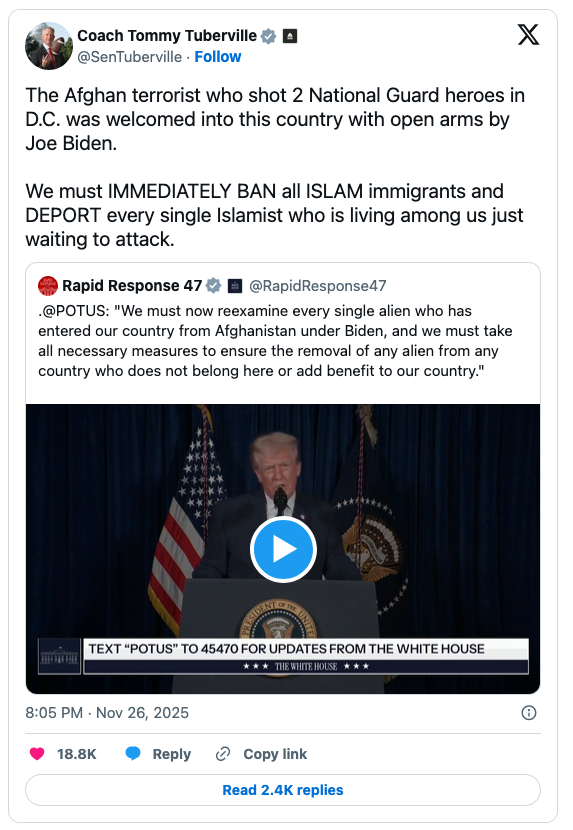
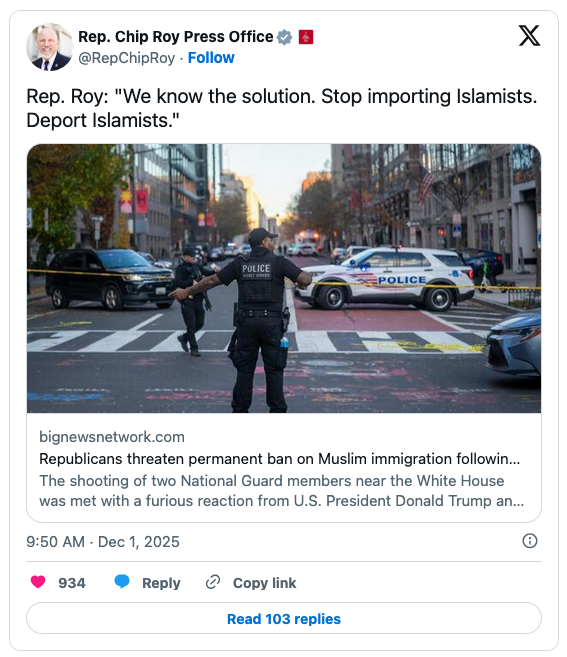
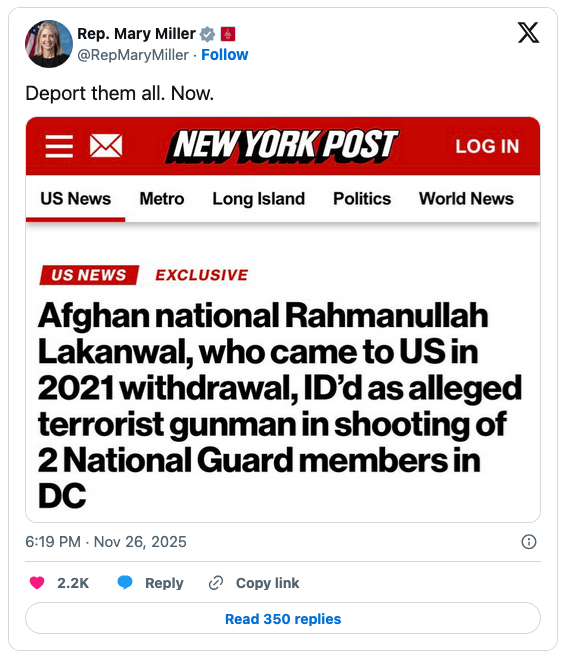
The signs are everywhere. Numerous politicians have in recent times suggested halting Muslim immigration. One states that Sharia law adherents should be deported. Another introduced a bill that would rescind the nation-rending Immigration and Nationality Act of 1965. Taking action, President Donald Trump has paused immigration processing and asylum decisions from dozens of countries (many Muslim-majority or African). And, in fact, he has expressed a desire to “permanently pause migration from all Third World Countries.”
In this vein, a writer insisted just today that immigrants with culturally “incompatible” practices should be banned from the U.S. A different commentator reports on a growing organization: the Mass Deportation Coalition.
Now, none of this is to say anti-immigrationists (i.e., demographic realists, or DRs) are in the majority. A plurality of Americans (38 percent) want immigration kept at present levels, according to a 2025 Gallup poll. (This is up from 26 percent in 2024. This evidences how many Americans are swayed by current events, media propaganda, and their own ever-morphing emotions.) Support has also declined for President Trump’s immigration policies, which, again, illustrates the second parenthetical sentence’s accuracy. Lastly, Gallup found that a record number of Americans (79 percent) fancy immigration a “good thing” for the United States.
Nonetheless, the point is that we do now have those bold dissenting voices uttering sentiments that would’ve brought “cancellation” perhaps just a decade ago. What has changed? And what are these DRs concerned about?
Demographics Is Destiny
Does the country (the physical land) make the people? Or do the people make the country?
Can you make a bad family good by putting it in a good family’s house?
Well, consider a related phenomenon. Famed economist and commentator Thomas Sowell has long spoken of how natural resources don’t guarantee a rich country. There are, in fact, numerous examples of dirt-poor, resource-abundant nations. Then there are lands such as Hong Kong. It’s one of the world’s wealthiest places despite having no significant resources. What’s the difference?
“Human capital” is, Sowell says (short video below).
This brings us to the DRs’ concerns. If demographics is destiny (or at least a major part of it), as is said, does it make sense having immigration policy guaranteeing ever-changing demographics? This is precisely what we have, too.
The reason why is the aforementioned Immigration and Nationality Act of 1965 (INA). Also known as the Hart-Celler Act, it is, PBS writes, the legislation that “Changed [the] Face of America.” It was sold to Americans based on falsehoods, too.
Not-so-sweet and Not-so-little Lies?
Just ponder what the late Senator Edward Kennedy (D-Mass.) said on the Senate floor while pushing the INA. On February 10, 1965 he made the following claims (quotations courtesy of the Center for Immigration Studies):
- “First, our cities will not be flooded with a million immigrants annually. Under the proposed bill, the present level of immigration remains substantially the same.”
- “Secondly, the ethnic mix of this country will not be upset.”
- “Contrary to the charges in some quarters, [the bill] will not inundate America with immigrants from any one country or area, or the most populated and deprived nations of Africa and Asia.”
- “In the final analysis, the ethnic pattern of immigration under the proposed measure is not expected to change as sharply as the critics seem to think.”
You can decide if good ol’ Chappaquiddick Ted was lying or just uttering untruths. But going down the above list, here are the facts:
- Our nation was, and has been ever since the mid-’60s, flooded with more than a million (legal) immigrants annually.
- European-descent people (Westerners) constituted fairly close to 90 percent of the United States’ 1965 population. Today this figure is approximately 58 percent — mainly because of the INA.
- Under the INA, approximately 52 percent of our legal immigrants have come from one “area”: Latin America. Eighty-five to 90 percent have, too, hailed from the Third World and Asia.
- See 1, 2, and 3 above.
Looking back on this in 1982, journalist Theodore White summed up the INA. The act was, he wrote, “noble, revolutionary — and probably the most thoughtless of the many acts of the Great Society.”
What Was Implied and What’s Now Said
Notable, too, is that the 1965 Senator Kennedy should agree. After all, he didn’t say that “‘the ethnic mix of this country’ will be upset — and that’s a good thing.” (Though some cultural devolutionary immigrationists proclaim this today.) Rather, implicit in his denial that it would occur is that it would be a bad thing.
This brings us back to how more and more Americans agree — and are increasingly saying so. Commentator Richard McDaniel, writing today, noted that:
Contrary to the many conservatives who optimistically (and naively) believe that immigrants will naturally assimilate over time, immigrants and their descendants invariably reproduce their culture here.
This may, too, McDaniel warns, “have adverse effects if there is a large culture gap between the U.S. and the immigrants’ country of origin.”
Then there are the aforementioned DR politicians. “Multiculturalism is NOWHERE in the Constitution,” Representative Andy Ogles (R-Tenn.) unabashedly wrote last month. He has also proposed rescinding the INA. More examples:
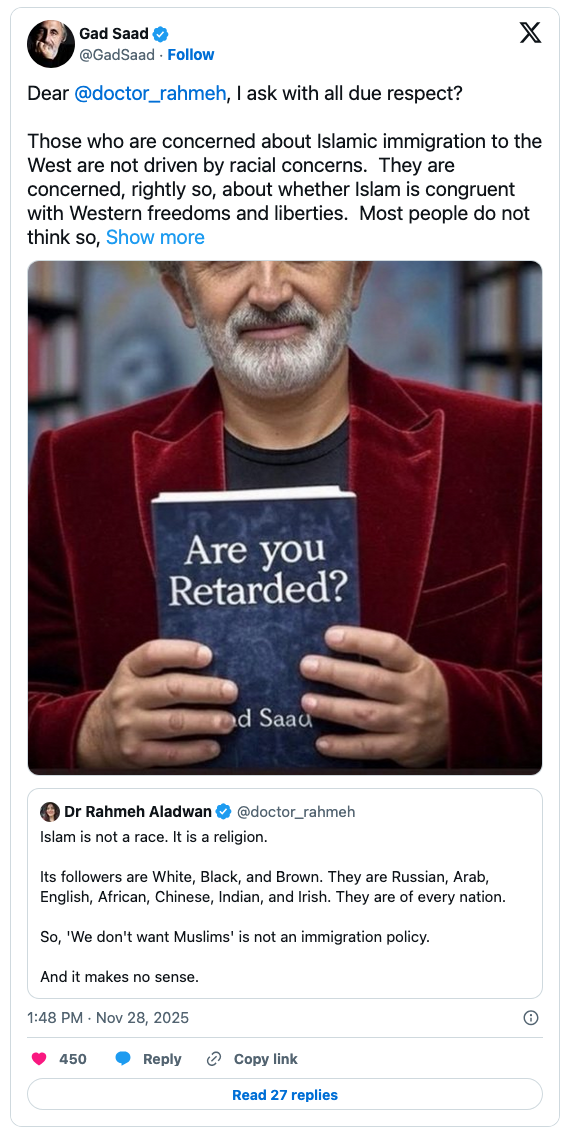
Evolutionary behavioral scientist Professor Gad Saad has opined likewise (below).
The Great Social-wall Solvent
Whether one agrees or disagrees is not right now the point. It is, rather, that a vast cultural shift has occurred. And why? At least in large part, it’s for the same reason many types of ideas once residing outside the Overton window are now being expressed.
That is, there’s “strength in numbers” — strength in conviction included. In the age of legacy-media dominance, a person would’ve felt very alone voicing DR sentiments. Today, however, he can go on the internet, that great social-wall solvent, and find innumerable other voices singing his tune. And as more people do it, more people do it — and the idea is transformed into “acceptable discourse.” (Note: Elon Musk facilitated this, too, by buying Twitter and providing a platform for expressing un-woke truths.)
This is positive because the immigrationist status quo was a wall warranting dissolution. After all, imagine someone asked, “Would having another person come stay in your home permanently be good for your family?” The obvious and intelligent response is not just yes or no. It is, “Who is this person? What are his beliefs, passions, practices, and habits?”
If we’re not asking the same questions about who may enter our national home, we’re not discussing immigration intelligently. We’re merely doing something, dogmatically, because we’ve always done it. And a civilization may not long survive thoughtless policy.



![Hegseth Demands Fitness Requirements, Says 'Fat Troops' 'Not Who We Are' [WATCH]](https://teamredvictory.com/wp-content/uploads/2025/09/Hegseth-Demands-Fitness-Requirements-Says-Fat-Troops-Not-Who-We-350x250.jpg)