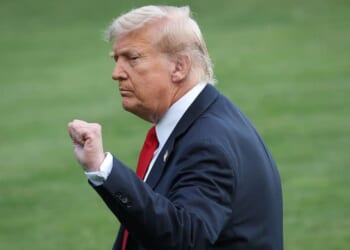
President Donald Trump is tinkering with the idea of dialing back America’s military presence in Europe because a number of countries refused to cooperate with the U.S. in Iran. But there is only so much he can do on his own.
Trump announced Wednesday on social media that “the United States is studying and reviewing the possible reduction of Troops in Germany, with a determination to be made over the next short period of time.”
Half of America’s active-duty military personnel in Europe — about 36,000 — are stationed in Germany.
The president made his comments after criticizing German Chancellor Friedrich Merz, who said that “the Iranians were humiliating the U.S. in talks to end the two-month-old war,” according to reports.
On Thursday, a reporter asked Trump if he is considering dialing back troop presence in other European countries as well. “You talk about possibly pulling … some troops out of Germany,” the reporter said. “Would you be considering the same thing for Spain and Italy?”
Trump responded, “Yeah, probably. … Why shouldn’t I? Italy has not been of any help to us. And Spain has been horrible. Absolutely horrible.”
Reassessing NATO Involvement
The president has repeatedly gotten mad at NATO nations for not contributing military assets to help open the Strait of Hormuz after the Iranians closed it. And during the peak of the war, Spain and Italy denied America access to their bases. The U.K. initially blocked American access before opening up for “defensive” or “collective self-defense” missions, while France restricted access to its bases, allowing only U.S. aircraft that aren’t involved in the war.
High-ranking Trump officials have also suggested that it is time to reassess America’s relationship with NATO. Secretary of Defense Pete Hegseth said back in March: “You don’t have much of an alliance if you have countries that are not willing to stand with you when you need them.” Secretary of State Marco Rubio, who’s been a NATO cheerleader his entire political career, made similarly critical comments. “If NATO is just about us defending Europe if they’re attacked but then denying us basing rights when we need them, that’s not a very good arrangement,” he said.
Whatever its intentions and wishes, when it comes to NATO, there are limits to what the administration can do.
Restrictions on Withdrawal and Drawdowns
First off, Trump can’t withdraw America from NATO on his own, as complete withdrawal requires Senate approval. A bill barring the president from withdrawing the U.S. from NATO was incorporated into the 2024 the National Defense Authorization Act (NDAA). Interestingly, among the bill’s co-sponsors was Rubio, who was then a senator. The legislation was drafted with Russia’s invasion of Ukraine in mind. Rubio said at the time, “We must ensure we are protecting our national interests and protecting the security of our democratic allies.”
There are even restrictions on troop drawdowns. Interestingly, the 2026 NDAA that Trump signed into law prohibits the Pentagon from reducing U.S. troops below a certain number. As noted by the Atlantic Council, an intelligence front organization, “The bill establishes guardrails by prohibiting the use of funds to reduce US force structure in Europe below 76,000 troops, remove major equipment, or relinquish the role of an American Supreme Allied Commander Europe (SACEUR)—unless the Pentagon can provide a detailed impact report certifying that such decisions were made in consultation with allies and are consistent with US national security interests.”
The U.S. should get out of both NATO and the United Nations, as they were created to aid the buildup of a world government. But it’ll be up to the people to exert enough pressure to make this happen. The president’s hands are tied.