
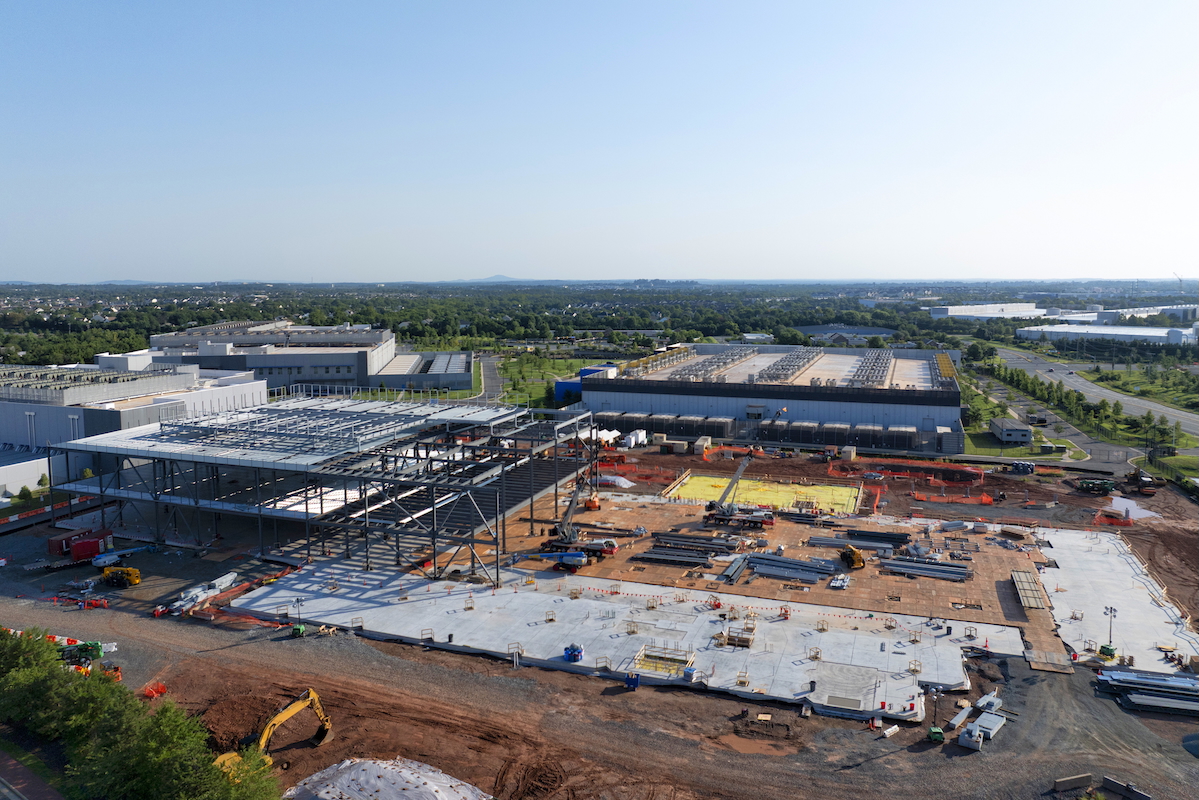
Public opposition to artificial intelligence and its infrastructure is growing.
It is erupting at protests, county meetings, school board hearings, and rural town halls.
As AI data centers multiply at extraordinary speed, Americans are beginning to feel the costs in their own communities. These facilities consume vast amounts of water and power, destroy farmland, strain local ecosystems and fragile grids, and leave residents facing higher utility costs.
But the concern runs deeper.
Many Americans can also sense the political direction. Data centers do not merely power chatbots and AI slop. They form the backbone of the emerging digital prison: surveillance systems, digital IDs, programmable money, automated censorship, predictive policing, and behavioral scoring.
The same AI boom is also threatening work itself. A Senate HELP Committee report warned last June that AI and automation could replace nearly 100 million U.S. jobs over the next decade.
In other words, communities are being asked to absorb the physical burden of a system that may replace their jobs, monitor their lives, and reduce citizenship to managed behavior inside a machine.
Now, according to a new WIRED report, federal agencies are closely watching the backlash. “Anti-tech extremism,” broadly defined, can pertain to real violence — which should and can be addressed by local law-enforcement. But the label can also sweep in lawful protesters, AI skeptics, privacy and environmental advocates, and ordinary citizens simply saying “no.”
The New “Threat”
Last week, WIRED reported that federal intelligence agencies and domestic law enforcement have begun circulating warnings about a new threat: “anti-technology extremists.”
The shift comes amid attacks on executives, growing opposition to data centers, and public anxiety over AI-driven job losses. But WIRED’s reporting suggests that officials are not only tracking violence. They are also building a broad framework for monitoring people and groups opposed to AI, data centers, and the technology industry more generally.
According to the outlet, more than 1,000 pages of unpublished reports from the Department of Homeland Security, the FBI, and regional fusion centers show “a national shift” toward surveilling this “new and worryingly broad category of people and activities deemed an emerging threat.”
What kind of threat is it? One New York Intelligence and Counterterrorism Bureau report quoted by WIRED warned,
The chaotic atmosphere that may result from emergent AI technology in the next five years may fuel large-scale protests that devolve into civil unrest and anti-tech violent extremist activity, especially in large urban areas such as New York City.
WIRED noted that the term “anti-tech violent extremism” does not appear in publicly available DHS or FBI domestic extremism reports or guides. It appears to create a new conceptual box, grouping a wide range of beliefs and movements under one threat label.
The outlet tied the effort to President Donald Trump’s National Security Presidential Memorandum-7 (NSPM-7). It directs the Justice Department to target people holding “anti-American,” “anti-Christian,” and “anti-capitalism” beliefs. The result is a criminalization of “speech and assembly that [challenge] the ideology of the White House.” The new label fits this pattern. Per the outlet,
A new focus on anti-technology extremism adds an unreported category to already public designations under a presidency that has heavily invested political and material capital in AI and data center proliferation.
More on that investment later.
Journalist Daniel Boguslaw, who authored the WIRED report, published screenshots of some of the official documents on his Substack page on Monday.
From Town Hall to Threat Stream
Regional fusion centers sit at the center of the “threat”-tracking system. Created after 9/11, they connect federal agencies with state and local law enforcement. In theory, they help identify threats. In practice, they often blur the line between violence and lawful political activity.
WIRED describes a Northern Virginia intelligence report that warned about “anti-government, anti-authority violent extremists” targeting data centers and other infrastructure. What exactly could trigger a closer look from the authorities? The report describes:
Among the vaguely defined activities flagged by the Northern Virginia intelligence center as suspicious are “expressed/implied threat,” “observation/surveillance,” “photography,” “testing/probing of security,” and “attempted intrusion.”
That, the outlet suggests, is the tried-and-true method of criminalizing dissent. Spencer Reynolds, senior counsel at the NAACP Legal Defense Fund, a civil-rights legal organization, told WIRED,
These intelligence reports are part of a long tradition of agencies identifying protest or even simply having strong opinions as precursors to violence…. Suspicious activity reports are incredibly unreliable, often about vague or innocent behavior, issued under permissive standards. These reports, often received in large volumes, allow officers to inject their own biases and see what they want to see in the facts.
In that framework, a strongly worded town-hall objection, a photograph, or a resident’s attempt to document a project can move from civic participation into a law-enforcement “threat” stream.
Scouring the Web
The dragnet also reaches online speech.
The report says that private intelligence firms contracting with law enforcement are scanning the internet for what they call “anti-technology sentiment.” For instance, in January 2025, a private intelligence contractor of law-enforcement customers, SITE, circulated bulletins about a “neo-Luddite” Discord server where conversations allegedly turned violent. That, apparently, included one user’s call for attacks on tech CEOs and power plants.
SITE defended the monitoring. Founder Rita Katz told WIRED that even “trolling remarks have an informative value” when they show sentiment inside communities linked to real-world harm. She said SITE had seen “a notable spike in online threats advocating for sabotage against data centers.”
But critics warned that the method sweeps too broadly.
Reynolds told WIRED that firms such as SITE try to mine “anonymous posters, full of in-jokes, slang, different languages, vagueness,” and turn that into threat intelligence. In practice, he said, this often targets people’s views on “policing, abortion, economic inequality, vaccines, or any other hot-button topic of the day.”
The outlet offered a notable example. SITE flagged a More Perfect Union video criticizing the effects of a Georgia Meta center on nearby residents.
“Nothing in the video advocated for violence against property or people,” the report said. Yet the video still entered the law-enforcement intelligence stream.
Public-Private Partnership
Corporations and the state are turning AI from a software boom into hard infrastructure protected and accelerated by federal policy.
Corporate spending is staggering. Estimates place combined 2026 AI-related capital spending by Amazon, Microsoft, Alphabet, Meta, and other major hyperscalers between roughly $700 billion and $750 billion.
Those companies are not committing that capital as charity. They expect return on investment. That is where federal policy enters.
The Trump administration came into power with strong support from Silicon Valley and Big Tech technocrats. Those included Marc Andreessen, Elon Musk, and other investors and technology executives already aligned with the Deep State through military and intelligence contracts. Not surprisingly, AI quickly emerged as a central pillar of national strategy. The administration moved to accelerate data-center construction, clear permitting barriers, expand federal adoption of AI, and centralize the policy framework.
That is why the AI boom has inevitably triggered local pushback. These investments and policies do not stay in earnings calls, White House statements, or corporate press releases. They land in suburban corridors, rural counties, power grids, water systems, and zoning boards. They become substations, backup generators, high-voltage lines, chip orders, long-term power contracts, tax abatements, and land deals.
In this arrangement, Wall Street books the capital expenditure. Big Tech collects the revenue. Washington expands control. Communities carry the physical burden.
The Backlash
Yet communities are increasingly saying “no.”
WIRED quoted Data Center Watch, a research project that tracks opposition to the buildouts, which found hundreds of organizations across 42 states that have organized to block data-center construction. Gallup found that seven in 10 Americans oppose an AI data center being built in their local area.
Communities object to water use, power demand, noise, diesel backup generators, transmission lines, tax breaks, and limited transparency around site selection. Harvard’s analysis also noted the bipartisan nature of the opposition.
Local governments are responding. Good Jobs First, a watchdog group focused on economic-development incentives, reports that lawmakers in at least 12 states have introduced legislation this session to temporarily restrict or pause new data-center development. Some other states consider executive actions, and many cities and counties weigh their own local limits.
There are 4,313 data centers in the United States, with roughly 1,000 more under construction. For comparison, China has 368.
Robot Dogs Being Deployed at Data Centers as Public Opposition Grows









![WHAT POLICY? Crockett Trips Through MS NOW Softball Question on Her Agenda if Elected to Senate [WATCH]](https://teamredvictory.com/wp-content/uploads/2025/12/WHAT-POLICY-Crockett-Trips-Through-MS-NOW-Softball-Question-on-350x250.png)