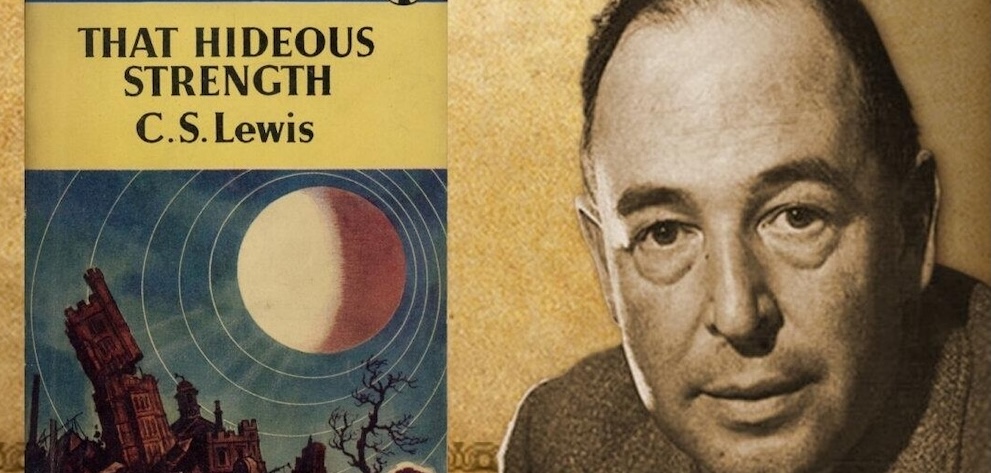
Michael Ward set the gold standard for Lewis scholarship in 2008 with the publication of Planet Narnia: The Seven Heavens in the Imagination of C.S. Lewis. Ward demonstrated that Lewis’s fairy tales revealed unmined depths. Since 2008, there has been a significant increase in Lewis scholarship. In 2024, George Fox University hosted the first Undiscovered Lewis Conference, with over 90 paper presentations considering new efforts in studying Lewis. That conference is returning this month and has sold out; in fact, more than 160 papers will be presented. There is strong intellectual interest in C.S. Lewis, and the bar that a work of Lewisian criticism must clear is rising.
Lewis also fascinates nonacademic readers. The combination presents a particular challenge when a nonacademic crafts a work of Lewisian criticism in scholarly form. Such is Joseph Weigel’s Planet Thulcandra: Magic and Science in C.S. Lewis’s That Hideous Strength. Weigel has partnered with Dr. Sorina Higgins to bring forth this book, published by Apocryphile Press. Weigel mines fascinating elements from THS, but Planet Thulcandra is by no means the thorough or sufficient commentary that That Hideous Strength demands.
That Hideous Strength (hereafter THS), published in 1945, is the third novel in C.S. Lewis’s Ransom trilogy. As a whole, the trilogy depicts the redemption of Earth, called “Thulcandra” or the “silent planet,” into a cosmos united in right worship of the God who created all things. THS follows two protagonists, Mark and Jane Studdock, on parallel adventures. Mark enters a community called the National Institute for Coordinated Experiments (N.I.C.E.), a cabal of scientists who seek to combine an infinite budget with State power to remake human nature in accordance with demonic instructions. Jane joins the Community at St. Anne’s, a fellowship of men, women, and animals seeking to live faithful lives in accordance with their natures. This is a complex novel that functions as a critique of scientism; at the same time, it operates through a medieval cosmology that combines Arthurian, astrological, and biblical imagery to defeat the N.I.C.E. and heal the Studdocks’ marriage. This complex novel merits a commentary all its own, presenting the reader with a story told by a younger C.S. Lewis who appears indifferent to the casual reader’s comprehension.
Planet Thulcandra functions as an introduction to the study of alchemy and notes several layers of THS that illustrate that Lewis reasoned alchemically as he considered how to transform characters and institutions. Sorina Higgins shares her research into early 20th century secret societies and compares the organization of those to the two communities in THS. Weigel has read widely and brings that reading to his analysis. By the conclusion of Planet Thulcandra, the reader will be aware of many cultural, scientific, and ethical quandaries faced by the early-to-mid-20th-century West. But will exploring them help the reader better understand That Hideous Strength? Since it presents itself as a work of Lewisian literary criticism, Planet Thulcandra must pass the measure Lewis sets forth in An Experiment in Criticism—does the work of criticism help the reader see more deeply into the work of literature under discussion?
The task of the literary critic is to help the reader understand complex literature; presenting oneself as an authority on a text presumes the ability to read the text correctly and help others do the same. In this case, that threshold is unmet. This volume suffers from three primary flaws: Many of the observations lack sufficient nuance; the organizational scheme produces fragmentation rather than a unified understanding of the text; and Weigel falls prey to specious etymological reasoning.
Who’s the Boss?
Authority, and how it is wielded, is one place Weigel’s misjudgment becomes evident. Ransom is the director of the community at St. Anne’s; he received perpetual youth as a result of his adventures on the planet Perelandra. Annie Crawford analyzes Ransom in terms of Solar imagery, arguing that Ransom is the Solar King. As such, he wields authority in a kingly manner, acting as an icon of God Himself. Rather than exploring these themes, Weigel contrasts Ransom with the N.I.C.E., writing of the latter that it is “Lewis’s illustration of what it looks like to claim unquestionable knowledge of the good, justice, and the choices of practical judgment.” The N.I.C.E. is condemned for the certainty of their knowledge, which rests in scientific expertise. “Ransom, in contrast, demonstrates the statesman’s virtue of prudence and the requisite humility that genuine prudence depends upon,” writes Weigel. While humility and prudence are virtues, Ransom is no less certain in following orders from his spiritual commanders than are the officers of the N.I.C.E.
Consider Ransom’s words to the community of St. Anne’s regarding their acceptance of Merlin. In response to MacPhee’s question, “Do I understand, Dr. Ransom, that you are asking us to accept this person as a member of our organization?” Ransom replies, “I am afraid I cannot put it that way. He is a member of the organization. And I must command you all to accept him.” Ransom commands St. Anne’s, not because of his pride, but because he is under authority. He has even more certainty than the N.I.C.E., but his certainty is correct because his master is good. Such certainty is a hallmark of the Christian faith: “Some trust in chariots, but we trust in the name of the LORD our God.” The certainty of doctrine is not rooted in political or cultural victory, but in confidence in the One who is the source of doctrine. Ransom’s calling as director involves wielding authority as an icon of Maleldil; to hedge, or lessen his own confidence, would require abandoning his role. Both Ransom and Withers lead with authority; the real contrast is in the nature of their masters, and what they do with their authority, rather than certainty vs. humility.
Words, Words, Words
Weigel loosely aligns Planet Thulcandra with the 17 chapters of THS. He typically pulls one concept from each chapter to initiate a discussion of something outside the novel. Instead of equipping the reader with deeper analysis of the novel itself, this method moves the reader outside the text. For example, chapter four focuses on Straik, a member of the N.I.C.E., for two paragraphs. Weigel then writes, “Straik bears more than a passing resemblance to the father of the Social Gospel, Walter Rauschenbusch (1861–1918).” From there, Weigel meditates on the Social Gospel, and then connects the Social Gospel to Hegel. He then brings his focus back to Straik and Studdock to close out the chapter. Chapter eight contains a lengthy digression on “AI and sex, AI as god, and AI as the means to create immortal consciousness.” While these topics may be of value, discussion does not stay grounded in the details of the text, which good literary analysis must do.
In Studies in Words, Lewis describes the importance of contextualizing any use of ancient words. Dictionary meanings alone are insignificant; one must note the actual meaning in use at the time of original authorship: “One discovers, often after years of contented misreading, that one has been interpolating senses later than those the author intended.” Lewis contends that “as far as possible our knowledge should be checked and supplemented, not derived, from the dictionary” because language expresses living thought in a specific moment in time. As time marches forward, the semantic range of various terms shifts. Reading old texts and old language requires knowing what words meant precisely when they were first penned.
Lewis describes a particular temptation facing the intelligent reader who has only an introductory knowledge of a language:
So far from being secured against such errors, the highly intelligent and sensitive reader will, without knowledge, be most in danger of them. His mind bubbles over with possible meanings. He has ready to hand un-thought-of metaphors, highly individual shades of feeling, subtle associations, ambiguities—every manner of semantic gymnastics—which he can attribute to his author. Hence the difficulty of “making sense” out of a strange phrase will seldom be for him insuperable. Where the duller reader simply does not understand, he misunderstands—triumphantly, brilliantly. But it is not enough to make sense. We want to find the sense the author intended.
The pattern Lewis describes runs throughout Planet Thulcandra. Weigel offers several speculative arguments rooted in etymological reasoning, giving rise to specious claims.
Two examples illustrate this trend:
“Nice” comes from the Latin nescius, which literally means “not-knowing.” Notice the similarity between the second half of the Latin word and the English word “science.” That is because scientia and nescius share the same common root, scire (to know). Thus, to be nescius is to be without scientia, to be without knowledge or understanding.
Weigel further writes,
The name “Belbury” may even suggest this very point. “Bel” is an ancient Babylonian deity equivalent to what the Hebrews called “Baal” in the Old Testament. Meanwhile, “bury” may have a double meaning. There is the verb “bury,” which means to place something under the earth, but there is also the suffix “bury,” which means a fortified place. If Lewis is drawing “Belbury” from the ancient Bel, then the implication is that the evil stronghold buries itself, it self-destructs.
The task of understanding a word requires more than parsing all possible meanings and asserting that those meanings are carried by that word (or by a part of that word) regardless of original authorial intent. Building argumentation on etymological investigations constructs upon shaky ground.
Much “expertise” has rightly fallen into disrepute. The abuses of authority during COVID-19, the ongoing decay of the Academy as revealed in the recent Jason Arday scandal, and the continued weakening of humanities scholarship have all created a dearth of good resources to help a reading public comprehend complex works of literature. Lewis says of the authors of “the Green Book,” a controversial text given to upper-form students in British schools beginning in 1939, that “literary criticism is difficult, and what they actually do is very much easier.” The same could be said of Planet Thulcandra. THS needs a good commentary to elucidate the novel; Weigel’s volume, however, is not that commentary.