Reflecting on the American Revolution, a resentful John Adams lamented that few would remember his contributions to the country’s struggle for independence. He predicted that future generations would be taught that “Dr Franklins electrical Rod, Smote the Earth and out Sprung General Washington. That Franklin electrified him with his Rod—and thence forward these two conducted all the Policy Negotiations Legislation and War” [sic].
While Adams did end up taking a historical backseat to the soaring reputations of Franklin and Washington, he still fared better than other Founding Fathers. As Adams well knew, the Revolution’s success hinged on the work and sacrifices of countless other men: politicians, propagandists, diplomats, officers, soldiers, and the women and children they had to leave behind to fight the war. Few of them would ever have books written about them, let alone a highly successful HBO series.
One of the most important of these forgotten founders was Gouverneur Morris. To look at him, you might think Morris would be one of our most recognizable founders. He was tall, handsome, and had a distinctive peg leg. He was also ubiquitous during America’s early years, serving as a delegate at the Continental Congress, where he signed the Articles of Confederation and worked tirelessly to supply Washington’s army and save the nation from financial collapse. He later helped to craft the U.S. Constitution and had more influence over the final document than perhaps any other individual. As America’s ambassador to France in the early 1790s, he bore witness to the worst atrocities of the French Revolution.
So why isn’t Morris better known? That’s the question Scott S. Greenberger seeks to answer with his new book, The Forsaken Founder: Gouverneur Morris, the Unsung Patriot Who Wrote the Constitution, Stood Up to Slavery, and Survived the Reign of Terror. It’s a colorful narrative about a colorful man. Greenberger, a journalist who debuted as a historian with an illuminating biography of another forgotten politician—Chester A. Arthur—has a much more exciting subject to work with this time. In addition to his career accomplishments, Morris had a stand-out personality: He was charming, witty, and appears to have been genuinely kind. Greenberger’s challenge was to write a book as interesting as his subject. His keen observations, punchy prose, and breezy pace (the book is a comfortable 260 pages) pair perfectly with Morris’s almost irresistibly likable personality.
In fact, Morris is probably the most likable of all the major Founding Fathers. Greenberger notes that Morris carried himself with “characteristic cheer,” a trait that served him well as he navigated through some truly dark events, both professionally and personally. A precocious intellect, he began a career in law before being elected to the New York Provisional Congress at a mere 23 years old. He impressed his peers so much that they sent him to Philadelphia in 1778, where he quickly discovered how dire the Revolutionaries’ situation truly was.
The Continental Army was perpetually short on supplies. Troops routinely went without sufficient rations. Some didn’t even have shoes. Promises to pay them went unfulfilled. The Congress lacked any real power to levy taxes, making it impotent to raise funds. Mutiny seemed imminent. In this environment, Morris must’ve questioned his decision to enter the political fray. Before the war began, he wrote disdainfully, “Politics I dislike and only look on with pity, while the madness of so many is made the gain of so few.” He could have chosen to stay at his New York mansion, staying out of politics and avoiding risking his property in the event of a British victory.
Instead, he rolled up his sleeves and worked himself nearly to death requisitioning supplies and money for Washington’s army. He and his fellow delegate Robert Morris (no relation) managed to overhaul the Army’s procurement system, pressure the states into providing more assistance, and pass a workable pension program for Army officers.
Greenberger makes a convincing case that the American Revolution probably would not have succeeded without the two Morrises. But despite his commitment to the Revolutionary cause, many distrusted Gouverneur Morris because of his fondness for women and wine. Robert Morris noted that while Gouverneur could be “a little too whimsical,” he also had “more virtue than he shows and more consistency than anybody believes.”
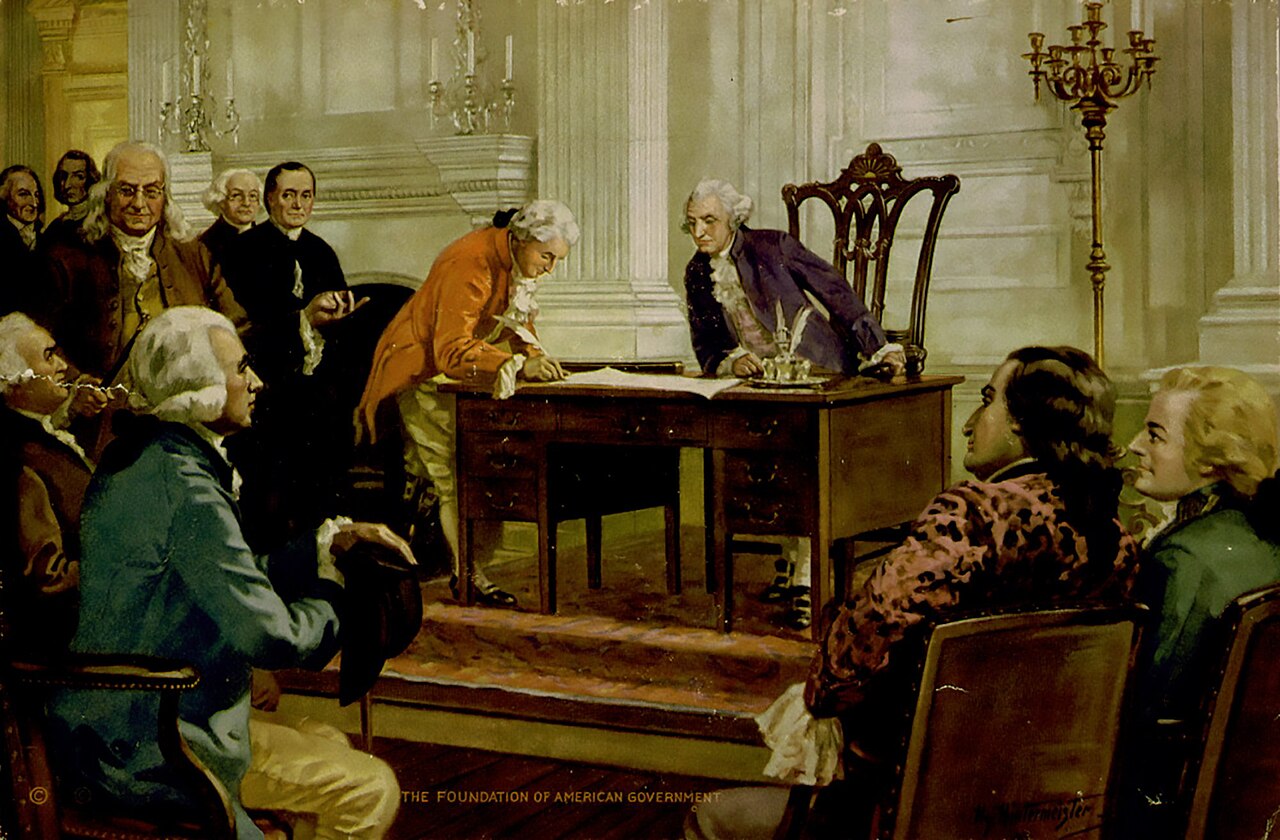
He would get an unprecedented opportunity to display that virtue and consistency just a few years after the war, at the Constitutional Convention of 1787. Chosen to represent New York, Morris’s perspective at the Convention was unabashedly nationalistic. He wanted to unite the whole country under a strong, central government that was capable of pursuing national interests, without being hindered by state and regional interests.
The most significant threat to national progress and unity at the time was, of course, slavery. Given his “whimsical” nature, Morris may have seemed like the least likely delegate to put up a fight against the “peculiar institution.” But then as now, it’s often the fun-loving party animals who best cut through the bull.
At the Convention, Morris was relentless in pointing out the absurdity of the pro-slavery delegates’ positions, especially the infamous Three-Fifths Compromise. This curious part of the Constitution allowed states to count three-fifths of their slave population as part of their total population, which in turn would determine how Electoral College votes, House seats, and taxes were apportioned.
Southern delegates originally wanted slaves to be counted as whole persons, just like free individuals. Northern delegates saw right through this power grab and pushed back. But it was Morris who spoke out most forcefully. “Upon what principle is it,” he asked, “that the slaves shall be computed in the representation? Are they men? Then make them citizens and let them vote. Are they property? Why then is no other property included?” The South could augment its political power simply by kidnapping more people from the African coast, Morris suggested.
That barb surely didn’t sit well with his aristocratic Southern colleagues, but they still won in the end. The Three-Fifths Compromise was passed, as well as a guarantee that the federal government would allow the importation of new slaves until at least 1808. Nonetheless, Morris’s moral clarity and courage should inspire modern readers. Nobody else at the Convention spoke out against slavery with as much gusto as Morris did.
This failure aside, Morris still played a crucial role in crafting the Constitution. As Greenberger points out, he “offered the most motions (thirty-nine), and had the most adopted (twenty-two).” He also wrote the Preamble largely by himself.
Despite the Constitution’s flaws, Morris was optimistic about America’s future. He looked ahead to a time when America would become an “asylum to mankind” and “receive to her bosom and comfort and cheer the oppressed, the miserable, and the poor of every nation and clime.” He couldn’t say the same about America’s ally, France, which was thrown into a violent revolution while Morris was living in Paris, first as a private citizen and later as America’s ambassador.
Greenberger’s account of Morris’s time in Paris is thrilling. Morris saw the chaos of the French Revolution firsthand and lost many friends to the guillotine, though he managed to harbor some fugitives in his house. Already an amputee, he managed to lay low enough to keep his head.
Perhaps it was his proximity to the political upheaval, or perhaps it was his natural aversion to unbridled democracy, but Morris saw very early on—long before the Terror began in earnest—that the Revolution would not end well. When events proceeded as he predicted and the rule of law broke down, he reflected on how much appreciated the relative peace and tranquility of his own country.
“I was never until now fully apprised of the mildness of American character,” he wrote. “We know not what it is to slay the defenseless victim who is in our power. We cannot parade the heads of our fellow citizens and drag the mangled carcasses through the streets.”
When Morris moved back to the United States in 1798, he briefly returned to politics and served in the Senate. He fretted about Thomas Jefferson and his acolytes, worrying that their democratic proclivities might threaten the orderly republic that Morris helped to create. But as much as he opposed many of Jefferson’s policies, he wasn’t a partisan; he was just as willing to criticize his fellow Federalists as he was to argue against the Jeffersonians.
It was precisely this independent spirit that made Morris so great but that also consigned him to historical obscurity. His peg leg marched to the beat of his own drum, and this rubbed many of his contemporaries the wrong way. When he died, he left behind no political movement, party, or ideology.
“Gouverneur Morris shaped a nation that never quite knew what to do with him,” Greenberger writes in the final chapter of Forsaken Founder. “He was too bold for his age, too honest for party, too visionary for faction, too modern for mythmaking.”
But the qualities that relegated Morris to a third-rate Founder after his death ought to make him a household name today. Morris’s boldness, sincerity, independence, and intellectual imagination are all traits that speak directly to the political anxieties of Americans today. We desperately want politicians who, like Morris, will speak the truth forcefully on controversial issues but without resorting to petty partisan squabbling. We want public servants who are willing to stick their necks out to do the right thing, whatever the consequences for their careers and reputations.
In that sense, Morris is a founder perfectly suited for our times. As Greenberger writes, Morris was too modern for mythmaking. But while Morris’s personality naturally resists turning him into a mythical demigod (the way we have treated some of the other Founders), he is all the more ripe for imitation.
Though we can admire our more mythological Founders—the stately and courageous Washington, the philosophical Jefferson, and the scientifically gifted Franklin—we could never hope to become them. But we can all strive to be a little more like Morris. And if we did, America might yet survive another quarter millennium.