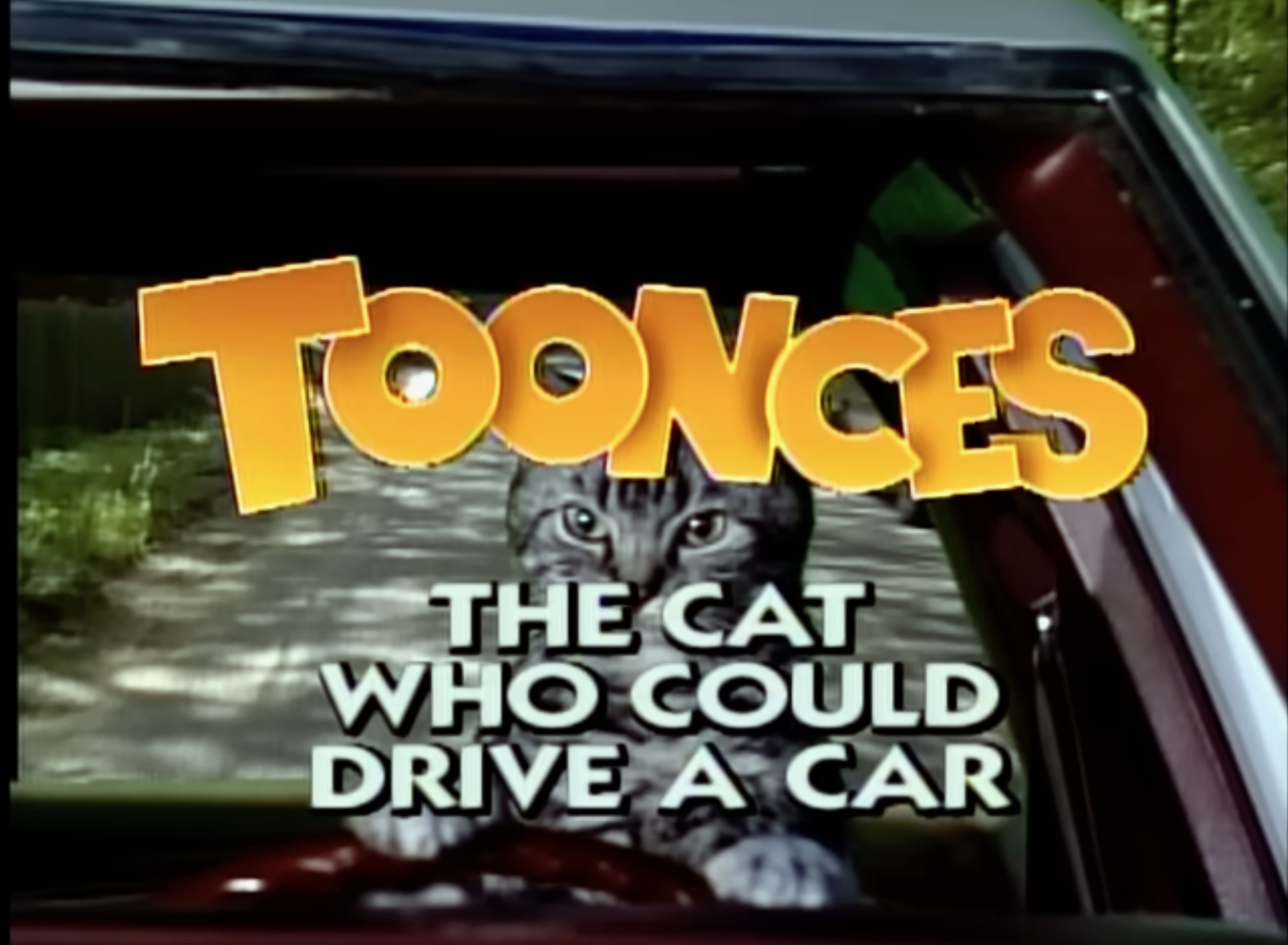
Most of us live at least part of our lives on autopilot. Most of us also, sooner or later, stumble across Albert Einstein’s famous warning: “Doing the same thing over and over again, while expecting different results, is the definition of insanity.” Most of us then ignore the warning, because few of us listen the first time. As it turns out, Einstein’s words are apocryphal. In real life, he never actually said them. Yet they’re nonetheless true. And more importantly, they give us a chance to consider some key tidbits of wisdom, illustrated by Toonces, the Cat Who Could Drive a Car.
Who was Toonces? For those too young to know, or too old to remember him, Toonces was a frequent guest on Saturday Night Live, 1989-93. A uniquely gifted feline, Toonces was the treasured pet of an everyday human family with unshakable faith in his abilities. Where that typically led is best captured in the brief SNL “Martians” sketch archived here.
Toonces was the brainchild of writer Jack Handey, a comedic genius. We can laugh at Toonces and his antics because they capture something true about ourselves. We all have a few unthinking habits; a pattern of brainlessly repeated mistakes tucked away somewhere in our lives. We’re each of us imperfect creatures. And our imperfections, in a marvelously ironic, if too-often boneheaded manner, seal us together in a common humanity. We complete each other in more ways than one. God, it turns out, has a vivid sense of humor.
Here’s the problem: Our little personal foibles, given the right climate and numbers, tend to metastasize into larger, less entertaining tumors.
Remember that other, not so funny writer; the one who suggested “from each according to his ability; to each according to his need”? That particular Big Idea – tried again and again, more and more forcefully over the past century with the same unpleasant results – cost some 100 million lives. Millions more were shoveled into forced labor systems. Some 65 million died in the wake of the Chinese Communist revolution, the “Great Leap Forward,” and the Red Guard turmoil. Pol Pot’s modest attempt at social reform buried two million Cambodians. This, in a population of seven million. And the same sunny Big Idea currently gestates, like the creature from Alien, in some of our loudest, most annoyingly “progressive” political figures.
Happily, we Americans don’t believe in utopias. Some of us don’t seem to believe in anything more than ourselves. If by “we,” one means our secularized leadership classes, we’re pragmatic in our convictions. We believe that happiness is a product of maximum personal liberty; maximum self-realization; maximum material abundance.

We believe that more of whatever we want, or think we need, is always good. This is why more money for bigger budgets is always the answer to obviously ill-structured, misconceived public-school systems that produce semiliterate adults. Looking back, this also explains our actions in Vietnam. The solution was always more troops, more bombing, more aid programs. In effect, more of the same. More would win the day. Until it didn’t.
“We” further believe that political and religious principles are usually pliable. They’re often just posturings that mask an appetite for the higher moral ground or a better deal. But we especially, and immovably, believe in the saving power of technology.
As the late media scholar Neil Postman argued:
[American] television commercials are a form of religious literature. To comment on them in a serious vein is to practice hermeneutics, the branch of theology concerned with interpreting and explaining the Scriptures. . . .In television-commercial parables, the root cause of evil is Technological Innocence, a failure to know the particulars of the beneficent accomplishments of industrial progress. This is the primary source of unhappiness, humiliation, and discord in life. [And the ugly] consequences of technological innocence may strike at any time, without warning, and with the full force of their disintegrating action.
On the matter of technology, we might profit from reading St. Paul on the nature of idolatry. But when it comes to national blind spots and chronic wisdom deficits, we’re hardly alone. Argentina has defaulted on its sovereign debt nine times, each time “fixing” the problem with essentially the same failed policies. Under Chàvez and Maduro, Venezuela handled its shrinking oil revenues by simply printing more money and changing the name of the currency – several times. Inflation no surprise, then hit 1 million percent.
Similar examples are legion because reality is unforgiving. At every level of life, from the personal to the macro, dumb-think and no-think come with a price tag and compounded interest.
So where am I going with this? Just here:
Peter Drucker, the late, great business guru, noted long ago that every failure contains the seeds of success if we learn the right lessons from the experience. The opposite is also true. Every success bears the seeds of failure if we ignore and fail to address them.
As a nation, we have astonishing wealth and power. We’ve had them now for three or four generations. It’s just long enough to forget where they came from, and how. We assume we deserve them. We imagine their permanence. And these delusions have been the vestibule, again and again, for every great people’s decline.
Nations rise and fall. Such is the nature of things. We Christians once knew that our mission in the world was to convert it; to be “other than” the furniture in a culture’s showroom; to have passion in witnessing Jesus Christ. But that was then. This is now. Too often, too many of us have chosen a kind of moral narcolepsy over zeal.
And Toonces – remember Toonces? – is happy to show us, through his canine friend Flippy the Chihuahua, exactly where an oblivious spirit can lead. It doesn’t have to be this way. We can be real disciples again. But it does take a new conversion of heart in each of us. And then we need to act on it.


![Hegseth Demands Fitness Requirements, Says 'Fat Troops' 'Not Who We Are' [WATCH]](https://teamredvictory.com/wp-content/uploads/2025/09/Hegseth-Demands-Fitness-Requirements-Says-Fat-Troops-Not-Who-We-350x250.jpg)