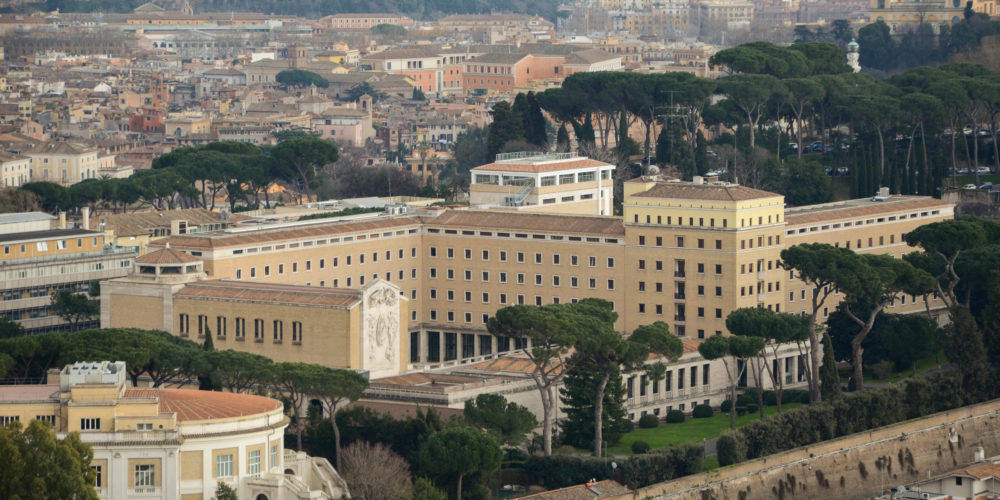
Rome, if not quite the “Eternal City,” is nearly 2,800 years old and counting. I first encountered it in the 1970s, visiting my wife’s uncle, a priest who served in the Congregation (now the Dicastery) for the Doctrine of the Faith. What I remember most vividly from those few days is a Fellini-esque evening performance of the opera Aida with live elephants in the Baths of Caracalla, followed by a hair-raising drive home through Roman traffic. The city then was an electric blend of the sacred and profane: a cocktail of religious piety, astounding beauty, garish energy, and opiate nostalgia; strange and intoxicating at the same time. I loved it.
Over the years I’ve returned many times, always with the same mix of feelings. In all those visits, the living Catholic soul of the city redeemed its vulgarity and graffiti porn – a venerable Roman tradition – and offered some clean, fresh joy for the spirit to counter the narcotic scent of the past and its ruins.
I’m old enough to remember, as a child, the recorded voice of Pius XII. In the papacies of John XXIII to Benedict XVI, evangelical zeal, pastoral service, and brilliant intellect coincided and reinforced each other. They converted my adult heart. Exacting Catholic thought mattered. It was the fertile soil for Christian action.
I visited Rome twice in the last years of the Francis papacy. The mood of the place had changed. Some of my disenchantment with the city doubtless came from age; my own, not the city’s. Skepticism tends to grow along with one’s years. But it was also more than that.
There were days, then, when Catholic Rome felt like Constantinople in the last sclerotic years of the Palaiologoi emperors: a museum amid the hostile and indifferent, curated by the mediocre. For the believer who looks too closely and reflects too long, Rome can sometimes be more of a scab on the spirit than a spring of refreshment. This isn’t new of course. Quite the opposite. Martin Luther had the same reaction. That didn’t end well.
It was new, though, for me and many others who entered their teens as Vatican II opened; years subsequently blessed by a string of intellectually gifted popes who’d suffered and survived the worst years of the last century. Francis came from very different roots. He was a champion of the poor, and his pontificate had important strengths, but not in the same category. His death a year ago this week left a range of internal Church conflicts unresolved.
Easter is a time for celebration and renewed hope. In a few weeks we need to carry those qualities into the liturgical season of “Ordinary Time.” A question we face going forward is this: How can we heal the frustrations and divisions that naturally come with Church conflict in a time of profound change? Worries and resentments can strip the heart of joy like a plague of locusts at harvest. So I go back, again and again, to three things.
First, we need to remember and pray for Pope Francis, and also for our own conversion from the role we ourselves play in today’s ongoing ecclesial conflicts. And we need to do it sincerely, with a good will.
Second, we need to remember Church history because it’s a lesson in hope. Reading Carlos Eire’s Reformations, or Brad Gregory’s The Unintended Reformation, or Hubert Jedin’s great History of the Council of Trent, or any similar record of the medieval or ancient Christian Church is both sobering and encouraging. Sobering, because division in the Church is a chronic human virus. Encouraging, because Nero (and so many others like him) would be shocked we’re still here.
There’s never really been a golden age of tranquility in Christian life because our nature doesn’t allow it. We’re flawed creatures. We – and “we” means all of us, from popes to plumbers – do bad things that have big consequences. That’s why Golgotha and Easter had to happen. But we’re also capable of heroism, virtue, self-sacrifice, and nobility, and God never abandons us. That’s why we’re still here.
Finally, every summer I reread Tolkien’s Lord of the Rings trilogy. It’s a kind of therapy. Peter Jackson’s films of the story are good, but the books are vastly better. And the lesson in all their hundreds of pages is this: We need to do the best we can with the time given us. None of us can see the whole picture of the world around us. But God does. And we can trust Him.
On that matter of trust, I’ll close with a story.
Suann (my wife) and I returned to Rome earlier this month. The mood of the place had changed yet again; this time in a different direction. The Leo pontificate, barely a year old, has brought a fresh, hopeful spirit to the city and the Church without diminishing any of its predecessors. Time will tell its substance. But two details of our visit will stay in the memory for a very long time.
The first was a Rector’s Award Dinner at Rome’s North American College honoring Michaelann and Curtis Martin, cofounders of the Fellowship of Catholic University Students (FOCUS) – an astonishing apostolic success at a difficult time in a challenging environment. The room was packed with hundreds of clergy and lay Catholic leaders and donors. Many of them were young. All of them were committed to the Church and her mission. Not one of them was afraid of the future, the world, or the work ahead.
The second detail, easy to miss and unacknowledged, was a gifted young laywoman in the audience. A year ago, on her own, she moved to Mongolia to serve the Apostolic Prefecture of Ulaanbaatar. It’s a quintessential mission Church of the poor, serving 1,500 Catholics spread across a vast countryside.
I’ve never had that kind of courage. But she does. So Rome may not be “eternal,” but the Gospel of Jesus Christ clearly is.
Like I said: Nero would be shocked.
The post A Note on ‘Roma Aeterna’ appeared first on The Catholic Thing.