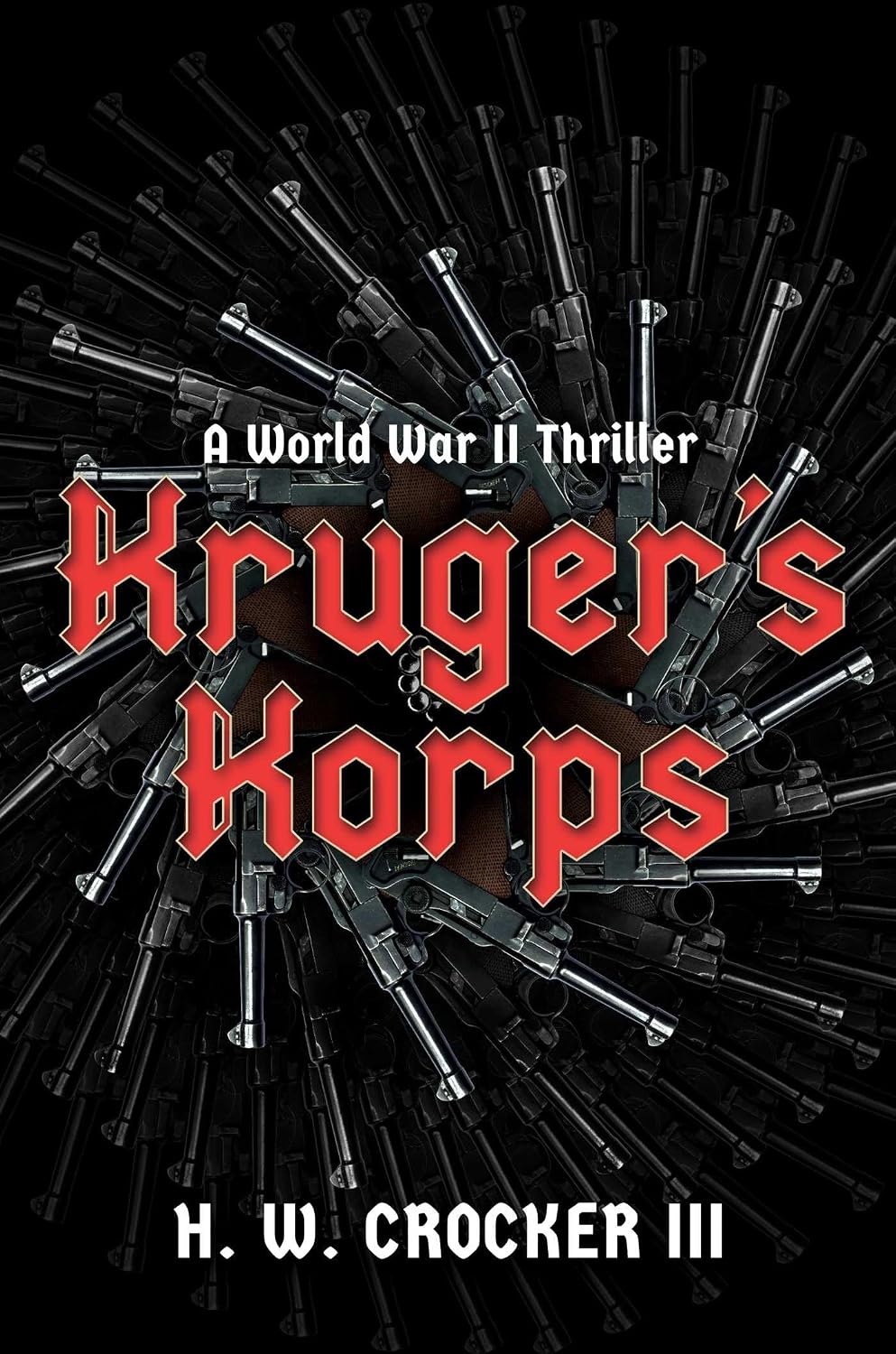
Rod Dreher is hard at work on a book about “Weimar America.” The disquieting trends that trouble Dreher – rising anti-Semitism and social alienation, the decline of Christianity, and the likelihood of civilizational war – are also the subject, in a different context, of Kruger’s Korps, my most recent book, which I’d like to tell you about because there’s more to it than its cover of spiraling Lugers might imply.
On the face of it, Kruger’s Korps is a breathless World War II action-adventure story about American spies penetrating the German Afrika Korps. At that level, I’d like to think it offers high-caliber entertainment and has everything a reader would want from that genre: battles, mystery, a beautiful woman, shocking plot twists.
And it has some things – in fact, a lot of things – you would not expect to find, including references to Nietzsche and Ernst Jünger; a guest appearance by Fr. Marcel Lefebvre (!); and a good deal of humor.
But this is also, in some ways, a tragic book. The Fatherland plays a big role in it, of course, but so does fatherhood – both the nobility of fatherhood and the tragedy of it. Without giving too much away, the plot hinges, at least in part, on the misdoings of a prodigal son who grew up with every advantage and was well-tutored in duty, honor, and piety, in a family that lived those virtues, and who yet still went astray – badly and wickedly astray to an extraordinary degree.
I imagine that this part of the story will be painfully relevant to many Catholic parents.
The prodigal son in Kruger’s Korps is a German who grew up during a pressure-cooker of a time, spanning the First World War, the Weimar Republic, and Nazi rule. If we think raising young men today is difficult, think of raising young men then.
The hero of the story is another young man, Rolf Kruger, born in Germany but raised in the United States – in Hollywood, of all places – where his father works as a carpenter/set-designer and Kruger himself works as an extra and fencing instructor.
The contrast between these two German-born young men – the prodigal son and Kruger – is a major theme of the book. The prodigal son has rebelled against the best of German culture (and against his father who represents it; “a Habsburg man, not a Hitler man” is a repeated line), while embracing the worst, losing his moral compass (and therefore his mind) completely in the process.

If America is going through its own Weimar moment, it’s important not to make the common but serious category error that Adolf Hitler was a “traditionalist,” as, for instance, former Daily Wire CEO Jeremy Boreing recently did on his podcast.
Hitler was anything but a traditionalist. He was a radical, atheistic, anti-Christian (he much preferred Islam) modernist, which is why Evelyn Waugh could say that the Hitler-Stalin Pact represented “the modern age in arms.”
It is a point emphasized not only in Kruger’s Korps but in my history of the Catholic Church, Triumph, where I quote the great historian John Lukacs, who notes that the “greatest revolutionary of the twentieth century was not Lenin or Stalin. It was Hitler. . . His greatest reactionary opponent, Churchill,” was the traditionalist.
The prodigal son in Kruger’s Korps rejects traditionalism and his inherited Catholic faith in favor of political radicalism, first National Socialism and then Communism (a not uncommon occurrence, though it usually worked the other way round).
The young German-American Kruger, however, takes another path. He remains a Catholic and holds fast to his father’s traditional values. He becomes an officer in the U.S. Navy and then a spy for the Office of Strategic Services (and doesn’t neglect praying his rosary). He embraces all the heroic virtues that Hollywood once proclaimed in its films and becomes a hero himself.
For a book that appears to be a sheer adventure story, the intent is to give the attentive reader much to ponder. A few historical characters have passing roles, and big topics – politics and religion, loyalty and morality – peep between the gunfire, the racing jeeps, the panzers, the challenges, and the dangers that drive the plot.
I fear nothing more than boring a reader, so the pace is kept on overdrive, and I trust that no one will find Kruger’s Korps either didactic or preachy. But it is a bit of a parable – short, pithy, and, I hope, memorable – in an unexpected form: a novel about Field Marshal Erwin Rommel’s Afrika Korps and a secret mission that could change the outcome of World War II.
As a war story, it’s about panzers and planes, yes, but it’s also about individual courage and conscience, and standing up for what’s right even when confronted with temptation, pointed Lugers, and desperate foes. If packed in the suitcase of a son departing for college, it might provide some inoculation against conforming oneself to popular evils, including some of the very same ones that students confront today (like resurgent Communism).
Kruger’s Korps is written to appeal to a wide audience. It is very cinematic in its presentation, and the narrative tension is kept high (as just about every reviewer has noted, including here, here, here, and here).
Even in these post-literate days, I hope it will find a large readership because it is, in its own way, all about the Good News.