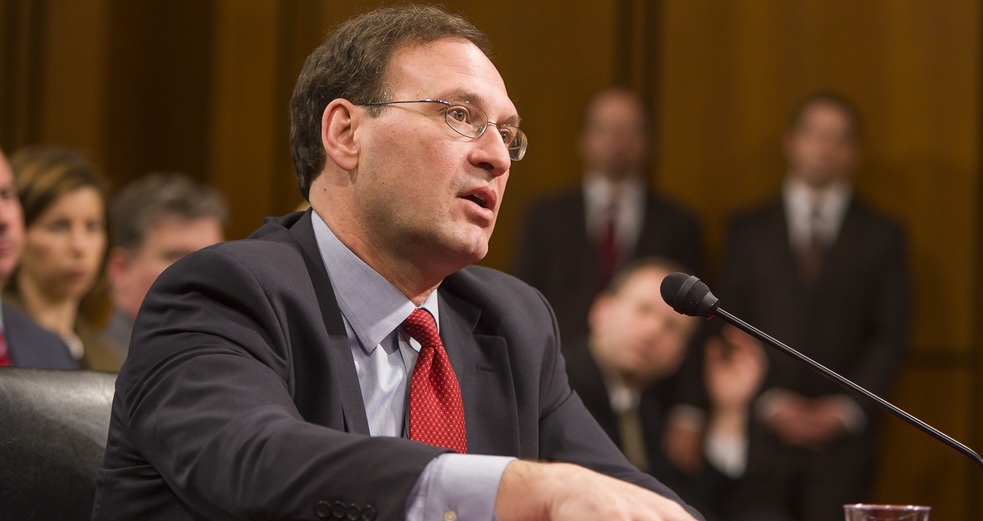
The first full-length biography of the Supreme Court justice presents us with a quiet man of clarity and consistency more focused on the law than on obtaining celebrity status.
I was finishing my last year of law school when the Supreme Court was significantly reshaped by the nominations of John Roberts and Samuel Alito. During that year, I had the rare privilege to take courses taught by one of the nation’s leading experts on the federal courts. He was a man firmly on the left, so it was surprising to me that he expressed unmitigated enthusiasm for the nomination of then Judge Alito. Despite the disagreements that he may have had with Alito’s approach to the law and overall view of the world, my professor told our class, “The most important thing about a Supreme Court justice is clarity and consistency, and there is no judge more clear or consistent than Judge Alito.”
There’s been surprisingly little ink spilled trying to understand or explain him, however. Until now. Mollie Hemingway’s new biography, Alito: The Justice Who Reshaped the Supreme Court and Restored the Constitution, is the first book-length portrait of a man who will likely be remembered as one of the nation’s most consequential justices.
Alito has served on the Court during the first era in American history when justices are able to attain celebrity status. He served for nearly 15 years with the original celebrity justice, Ruth Bader Ginsburg (aka Notorious RBG). His ideological kinsmen, the late Justice Antonin Scalia and Justice Clarence Thomas, have higher public profiles, too, for various reasons. The story of Samuel Alito has been overshadowed by these figures, and after reading this volume I am convinced that he likely prefers that. The quiet constancy that is the hallmark of his work on the Court has marked all aspects of his life. His family and friends from his childhood to the present confirm his humility, consideration, and deference to others. (This notwithstanding his one notable brush with controversy. When Barack Obama, a former constitutional law professor, mischaracterized a recent landmark case in the 2010 State of the Union address, Alito reflexively mumbled “simply not true” clearly enough for his lips to be read.)
Unfortunately, Alito’s positive traits have proved unable to sustain a positive view of the court he sits on.
A 2025 survey revealed that confidence in the Supreme Court among Americans had fallen precipitously since 2020, when about 70% of Americans viewed the Court favorably. Today, that number hovers around 50%. For the most part, this decline is not the fault of the justices. The judicial branch was never intended to be political. But politicians who promise to make judicial appointments on factors wholly unrelated to the job or who threaten that justices will “pay the price” for handing down decisions with certain policy implications have stoked the flames of tribalism and fear and thus politicized the Court. Which is why Hemingway’s book could not have come at a better time, as it is a valiant contribution to the effort to restore faith in America’s High Court.
If there is one notable moment that ignited the sharp decline in support for the Court, it was in 2022, when the Court overturned Roe v. Wade, the 1973 case that articulated a previously undiscovered constitutional right to abortion. That controversial decision created heated political debates and was at the center of nearly every judicial confirmation hearing for five decades. So it is little wonder that when Roe was challenged, high drama ensued.
On May 2, 2022, a draft of Dobbs v. Jackson Women’s Health Organization was leaked from within the Court. It revealed what most Court-watchers expected and abortion activists feared—Roe v. Wade was destined to be overturned. Since no decision is final until it is publicly announced, a change in the composition of the Court could change the outcome of the case. This placed the justices in the conservative majority at significant risk, and their homes were swarmed by protesters, with Justice Brett Kavanaugh and his family targeted for assassination. According to Hemingway’s sources, it also significantly raised tensions inside the Court. Justice Elena Kagan, we learn, screamed at Justice Breyer so vociferously that the “wall was shaking.” Justice Alito was at the center of this unprecedented and alarming event. He had been selected to pen the decision that would overturn the most tendentious and divisive Supreme Court decision of all time.
The weeks surrounding Dobbs proved that my law professor was right about Alito all along. The leak of the draft opinion had put all the justices in the Dobbs majority on edge. It was clear what the public and political fallout would be once the decision was formally announced. Yet Alito did not cave to the pressure. The ruling was officially handed down the following month and the decision was substantially unchanged from the draft that was leaked.
There is a certain challenge in writing a biography of a living public figure, especially a Supreme Court justice. Justices must maintain neutrality both in reality and in appearance, and information that seeps out about them can alter that perception, make them political targets, or present opportunities for those before the Court claim conflicts of interest. As a result, these types of books tend to drift into hagiography and are largely bland reads.
Hemingway transcends the genre, however. This is a favorable and sympathetic biography, but it is interesting, compelling, and energetic. She weaves personal snapshots of the justice into a broader narrative about the conservative legal movement, the work of the Supreme Court, and the evolving political climate during his tenure. There are also a handful of insider stories, like the one about the temperature inside the Court in the weeks following the Dobbs leak.
If the work has one fault, it is one beyond Hemingway’s control. She certainly provides insights into Alito’s early family life and a few stories about law school, law practice, and the earliest days of his time on the federal bench. We learn that all four of his grandparents were immigrants from Italy, his family life growing up was supportive and warm, and, surprisingly, he didn’t enjoy law school. But this information is limited, without enough depth to present a truly textured portrait of the justice. Biographies of other justices tend to evolve. Those written during their tenure and those written after differ in terms of the details and depth of portraiture for practical reasons, and I’m certain that will be true for Alito as a subject, too. Hemingway hints that future biographies that delve deeper into such subjects as religion and intellectual influences will produce further fascinating insights into Alito’s character and temperament.
What this work does give to readers, however, is a first look behind the veil at a quiet justice who will likely be remembered as one of the most significant justices ever to serve on the Court. At a moment when confidence in the institution is waning and the actions of the political branches of government have damaged the Court, I hope that Hemingway’s excellent biography of this principled and ethical justice will do some good in restoring that trust.