It’s been a week since the publication of Magnifica humanitas, and I’ve been re-reading certain sections, trying to probe into it more deeply (after my own quick reactions on a recent Prayerful Posse, the very day Pope Leo’s first encyclical appeared). Serious questions about the text remain, to be sure: the functional pacifism and an over-optimistic belief in multilateral statism and “dialogue” as the go-to mechanism to rein in not only the AI juggernaut, but virtually all human conflict. (Odd stances for an Augustinian). But I confess that my initial suspicions may have been exacerbated by the many ways that, for over a dozen years, Pope Francis repeatedly left many of us on a hair-trigger because of heterodox notions smuggled into papal documents. Leo’s effort to defend what’s human is carefully positioned within the Church’s modern social teaching, sincere, open, and – from its first words – focused on Christ.
So I’d like to acknowledge a culpa – mea, but not maxima. Because we still need something much stronger and quite different to meet the challenges of our “new era.” The pope speaks often about “disarming” language and AI, when what we also, desperately, need is a call to arms – of a different kind, to defend the faith and human civilization.
If you think about it, we’ve already had plenty of warnings, in many quarters, about the potential threats from AI – from job losses to environmental threats to rogue military uses – even from Silicon Valley itself. And the disastrous narrowness of the “technocratic paradigm,” the slow slide into believing that the machines we create will provide all the truth and everything else we need, has been on our cultural radar for at least a century.
The real defense of humanity must begin with humanity defending itself from itself. Which at times calls for physical means, but always means patrolling the cultural peripheries, not just to “accompany” but – can one use a Christian term here? – to convert.
That’s precisely the Christian challenge, which needs a more explicitly Christian solution: A more robust confrontation with what Christianity sees as the real situation of the creature made in the image and likeness, now in a fallen state, marked by sin and death, and in our time in particular often closed off to the saving message of the Gospel.
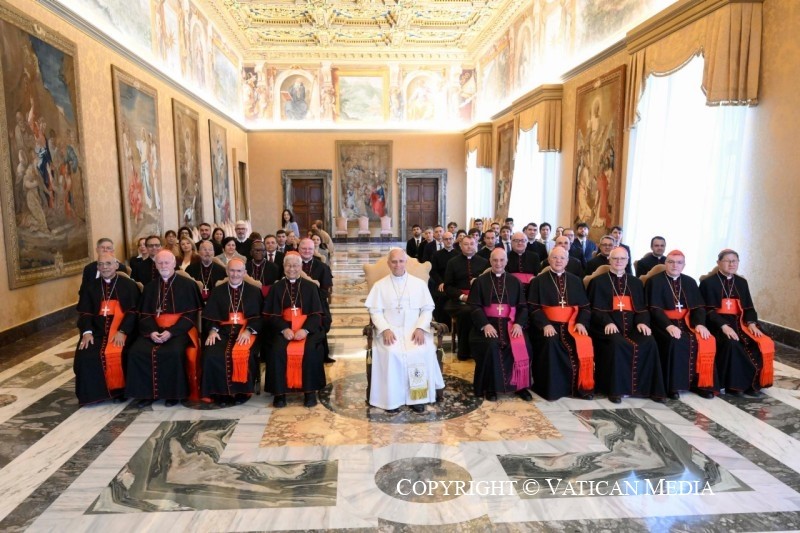
Leo himself acknowledged that a few days ago in an address to evangelists gathered in Rome:
The prevailing cultural climate in media-saturated and consumerist societies diminishes the capacity to learn with patience and to undertake, with effort, a personal quest for truth, with perseverance and a critical sense. Every message risks being perceived as just one opinion among many.
That’s a just description of the times. And he put his finger on the crucial point: “It is certainly not by watering down the content or softening the demands that Christianity can be made attractive, but by bearing witness with humility and courage to ‘the way, the truth and the life’ that has converted and sanctified so many people.” (Emphasis added.)
I’ve been saying for years that it would be not only inspiring, but taking the true measure of our challenge if the Church were to show as much urgency about conversion and eternal life as it has about peace, climate change, immigration, and ecumenism. Pope Leo has now sounded a similar note: “No one can take [the Church’s] place in this mission, which is as urgent as it is necessary to ensure a reliable foundation for the future of humanity, so that it may be a future of peace, justice, freedom and fraternity.” [Emphasis, again, added.]
Profoundly true, but why stop there, with these worldly aims – desirable as they are – speaking to evangelizers, when Jesus himself didn’t much touch political and social themes, and was clearly more concerned to lead us towards eternal life. It’s often been observed that the Church in Latin America has been pushing the “preferential option for the poor” and “social justice” for decades. Good goals, properly pursued, but the Church there is shrinking. Meanwhile, Evangelicals and other Protestants in South America preach Jesus, and are growing.
Rome would do well to notice this and speak very carefully. Magnifica humanitas, for example, starts out well enough by pointing out, “In Jesus Christ, this humanity in its grandeur becomes the Way, the Truth and the Life, opening the path for each of us. . .” And what is that path? The sentence ends. . .“to grow toward fullness.”
Fullness? As I pointed out on our Posse last week, the word ‘sin’ appears only three times in this encyclical, and two mentions were not personal but rather “structures of sin,” and the third came from a list of things in Dignitas infinita that do NOT diminish the dubious notion of infinite human dignity. Some have written me since that other major Church documents by traditional figures don’t mention sin at all. And that’s true. But they weren’t speaking of “magnificent” humanity.
I don’t know how you tell people with any urgency that they desperately need Jesus Christ unless you can first tell them why much of what they’re doing won’t “fulfill” them, even creating a just order on Earth, instead of pointing them towards Heaven. That’s certainly a more Augustinian view.
“Fullness” is precisely the kind of neutral language and, in my view, the “watering down” of the Christian message, that the pope himself cautioned against in the discourse he gave to evangelizers late last week.
A good evangelizer has to choose the best way to present the full Gospel in a given context, of course, and that may mean not to say everything at once in language that people may not understand. But even at sporting events these days, the most significant Christian expression (John 3:16) appears on signs – which our worldly, death-denying civilization urgently needs to hear: “For God so loved the world, that he gave his only begotten Son, that whosoever believeth in him should not perish, but have everlasting life.”