A long drive recently allowed me to listen to the unabridged audiobook of Homer’s Odyssey. It was worth all 780+ minutes.
Hearing the poem helped me understand why it is foundational to the Western understanding of human life, and how archetypal it is of human experience. My reactions are not those of a well-versed critic, but only those of an amateur, who undertakes an activity more for love than for profit or fame.
In other words, I’ll keep my day job.
Having fought in the Greek expedition against Troy, Odysseus must find his way home to Ithaca, where his family awaits him. Crossing the “wine-dark sea,” he overcomes an array of natural and supernatural obstacles. He demonstrates the virtues of courage, perseverance, and loyalty, together with cleverness and strategic thinking, that we associate with classical heroism.
The poem acknowledges implicitly that there are realities of truth, beauty, and goodness. Human excellence is to rise above mere pleasure-seeking and overcome all that obstructs us in a life that accords with those transcendentals, a life of honor. Death is always a possibility, and there are things worth dying for.
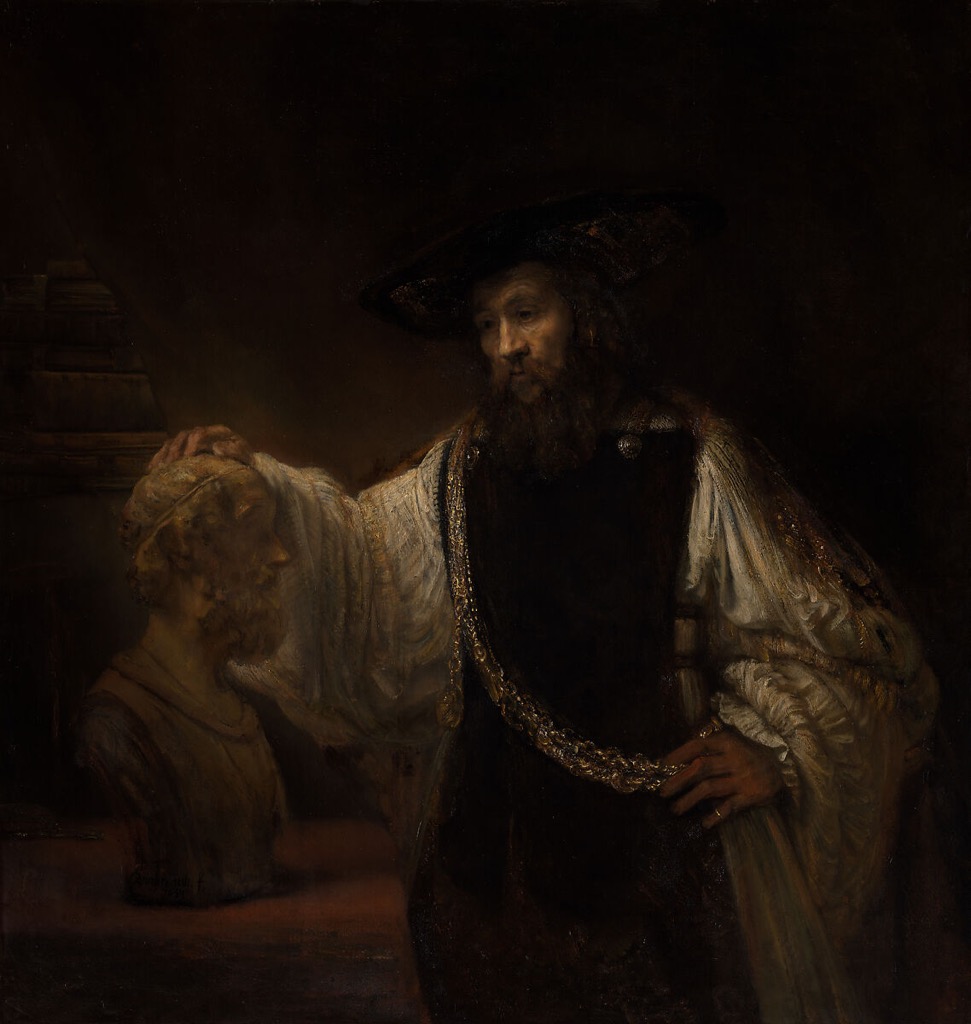
Not all of the characters in the Odyssey live the virtues of Odysseus. As Aristotle would later explain, we choose to cultivate the virtues. Odysseus’s son, Telemachus, does that during his father’s absence. The suitors who sponge off of Odysseus’s wealth and pursue his wife, Penelope, while he is away, choose differently.
Our sometimes puzzling relationship with the divine is also apparent in the poem. Odysseus knows he is aided by Athena, one of the “deathless gods.” But he does not always know which gods oppose him, or why. This confusion mirrors our own experience. The psalmist sometimes wonders why God seems to have withdrawn in our moments of great need. We can’t understand why God doesn’t seem to answer our prayers in the way we think best.
Yet Odysseus does not just turn himself over to fate. He knows he must use his reason to act, even as he calls upon divine aid.
The Odyssey’s virtues are for all of us, not just heroes. The humble swineherd Eumaeus, who tends Odysseus’s herds while the hero is many years away, shows unbending fidelity. When he must dare all to help Odysseus rid his home of the malingering parasites squatting about the place, he shows the same courage as Odysseus.
That need to dare is a paradigmatic feature of human experience, and it comes up throughout the poem. Odysseus must show physical daring repeatedly.
But in my listening, the most striking daring was the constant dare to hope. Penelope, Telemachus, and Eumaeus never give up hope of Odysseus’s return, though the hope dims at times. Odysseus himself never loses hope of seeing Ithaca again even as disasters overwhelm his company and death looms constantly.

The Odyssey presents universals of human nature. These are seen often in Scripture, where the stories of journeys move from the expulsion of Adam and Eve from Eden, to Abraham, to Jacob and his sons, to Moses and the Jews fleeing Egypt, to the Apostles told to leave all and follow Christ. God calls some to dare to voyage far from home with hope but uncertainty about the outcome. Some respond immediately, others have questions. It took Joseph, son of Jacob, many years to understand that his calling to his journey, effected by enslavement, was actually providential.
Western and Christian literature often turns on journeys: Homer and Virgil; Dante’s odyssey through Hell, Purgatory, and Paradise, frequently celebrated here at TCT; Tolkien and Lewis. The latter two even portray Heaven itself as a journey, as in Tolkien’s “Leaf by Niggle” and Lewis’s The Great Divorce and The Last Battle in the Narnian series. And that doesn’t even touch the literature of pilgrimage and tramping.
The call to risk the journey comes in every life. Some gain fame, but most undertake the voyage in hidden and obscure ways, in seemingly ordinary circumstances. It is followed, with special intensity, in silent monastic enclosures, cloistered convents, and hermitages.
Some commentators see evidence in the Odyssey’s universality that all myths spring from some human source, perhaps an evolutionary development. Judeo-Christian revelation can thus be dismissed as one interesting mythology among many.
Because every culture has at least some insight into human nature and the transcendent, it makes sense that different cultural stories share some features. The Odyssey highlights many of those features brilliantly.
We see them today in movies and television shows. Advertisers can play on that universality to great effect for profit. I’ve wondered whether the automaker Honda understood the depth of what they were tapping into when they named their minivan “Odyssey.”
But Judeo-Christian teaching understands both the nature of life – of individuals, peoples, and the Pilgrim Church – as a voyage, with the final good of that voyage in the Creator God. The happy ending is not just a coming home to family and friends – certainly a good outcome – but a full completion that transcends death.
Homer often distinguishes the mortals from the deathless gods, into whose immortality humans cannot finally enter. But there are hints of what Christianity calls “deification,” or our being made divine as we were created to be. And there is some kind of life after death, seen when Odysseus encounters the underworld.
On occasion, Athena takes particular care of Odysseus and his father by making them stronger and grander, more like gods. The effect is not to relieve them of mortality, but to point to a more godlike condition which the divine can bestow on their chosen ones.
Fr. James Schall’s final lecture at Georgetown was titled “The Final Gladness.” It’s a reference to Hilaire Belloc’s (himself a great pilgrim and voyager) return home after a long journey. The return is joyful, but it produces no final gladness.
Man’s grasp of such a final deified gladness would have to await the Redeemer. Homer seemed to catch a glimpse of it. It’s where our odyssey should lead.