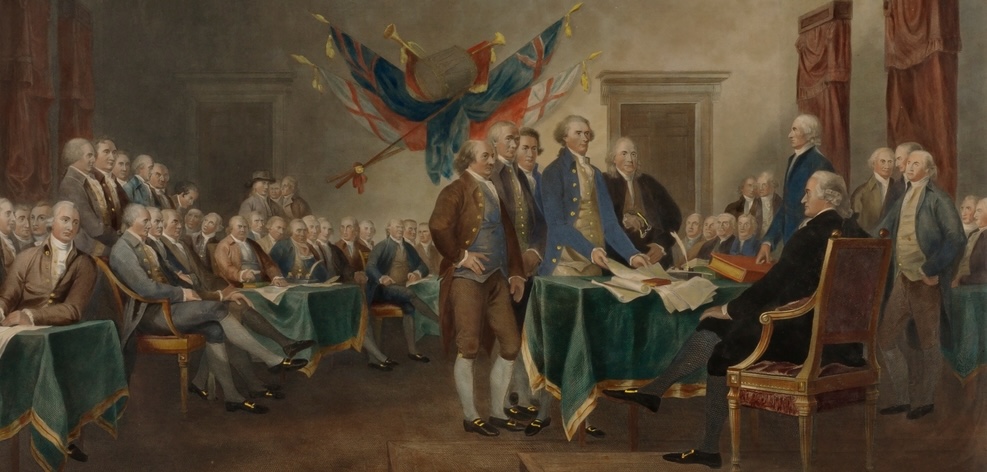
The founders drew on sources, ideas, and principles far older than the Enlightenment, and that will endure far longer than their critics. God willing.
“A republic, if you can keep it” was Ben Franklin’s famous answer when asked what kind of government the framers created at the Constitutional Convention. The founders were men of ideas, but they also took history, democratic practice, politics, and the reality of the human person seriously. They were men of vision, but they were not ideologues in search of the perfect society. Franklin and the founders knew that political liberty was rare, hard to build, and even harder to maintain.
Yet on the 250th anniversary of the American founding, increasing numbers across the political spectrum question its validity: from progressives who view the U.S. Constitution as an obstacle to social reform, to the 1619 Project that sees the founding as an apology for power and economic interests, to right-of-center critics who view the American founding as fundamentally flawed—a “liberalism that failed” and an ideological project of the Enlightenment that is the root of today’s social and cultural problems. Yet it is not only critics who see the founding in an ideological light. Proponents, too, speak of America as wholly unique, a radical vision, the singular source of our religious and political liberty. In contrast to “conservative” critics, they celebrate the Enlightenment vision of freedom as a departure from the tyranny and superstitions of the past.
A common thread is a lack of awareness of the long theoretical, theological political, and historical struggles that undergird the American founding. Too often critics and supporters alike talk about the American founding as some isolated moment that emerged fully formed out of Enlightenment philosophy. But the reality is much more complex, and the historical and theoretical pedigree of these ideas is much deeper and more robust. Robbing them of that pedigree either to critique or exalt the founding robs America of its authentic exceptionalism and weakens what the founders knew and were careful to preserve: As the historian Lord Acton put it, “Liberty is the delicate fruit of a mature civilization.”
Better Than We Realize
John Courtney Murray, drawing on an 1884 statement by American Catholic bishops, argued that the founders “built better than they knew.” Perhaps. But they also knew better than we realize. Yes, they were men of the Enlightenment, but their ideas, their politics, and their appreciation for liberty was rooted deep in history, practice, philosophy, and theology.
We are told by critics and supporters alike that the founders got their idea of social contract from John Locke and that Jefferson simply took Locke’s formula of “life, liberty, and property” and changed “property” to “pursuit of happiness.” There is no doubt that Locke influenced the founders, but the idea of a social contract didn’t start with him. Locke wrote his Second Treatise on Civil Government in 1689, but the “Americans” already had a social contract in 1620, with the Mayflower Compact. And they didn’t invent it either. Social contracts limiting central power were found throughout medieval Europe, from Italy to England.
As M. Stanton Evans pointed out in his accessible book The Theme Is Freedom, the American founders immersed themselves in the study of Greek, Roman, and Jewish and Christian reflections on political and religious liberty. The founders read deeply in Aristotle, Cicero, and Polybius. They knew the ancients worried about tyranny not only of king or oligarch. They imbibed the warnings about how democracy slides into tyranny of the majority.
Christianity played an especially important role. Donald Lutz notes in his essay “The Relative Influence of European Writers on Late Eighteenth-Century American Political Thought” that 34% of the references in the founders’ writings come from the Bible, 22% from Enlightenment thinkers—and only 2.7% come from Locke. As Dylan Pahman and John Pinheiro demonstrate in The Christian Roots of American Liberty, many of the ideas that animate the founders’ writings are derived from the Christian understanding of the person as free and created in the image of God. The idea of “unalienable rights” is the most obvious, but it is not limited to this. The concept of rule of law is found in Augustine and developed in detail in the writings of St. Thomas Aquinas: Law is an ordinance of reason, it must be promulgated, not retroactive, apply to all—and an unjust law is no law at all.
The idea of separation of church and state is not a practical discovery of the Enlightenment for helping people live together in peace in a plural society. Rather, the concept is a specifically Christian idea that comes from Jesus’s words, “Render to Caesar what is Caesar’s and to God what is God’s.” As Lord Acton explains, this idea was a radical departure from the ancient idea that Caesar is god and the state divine. Christianity desacralized the state and thereby limited it. And there are other clear Christian sources arguing for religious liberty. In Liberty in the Things of God, Robert Louis Wilken notes that while Jefferson was not necessarily influenced by Tertullian, he was aware of Tertullian’s letter to Scapula from around AD 197, wherein Tertullian writes:
It is only just and a privilege inherent in human nature that every person should be able to worship according to his own convictions; the religious practice of a person neither harms nor helps another. It is not part of religion to coerce religious practice, for it is by choice not coercion that we should be led to religion.
Scholastic writers like Francisco de Vitoria and Bartolomé de las Casas argued for private property, free exchange, and the consent of the governed. Juan de Mariana wrote that “new taxes should not be imposed on subjects without their free consent, not by force, curses or threats.” Not as pithy as “no taxation without representation,” but the point holds. Alex Chafuen documents the contributions of the late-medieval scholastics in his book Faith and Liberty. These scholastic thinkers influenced Hugo Grotius and the Scottish Enlightenment, including Adam Smith and John Witherspoon, the Scottish Presbyterian minister who taught James Madison and signed the Declaration of Independence. In short, these ideas did not enter the world for the first time through the Enlightenment mind.
The American founders also drew deeply from English tradition. The most obvious is the Magna Carta of 1215. But Adams and Jefferson and many others were students of the common law tradition and the writings of Fortescue, Coke, and Blackstone. The Declaration did not just argue for life, liberty, and the pursuit of happiness; it argued in favor of preserving the “traditional rights of Englishmen” that had been violated by Crown and Parliament. Americans did not have to read Montesquieu to understand why powers must be separated, any more than they had to read Adam Smith to understand the benefits of free trade and the division of labor. They knew this from their own experience with over 160 years of colonial self-government.
None of this is to say that America is not exceptional. Indeed, it is. One of the things that makes it exceptional is precisely that, unlike so many revolutions, the American founding was not a political ideology contrived out of thin air or an unreflective rejection of tradition. It is the exceptional distillation of ancient Western ideas and principles that have enabled the American republic to endure for 250 years. If we forget what the founders knew, we risk losing what they fought to preserve.



![Hegseth Demands Fitness Requirements, Says 'Fat Troops' 'Not Who We Are' [WATCH]](https://teamredvictory.com/wp-content/uploads/2025/09/Hegseth-Demands-Fitness-Requirements-Says-Fat-Troops-Not-Who-We-350x250.jpg)