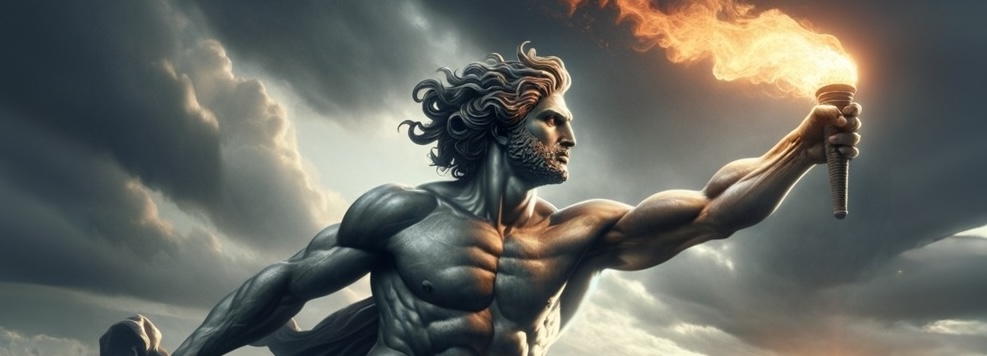
In Rockefeller Center stands the famous statue of Prometheus, the benefactor of mankind, bringing fire from heaven. In Hesiod’s telling, Prometheus is accompanied by Pandora; while Prometheus brings art and learning, she brings all the pains and travails of life, slamming the lid of her famous box before hope can escape. According to Aeschylus, Prometheus, “the lover of mankind,” comes alone in defiance of the tyrant Zeus and brings not only fire but also hope, thus relieving man of “the expectancy of death.” Zeus punishes Prometheus for the crime, but the chorus comforts the deposed god by assuring him of his ultimate triumph and Zeus’s fall.
Mary Shelley’s retelling of the Prometheus myth emphasized its tragic dimension. Dr. Frankenstein, horrified by his own creation, rejects the monster, setting off a series of unfortunate events that conclude in his own death. Rejecting limits, using forbidden knowledge, and hubris all combine to unleash suffering. The gift becomes a curse; or, maybe more accurately, no good gift comes without a curse. Any of us would choose the good thing over the bad thing, but life seldom presents such binaries, so we typically navigate our lives calculating trade-offs. What pain will I have to endure to achieve happiness?
In a recent effort at Promethean optimism, Arthur Herman accepts the god’s gift unequivocally. Combining the myth of Prometheus with that of a “founding,” his book Founder’s Fire: From 1776 to Trump attempts a reevaluation of American history while capitalizing on our nation’s 250th. The book is an unabashedly enthusiastic rendering of our past and present, a kind of Whig interpretation that, despite its many detours, connects the current president seamlessly to the first one. His history celebrates all of fire’s creative and transformative capacities and avoids any discussion of its destructive ones.
Herman underuses the fire metaphor and overuses the “founder” one. While focusing on a rather disparate but well-known group of persons, he also includes “thousands” of “unseen and unsung” persons who contributed to American exceptionalism and the great machinery of American capitalism and mass production, our Promethean gifts.
About halfway through the book, he gives his definition of a founder: “What is a founder? At the most basic level, a founder is someone who sees a problem and offers their own labor to create a solution—even at some risk to themselves.” Throughout the book he adds additional characteristics, the compendium of which does little to clarify his meaning. Founders defy convention, they operate with monomaniacal devotion to a vision, they are highly competitive, they tend to work outside the normal channels (many didn’t attend or finish college), they focus on every detail, they are uncompromising and controlling, they worry about their legacy, they are decisive and aggressive, and to the degree they want to work with others they do so with a small group of loyalists. Perhaps the most significant quality of a founder is that he (and there are no women in Herman’s story) has no respect for limits. The “founder” stands as a microcosm for America itself.
A definition must be broad enough, however, to include all instances of a thing and narrow enough to exclude “false positives” or look-alikes, and Herman’s book fails on this score. I found his use of the word “founder” more distracting than illuminating, especially when used as an adjective. Herman applies the term to anyone who has made a meal or sewn a dress, which I suppose counts if seeing a problem and acting on it makes one a founder.
The capacious definition creates more confusion than clarity. While in his preface Herman carefully distinguishes “founders” from “innovators” and “entrepreneurs,” it’s a marginal distinction at best. Founders might generate new institutions but also revivify old ones. They believe in the power of growth and change, where both growth and change are all flower and no thorn, Herman restating the kind of progressive optimism so characteristic of America. “Founding” always results in action, and again the definition is broad enough to include “crossing a river, an ocean, a mountain range … These are all founding moments.” So was the effort to create “the shining city on a hill,” which resulted from the impulse of “rebels and misfits” (in this case Winthrop) to tackle problems.
Founders do not “rely on traditional rules as a guide to the future” but rely instead on their own genius and force of personality. Some of his choices for quintessential founders seem strangely out of place. He celebrates Diocletian as a great founder, ignoring the fact that the tetrarchy Diocletian created and Herman celebrates soon collapsed and completely glossing over the brutal religious persecutions of Diocletian’s reign. Machiavelli is praised for having written the “how-to manual on becoming a founder,” and while I think The Prince is often misunderstood, it’s infamy has merit. In reviewing the “great age of founding” that took place around the Second World War, Herman singles out “one founder of that era” who towered “above all the rest”: Charles DeGaulle. Robert McNamara also comes in for high praise as a founder. Herman’s paean to the TV show Shark Tank makes one wonder if he received payment for promotional considerations.
The idiosyncratic nature of some of the judgments reveals a common theme: Herman has a special appreciation for those with a vision of “national greatness” buttressed by a powerful military. “The real test of a Great Power,” he writes, “is how it prepares for war. That’s when the true founders and innovators come forward to organize the resources that make it possible to prevail—including creating new weapons for victory.” Perhaps, but the victory, such as it is, results from the weapon’s destructive power, and Herman shows no interest in those on the losing end of these innovations. Not only is this true of “advances” in weaponry but also the disruptions wrought by industrial capitalism.
Indeed, Herman occupies much of the book looking at innovators in science, technology, and especially industry. I was intrigued by his reading of the Gilded Age. Herman criticizes government anti-trust efforts, arguing that large monopolies serve the public good. He defends the Robber Barons as founders who “lived by one simple rule: to make the things that most people needed and wanted to be more affordable. Far from being robber barons, the companies and industries they founded were gifts to the nation, which these men provided at considerable risk to themselves.” Far from “looting or robbing the public, they created industries” that made life for all “healthier and more sustainable.” Furthermore, “far from exploiting or oppressing their workers, they created myriad jobs for millions” while “connecting them together as a single national community from coast to coast.” In Herman’s telling, the Robber Barons must be counted among the great benefactors of mankind, in part because their industry was motivated by the obvious truth that wealth creation was a “limitless” enterprise.
Herman seems especially interested in disruptive technologies such as the railroad, advanced weaponry, and computer technology. Here again he calculates only benefits while ignoring costs, which would include not only encouraging in consumers a desire for products they don’t really need but also the environmental costs and the ways in which these technologies destroyed communities or attenuated basic human capacities. Has the smartphone made us dumber? Herman seems uninterested in that question, only whether it has made its inventors richer. He lauds Henry Ford as one of America’s great founders—indeed, as the person who articulated “the founder’s creed”—but sees the automobile as having no negative externalities. Not for Herman is Russell Kirk’s disparaging of the automobile as a “mechanical Jacobin.”
Herman becomes most excited when he contemplates the essence of industrial capitalism: mass production. “The miracle of mass production” results in and from uniformity, interchangeability, replication, replaceability, speed, and continuous motion. Had Herman considered Tocqueville’s argument, he would realize that these are precisely the things that make democratic man and society so unstable. Whatever the disadvantages that attend the advent of mass production and mass society, Herman is willing to overlook them solely in favor of wealth production. Granted, there is an increase in the standard of living, but at what cost? “Once the miracle of mass production was on the job [as if it were a person], there was almost no limit to what could be produced—in numbers that no one had ever imagined.” Herman’s business founders are not motivated by profit but by delivering the greatest benefits to the greatest number. Business, he insists, is not built on greed but on freedom “and the desire to extend that freedom to others, through products and services that a founder has taken the time and investment to make available to others.” To suggest, as he does, that human beings do not operate from mixed motives seems to me as fallacious as suggesting benefits come with no costs. I also doubt that the above claim holds universally: No doubt some producers of goods are primarily public-spirited, but not all. His claim comes off especially specious when he discusses the creators of social media.
The great enemy of the founder is the manager. Herman’s chapter on the “managerial revolution” holds up fairly well, in part because they are the only people he considers in a negative light. Managers only extend and preserve what founders create. They try to stabilize markets but do nothing to grow them. “Energy and vision were replaced by charts and bureaucracies.” Managers eagerly suppressed “the founder instinct,” finding it disruptive and dangerous rather than transformative. The most popular weapon in the managerial arsenal for suppressing “the genius of founding” was the emphasis on metrics. Bold creative dreams got buried under charts and graphs.
Herman sticks to his narrative theme, however: America carries the torch of the founder’s fire that combines interest and genius into a mode of national greatness. That narrative begins in 1776 and concludes with the Trump administration, a refounding of America that Makes America Great Again. Trump, according to Herman, recognized that America had slipped catastrophically on two fronts: the development of artificial intelligence and maintaining its global preeminence over China. Having served on Trump’s National Security Council, Herman witnessed firsthand Trump’s efforts to relight the founder’s fire. He suggestively titles his chapter on Trump “Toward the Limitless Horizon: Donald Trump, Elon Musk, and the New Golden Age.” Having spent his life battling the managerial mindset and understanding “the founder world from the inside,” Trump displayed “the same energy and determination” as America’s original founders.
One could argue what’s at the top of the list of America’s great international blunders, but there is no doubt in Herman’s mind that America’s “reckless enabling” of China’s rise to power “ranks as one of the most disgraceful episodes in the history of American international and economic relations.” A reset was needed. Trump’s business savvy rubbing against his pugilism resparked American greatness. Trump didn’t try to manage America’s problems but to end them through decisive action. Only the bad faith of his opponents and the quisling Republicans in Congress have kept that spark from bursting into flame. His supporters, meanwhile, realize that Make America Great Again is not simply “a catchy campaign slogan” but “a serious pledge to reconnect America with its entrepreneurial and founder roots, including the original Founding Fathers.”
Herman treats Trump’s “Golden Age” as if it’s a fait accompli, featuring: bringing peace to the Middle East, cracking down on illegal immigration, ending the war in Ukraine, stabilizing the African continent, restoring and reshoring American industry through the sensible use of tariffs, and freeing the private sector from overregulation. This Golden Age will feature “more direct investment in AI” as well as the expansion of its use, the most beneficial result of which will be a rebuilding of “America’s defense industrial base.” Trump will also make America the controller of cryptocurrency and restore the nation’s position as the leader in space exploration. Such is the “perennial power of the founder’s fire” that now belongs to Donald Trump.
The nearly martyred Donald Trump and the martyred Charlie Kirk are “real-life Prometheuses who light our way in a dark and uncertain world.” Herman seems not to have learned much from the Prometheus myth. “I hate all the gods,” Aeschylus has Prometheus say to Hermes. The gods themselves are always reminders of our own limits because, whatever we are, we are not gods ourselves. Nowhere does Herman’s tendency to see Prometheus’s fire as only life-giving seem stranger than in his chapter on the creation of the atomic bomb. After its successful detonation, its main architect declared “I have become death.” Such is the fate of humans who play with fire.