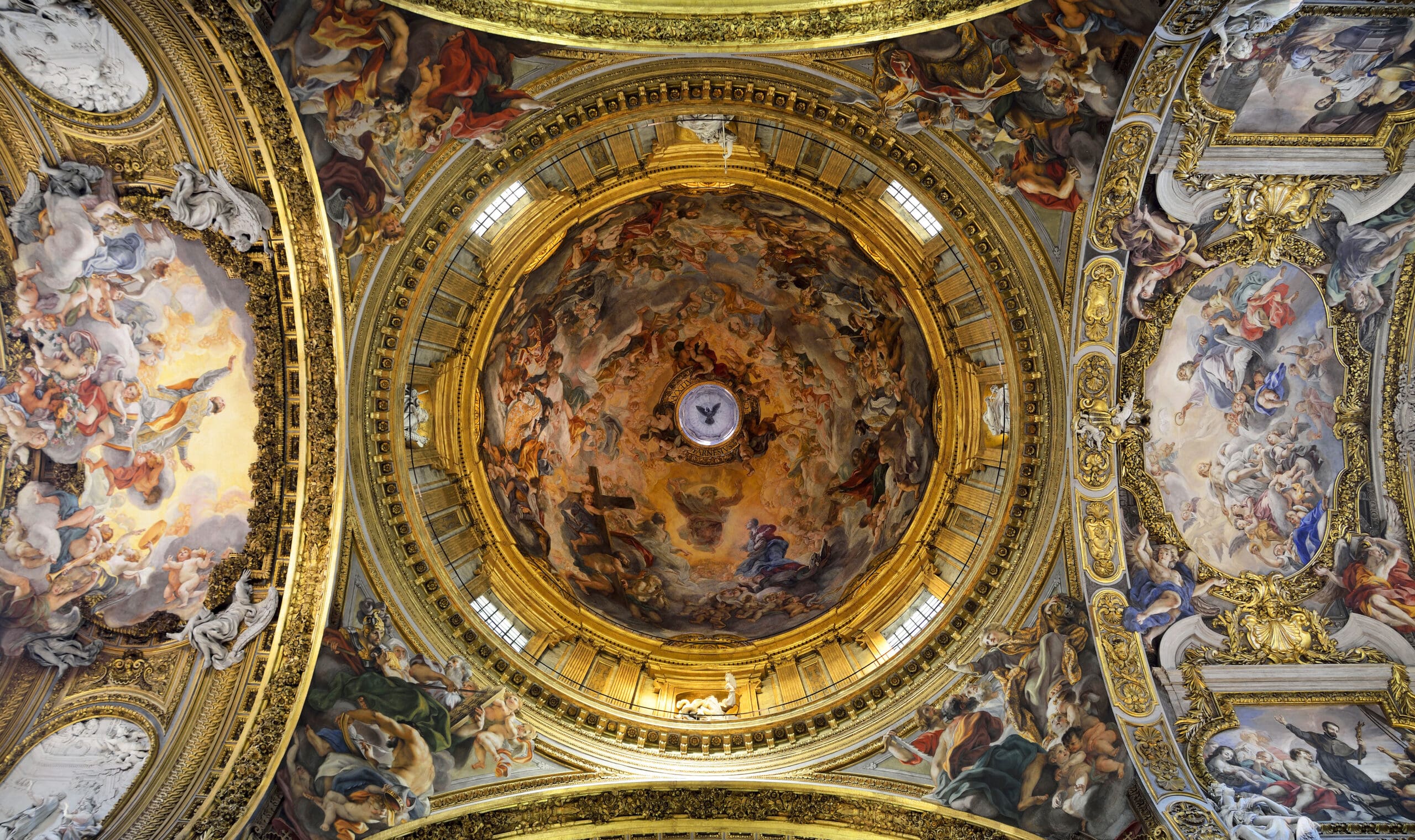
What do you suppose was the favorite site in Rome for the majority of a group of twenty-six college-bound students visiting for the first time? St. Peter’s Basilica and the Vatican Museums? The Colosseum and the Forum? The Trevi Fountain and the Spanish Steps?
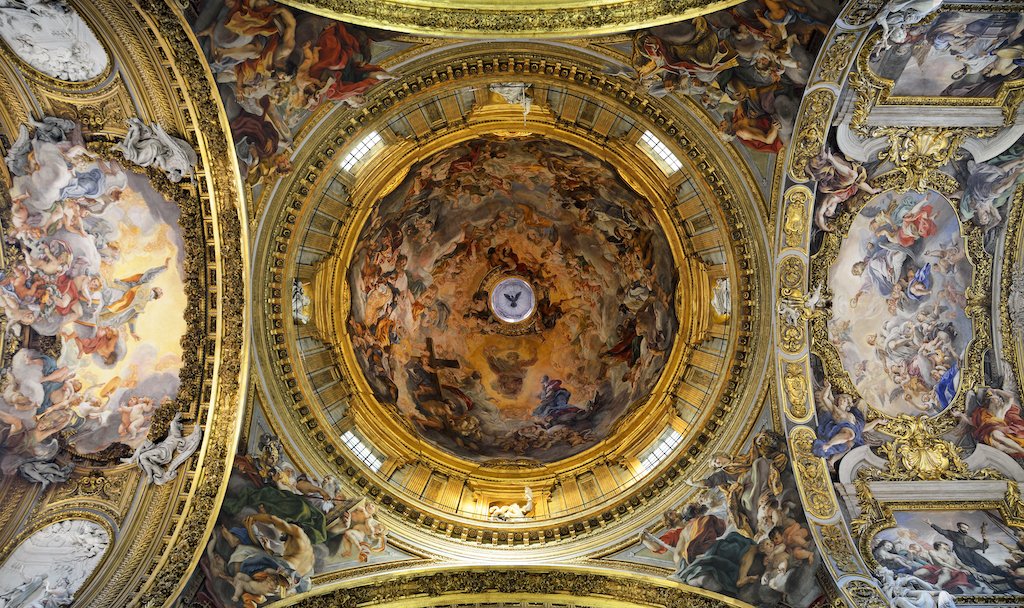
It was the Jesuit Church of the Gesù, the high point of Baroque church architecture. Its golden opulence; its eye-popping “Triumph of the Name of Jesus” fresco ceiling that draws viewers up to Heaven; its magnificent dome; its extravagant twin side altars dedicated to St. Ignatius Loyola and St. Francis Xavier. It’s like nothing late Gen Z American Catholics have ever seen – in person, on screen, or even generated by AI.
These students encountered real beauty for the first time and were overwhelmed by it, so much so that subsequent site visits, as fabulous as they all were, did not supersede the Gesù as the favorite. They were not just impressed; they had an existential experience. “Art moves us because it is beautiful,” wrote Sir Roger Scruton, “and it is beautiful in part because it means something.”
Catholics often remark that beauty should take the lead in evangelizing a culture that is impoverished by the mundane, the functional, and the ugly. Yet we have difficulty translating this talk into practice. We should not have to travel to Rome to experience beauty in architecture, painting, sculpting, décor, or, for that matter, in music or in the Mass.
We know only too well that, immediately following Vatican II, Church leaders, clerical and lay, made a conscious choice to reject the beautiful and impose the ugly. In the false name of renewal, beautiful churches were destroyed so widely – stained-glass windows and high altars were removed, gold tabernacles were replaced and pushed to the margins, marble was covered with wainscoting – that the term “wreckovation” was coined to describe the phenomenon. The same remove-and-replace process destroyed liturgical music and undermined the celebration of the Mass.
The last two decades have seen something of a revival, as a few pastors have raised money to restore splendor to their churches and to their liturgies. But even though some Church leaders now acknowledge the failures of the post-conciliar wreckovation movement, most Catholics still encounter only the ugly and the banal in their local parishes.
Why is this? I submit two interrelated reasons.
First, Catholic leaders of the Boomer generation, even if dissatisfied with the status quo, largely cannot shake the prejudice they imbibed or inherited – ironically, from many pastors of an earlier generation who implemented the stripping of the altars – against pre-Conciliar expressions of beauty. This explains their dismissal of or apathy toward the Traditional Latin Mass, Gregorian Chant, high altars, and ornate liturgical accoutrement. They will not allow these things in their parishes, therefore, or only grant them in limited quantities – an Angus Dei or Salve Regina or Tantum Ergo at benediction, but that’s all.
This leads us to the second reason. Our experiences of beauty (or ugliness) within religious contexts typically are filtered through sources of authority. They choose the designs of churches, the decorations, the music, the vestments – and they tell us what is beautiful, or what we should think to be beautiful.
In their defense, the Boomers are not unique in their prejudice against an earlier artistic expression: one generation often reacts against the tastes of its immediate elders: the 18th century Neoclassical movement summarily rejected the ostentation of the Baroque and Rococo; Cubist painters rejected the whimsical moments captured by their Impressionist forebears; or, closer to home, today’s late Gen X and Millennials are rejecting the wreckovations they grew up with for 19th and 20th-century ecclesial artistic and architectural expressions, through which they hope to encounter the divine.
Naturally, each of these groups think their preferred style is best; their preference often includes efforts to snuff out rival expressions they deem inferior. Here, too, there is a disconnect between talk and action: the Church rightly boasts of her legitimate diversity of expressions (artistic styles, apostolic rites of worship, religious orders, methods of prayer) but in practice she often imposes a strict uniformity on dioceses and parishes.
In a certain way, beauty is necessarily imposed by leaders: once a church design is chosen, for example, subsequent generations are stuck with it, for good or for ill. Beyond this, though, pastors should make room for legitimate expressions of beauty as desired by priests and lay people. What makes beauty in the Church legitimate? Whether it has been expressed within the Church’s long tradition, in the West or the East. What Pope Benedict XVI wrote about the Traditional Latin Mass applies for all Church art and architectural forms: “What earlier generations held as sacred, remains sacred and great for us too, and it cannot be all of a sudden entirely forbidden or even considered harmful.”
In Beauty: A Very Short Introduction, Roger Scruton continues: “Nobody who is alert to beauty, therefore, is without the concept of redemption – of a final transcendence of mortal disorder into a ‘kingdom of ends’. In an age of declining faith, art bears enduring witness to the spiritual hunger and immortal longings of our species. Hence aesthetic education matters more today than at any previous period in history.”
At a time when non-practicing Catholics outnumber the practicing 4 to 1, Church leaders should encourage any expression of legitimate beauty in the Church that can inspire faith – even if a particular form is not exactly to their taste. For if beauty awakens us to redemption and transcendence, it leads us to God, as Pope St. John Paul II promised young people at World Youth Day in 2000: “It is Jesus in fact that you seek when you dream of happiness; he is waiting for you when nothing else you find satisfies you; he is the beauty to which you are so attracted.”


![Hegseth Demands Fitness Requirements, Says 'Fat Troops' 'Not Who We Are' [WATCH]](https://teamredvictory.com/wp-content/uploads/2025/09/Hegseth-Demands-Fitness-Requirements-Says-Fat-Troops-Not-Who-We-350x250.jpg)