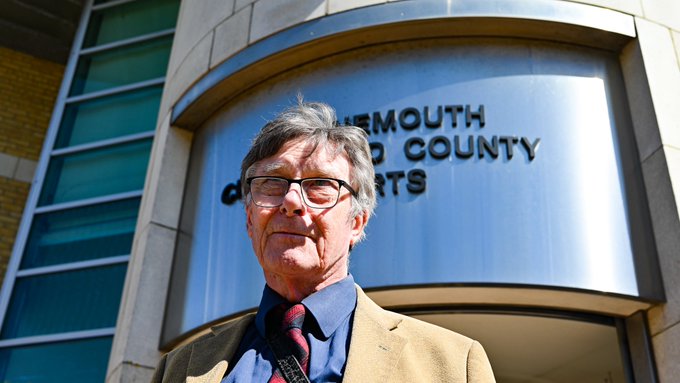
A High Court judge has overturned the conviction of veteran pro‑life campaigner David Skinner, for sending an email with graphic images opposing abortion and censorship zones around clinics in Bournemouth.
Today Mr Justice Saini ruled that although the offence was technically made out under domestic law, maintaining a criminal conviction would amount to a disproportionate interference with freedom of expression and freedom of religion.
The judgment was handed down today in Bournemouth, bringing to an end a criminal proceedings that have lasted nearly 3 years, as the court said the case raised fundamental constitutional issues under Articles 9 and 10 of the European Convention on Human Rights.
HELP LIFENEWS SAVE BABIES FROM ABORTION! Please help LifeNews.com with a donation!
The case was supported from the beginning by the Christian Legal Centre.
In April 2023, Mr Skinner, a long‑standing Christian campaigner opposed to abortion, sent an email to senior public authorities in Dorset, including a police inspector and the Office of the Police and Crime Commissioner and local councillors.
The email formed part of ongoing correspondence with police and local officials about the abortion clinic on Ophir Road in Bournemouth and the enforcement of a buffer zone around the site, which had been imposed in October 2022. In the letter, Mr Skinner set out his moral and political objections to abortion and to what he regarded as unjust policing practices within the buffer zone.
Attached to the email was a document entitled “Reporting Mass Murder Ophir Road”, which contained a few graphic images of aborted foetuses alongside strongly worded arguments condemning abortion and criticising the role of public authorities in enforcing abortion‑clinic buffer zones. This was along side other graphic images from the holocaust.
The police recipients reported experiencing ‘distress’ after opening the attachment. Following complaints, the Crown Prosecution Service charged Mr Skinner under communications legislation, alleging that he had sent electronic communications that were grossly offensive and intended to cause distress.
Mr Skinner accepted that he had sent the email and acknowledged that the images were offensive, but denied any intention to harass or threaten anyone. He maintained that the communication was a political and religious statement directed at public officials responsible for policing and public policy.
He was convicted at first instance.
High Court judgment
Originally fined (in total £3,840) and convicted by the District Judge sitting in Poole Magistrates court, today, the High Court judge allowed Mr Skinner’s appeal. The High Court ruled that while the elements of the offence were technically proved under domestic communications law, upholding the conviction would be incompatible with his human rights.
“This is a case about freedom of expression and freedom of religion,” the judge said.
The court accepted that Mr Skinner acknowledged the images were “offensive” and even “grossly offensive”, and that the offence was therefore prima facie established in law.
However, the judge stressed that this was not the end of the analysis.
The court focused on the fourth limb of the Bank Mellat proportionality test, the balancing of competing rights, and found that a conviction would not be proportionate in the circumstances.
In assessing proportionality, the judge noted that Mr Skinner is a long‑standing Christian campaigner vehemently opposed to abortion, and that his email had to be understood in its wider political and moral context.
The court referred to Mr Skinner’s presence in the buffer zone outside the abortion clinic in February 2023 with fellow campaigner Steve Green, and to his ongoing engagement with authorities about the policing of the buffer zone.
Emphasising that each case turns on its own facts, the court rejected the Crown’s reliance on earlier case law, finding the authorities cited to be distinguishable.
The judge placed particular weight on the fact that the recipients of the email were public officials, including an elected Police and Crime Commissioner and a senior police inspector, who were therefore subject to a higher threshold of tolerance than private individuals.
The court also noted that Mr Skinner had been corresponding with Temporary Inspector Fern Graham about buffer‑zone policing, including references to the Peelian principles of policing, and that the email formed part of a broader dialogue with decision‑makers.
In considering Mr Skinner’s use of imagery, the judge recognised the long‑established role of powerful images in public debate.
“We recognise the power of the image to carry a message in its most persuasive form,” the court said, referring to analogies with graphic cigarette health warnings and the open‑casket funeral of Emmett Till following his murder in 1955.
While acknowledging the distress experienced by those who received the email, the court concluded that allowing the conviction to stand would not be a proportionate outcome.
“We do not take away from the offence that the complainants would have experienced on receiving the letter,” the judge said. “Nevertheless, we find that it would not be a proportionate interference to allow the conviction.”
The appeal was allowed, the conviction quashed, and a defence costs order was granted covering legal fees and travel expenses.
Profound moral importance
Mr Skinner, an 80‑year‑old Bournemouth resident with no previous criminal record, said:
“I am deeply grateful that the court has seen this case for what it really was. I never intended to harass or frighten anyone. I was raising matters of profound moral and public importance with those in authority.
“This prosecution should never have been brought. It has taken a heavy toll on me, but I hope this ruling will protect others who wish to speak out peacefully on matters of conscience without fear of being criminalised.”
The Christian Legal Centre is now calling on prosecuting authorities to urgently review how communications offences are being applied, particularly where expression engages conscience, Christian belief, or political debate.
Andrea Williams, chief executive of the Christian Legal Centre, said:
“This is a vital and principled ruling. The High Court has confirmed that even where speech is confronting or deeply uncomfortable, the criminal law cannot be used as a shortcut to silence lawful expression on matters of public interest.
“David Skinner was targeted for expressing sincerely held Christian beliefs to public authorities about abortion and buffer zones. Today’s judgment reasserts that in a free and democratic society, the answer to speech we dislike is more debate, not criminal prosecution.
“This case should act as a warning to police and prosecutors against misusing communications laws to chill political or religious speech. David’s ordeal lasted far too long, and we hope this judgment will prevent similar injustices in future.”