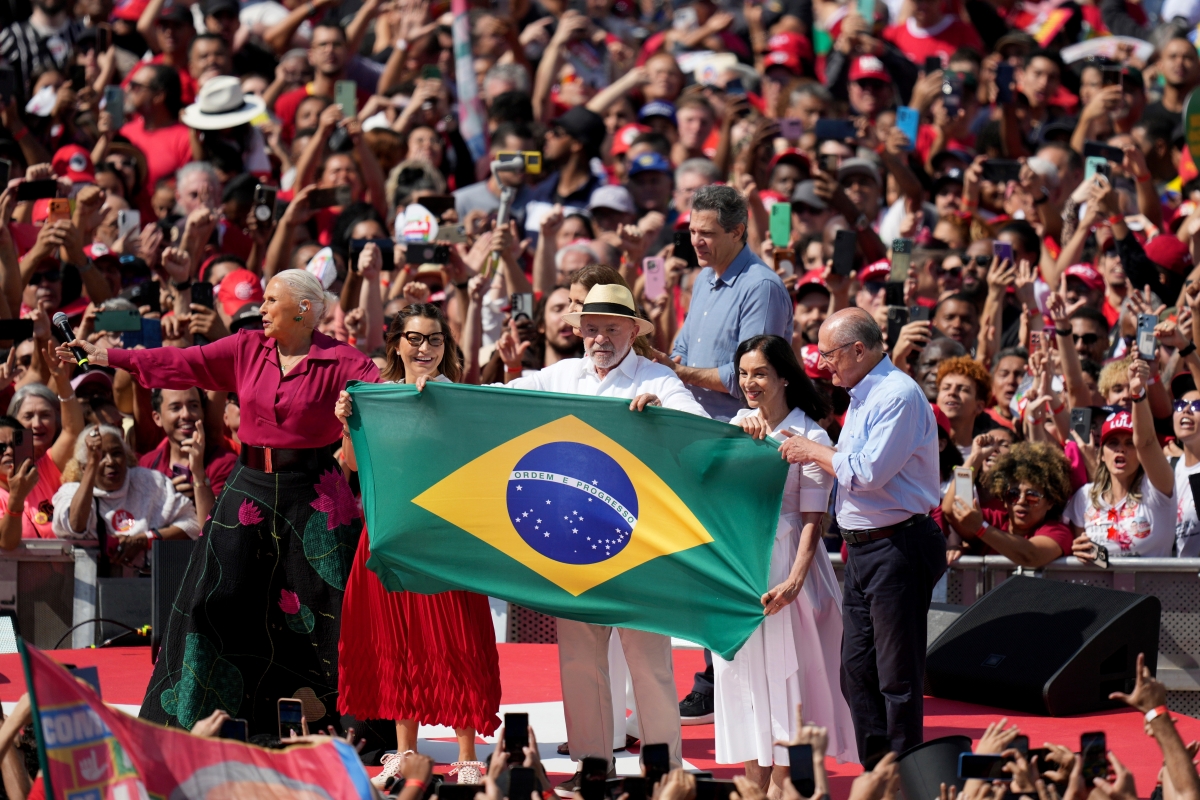
As the October 2026 presidential elections loom in Brazil, the international communist movement is fighting desperately to preserve its most important operational base in the Western Hemisphere. Under the third presidency of Luiz Inácio “Lula” da Silva, the South American giant has become the strategic headquarters for the coordinated advance of socialism across Latin America—a project whose architects have never hidden their ultimate goal of rebuilding what was lost when the Soviet empire collapsed. That project is now under severe pressure from a resilient Brazilian resistance led by the Bolsonaro family and its allies, even as the regime in Brasília escalates its campaign of judicial tyranny, censorship, and political persecution.
The stakes could hardly be higher for the United States. A consolidated communist beachhead in Brazil — home to more than 200 million people, vast natural resources, and a strategic position controlling much of the South Atlantic — would threaten American national security for generations. The same networks that once dreamed of a “Union of Latin American Socialist Republics” continue to operate openly through the São Paulo Forum, the organization Lula co-founded with Fidel Castro, the Sandinistas, and the mass-murdering Marxist narco-terror group FARC. Their success or failure in the coming months will reverberate far beyond Brazil’s borders.
The São Paulo Forum: Strategic Command of the Red Tsunami
Few institutions better illustrate the continuity of the communist project than the São Paulo Forum. Founded in 1990 in the Brazilian city that gave it its name, the Forum was the explicit response of Latin America’s Marxist parties and guerrilla movements to the fall of the Berlin Wall. As Lula himself later explained, the Left had previously believed “the only possible way to achieve power was violent struggle.” The Forum offered a new strategy: electoral conquest combined with the cultivation of criminal and terrorist networks that would provide both funding and muscle.
The late Brazilian philosopher Olavo de Carvalho, who went on to become President Jair Bolsonaro’s right-hand man during his term in office, offered warnings about the Forum for years. Unfortunately, they went largely unheeded by Western elites even as subversives within the U.S. government and the Deep State aided and abetted its takeover of the region. “The São Paulo Forum,” explained in a 2010 interview with this writer for The New American, “is the strategic command of the communist and pro-communist movement in the continent.”
Bringing together more than 100 legal parties and social movements alongside terrorist groups such as the Revolutionary Armed Forces of Colombia (FARC) and Chile’s MIR, the Kremlin-backed organization at one time controlled almost two thirds of Latin America’s governments. Legal organizations provided political cover; criminal networks supplied the money from drug trafficking, kidnapping, and extortion. The goal was straightforward: to recover in Latin America what had been lost in Eastern Europe, as the Forum itself recorded in its 1997 minutes.
Lula chaired the Forum for more than a decade. Under his first two presidencies (2003–2010), Brazil became the financial and diplomatic engine of the “Pink Tide” — what this magazine has long called the Red Tsunami. Venezuelan oil money, Cuban intelligence expertise, and Brazilian diplomatic cover combined to install allied regimes across the region. Even after Lula’s 2018 imprisonment on corruption charges (he helped steal money from the state-owned oil giant for himself and communist allies across Latin America) and Jair Bolsonaro’s 2018 victory, the Forum never disbanded. With Lula’s return to power in 2023 after an election marred by massive fraud, Brasília resumed its role as the movement’s principal base of operations.
Lula has made no secret of his ideological affinity. At a 2023 São Paulo Forum meeting he declared that being called a communist or socialist “does not offend us.” “On the contrary,” he continued, “it makes us proud.” The statement was not rhetorical flourish. It accurately reflected the continuity of a project that has always subordinated short-term economic pragmatism to long-term revolutionary consolidation.
Alliances With Moscow, Havana, and Beijing
Lula’s foreign policy has been a study in alignment with the principal enemies of the free world. His repeated visits to Moscow — including attendance at Vladimir Putin’s Victory Day parade — have drawn sharp criticism even from Brazil’s mainstream media. He has repeatedly echoed Russian and Chinese talking points on the war in Ukraine, suggesting that Kyiv should cede territory and that the United States is primarily responsible for the conflict. Brazil under Lula has remained a major buyer of Russian energy products and a vocal opponent of Western sanctions.
Relations with the Cuban dictatorship remain intimate. Lula’s personal friendship with Fidel Castro dated back decades; the Cuban Communist Party was a co-founder of the São Paulo Forum. The same pattern holds with the Chinese Communist Party. Lula has deepened economic dependence on Beijing while praising the “multipolar” world order that both Moscow and Beijing (and many Western globalists) promote as an alternative to American leadership. According to a U.S. congressional report released in February, the regime is even hosting a secret CCP military space base in Bahia.
These relationships are not mere diplomatic diversification. They form part of a coherent strategy to weaken U.S. influence in its own hemisphere while shielding the Forum’s member regimes from accountability for human-rights abuses, drug trafficking, and electoral fraud. As de Carvalho observed years ago, the revolutionary movement long ago perfected the art of using internal dissidence and tactical moderation as camouflage. Lula’s occasional “market-friendly” gestures serve the same purpose that Lenin’s New Economic Policy once did: temporary concessions to buy time for the consolidation of power.
Deep State & Globalist Support
The rise and restoration of Lula and the São Paulo Forum did not occur in a vacuum. Powerful forces within the U.S. establishment and the broader Western globalist apparatus have systematically aided, abetted, and shielded the communist network for decades — often while American taxpayers footed the bill and official Washington pretended the threat did not exist.
At the center of this enabling network stands the Council on Foreign Relations (CFR), the premier brain trust of the American Deep State. For years the CFR’s Latin America portfolio was directed by Julia Sweig, a figure U.S. counterintelligence officials identified as an “agent of influence” for the Castro dictatorship. Sweig enjoyed unprecedented access to Cuban archives, praised convicted Cuban terrorists in her writings, and secured exclusive interviews for Western journalists with Fidel Castro himself. The same organization that once helped install Castro — through New York Times propaganda by CFR member Herbert Matthews and State Department betrayal of anti-communist forces — continued to whitewash the Forum’s “Pink Tide” as a harmless social-democratic experiment. As countless Brazilian critics repeatedly warned, American elites deliberately camouflaged Lula as a “moderate” man “of the people” while the Forum consolidated power across the continent. During a 2009 G20 summit in London, Obama called Lula “the most popular politician on Earth.”
A former U.S. ambassador, speaking anonymously because the truth carried “huge” professional risks, finally stated the obvious in a piece for the Miami Herald: Brazil under Lula’s Workers’ Party forms part of “a powerful network of socialist and communist forces” bent on imposing tyranny. “All you have to do is read the records of the São Paulo Forum,” the ambassador declared, noting that Lula’s allies — Hugo Chávez and Nicolás Maduro in Venezuela, the Castros in Cuba, Evo Morales in Bolivia, and others — are “the enemies of the United States.” Cuban influence inside Brazil, he added, is “covert but very intense.” Yet successive administrations ignored or actively rewarded this reality.
The Obama years provided the clearest illustration. In 2010, the administration transferred $2 billion in American tax dollars and advanced technology to Petrobras, Brazil’s state oil giant, even as U.S. domestic offshore drilling was throttled. Obama proclaimed that America wanted to be “one of Brazil’s best customers” once the oil began flowing — effectively subsidizing the economic base of a Forum-aligned government.
The same White House engineered the delisting of Castro’s terror regime from the U.S. State Sponsors of Terrorism list, legitimizing the very dictatorship that co-founded the São Paulo Forum with Lula. Obama’s State Department and Secretary of State John Kerry then midwifed the “peace” deal with Colombia’s FARC narco-terrorists — founding members of the Forum — granting amnesty, political power, and continued control of drug routes to mass murderers. U.S. taxpayers poured nearly half a billion dollars into Colombia in a single year to underwrite the surrender.
That was nothing new. President Bill Clinton’s “Plan Colombia” offered economic and military aid to the Colombian government on the explicit condition that criminal organizations “of a political nature” be spared. “The result was that the old cartels were destroyed and the FARC became the absolute rulers of drug trafficking in the continent,” explained Carvalho. “In reality this kind of ‘war on drugs’ is a war that favors the Left against Latin America.”
Globalist foundations and United Nations organs reinforced the U.S. Deep State’s efforts. Michelle Bachelet, later UN High Commissioner for Human Rights, faced credible allegations of receiving campaign funds directed by Lula from a connected Brazilian construction giant — money ultimately traced to the same corruption and narcotics networks that bankrolled Forum campaigns across the region. When Jair Bolsonaro finally shattered the Forum’s momentum in 2018, the reaction from these circles was hysterical. Establishment media and CFR outlets branded the newly elected president a “far-right” extremist while recycling discredited smears; the same voices that had excused Lula’s alliances with terrorists and dictators now warned of impending “fascism” in Brasília.
This pattern of selective blindness and active subsidization continued into the Biden era. High-level American officials pressured Brazilian military leaders to accept the disputed 2022 results and transfer power to Lula, framing resistance as a threat to “democracy.” The Deep State’s preferred outcome — a restored Forum beachhead under Lula — was secured. The result is the very judicial dictatorship and regional radicalization now unfolding. Americans who wonder how a convicted corruption figure and lifelong communist operative regained the presidency of Latin America’s largest nation need look no further than the long record of America’s own globalist establishment.
Judicial Tyranny and the War on Dissent
Inside Brazil, the Brazilian people have paid the price for the Deep State’s machinations and the foreign interference. Freedom is rapidly being extinguished. The consolidation of power has taken the form of what critics call a full-blown judicial dictatorship. Supreme Court Justice Alexandre de Moraes has emerged as the regime’s principal enforcer. Operating with extraordinary powers and virtually no accountability, Moraes has ordered the censorship of social-media accounts, the freezing of assets, the confiscation of passports, and the pretrial detention of journalists, congressmen, and ordinary citizens whose only offense was criticizing the government or the supposed 2022 election results.
A coalition of Brazilian lawmakers who traveled to Washington in 2024 put the matter bluntly. “Americans must understand that Brazil is no longer a democracy,” Federal Congressman Gustavo Gayer told this writer at the time. Fellow deputy Eduardo Bolsonaro and others described a “dictatorship of the judiciary” that jails people for their opinions while releasing actual criminals. U.S. Representative Chris Smith (R-N.J.), chairman of the House Global Human Rights Subcommittee, documented “very large scale” human-rights violations, including the political abuse of legal procedures, persecution of journalists, and the use of “disinformation” laws as tools of censorship. Smith even announced plans for a “Brazil Democracy, Freedom and Human Rights Act” to address the growing crisis.
The parallels between the January 6, 2021, events at the U.S. Capitol and what happened in Brazil are impossible to ignore. On January 8, 2023, thousands of Bolsonaro supporters — egged on and even led by agents provocateurs as police did nothing — entered government buildings in Brasília to protest the stolen election. Lula, his minions, and his international allies immediately branded the episode a “coup attempt” and used it as the pretext for a sweeping crackdown. Thousands were arrested; many remain imprisoned years later under conditions that human-rights observers have described as abusive. The narrative of a coordinated “coup” has been the primary justification for the subsequent prosecution of Bolsonaro himself.
In September 2025 a Supreme Court panel sentenced the former president to 27 years and three months in prison for allegedly plotting to overturn the 2022 election results. He began serving the sentence in November 2025. In June 2026, the same court sentenced his son Congressman Eduardo — who now lives in the United States — to four years and two months for seeking American sanctions against the judges overseeing his father’s case. The pattern is familiar to anyone who has studied communist show trials: The law is applied selectively against political enemies while the regime’s own allies enjoy impunity.
Homeschooling families have not been spared. Courts have imposed actual jail sentences on parents for “intellectual neglect” when they refuse to submit their children to the state’s ideological extremism. The message is clear: The regime intends to control the formation of the next generation, and everything else.
In a stunning abuse that sent shockwaves around the world, a Brazilian court sentenced parents Audato and Ieda Denardi to 50 days in prison for the “crime” of homeschooling their daughters. What appears to have really infuriated the court: The family refused to submit to the Brazilian regime’s mandated gender, sex, and tolerance programming.
By all accounts, the daughters, Alice (15) and Lorena (11), were thriving, learning multiple languages, advanced piano, and reading dozens of books per year. An independent educational psychologist found no evidence of neglect. Even the prosecutor sought to free the parents. Yet the court convicted them of “intellectual neglect” anyway.
In an emotional interview set up with help from high-level authorities in Washington, D.C., the parents and their Brazilian attorney explained that they do not yet know what will happen with the case. However, they know they committed no crime, and they remain hopeful. The parents also vowed never to surrender in this battle.
“The communist indoctrination in the schools — and that is the reality — seeks to capture our children,” he said. “But we will not give up. The right to educate our children is a natural right that has existed from the beginning. We have a right to care for our children. We are the parents. So we are very hopeful. We just hope this moment will pass by as quickly as possible because we really are doing what is best for our children.”
The 2022 Election and the Question of Legitimacy
The foundation of the current regime remains the October 2022 presidential election. Jair Bolsonaro and his supporters raised serious questions about the integrity of Brazil’s fully electronic voting system long before the vote. Eduardo Bolsonaro, the congressman who received the most votes in Brazilian history, explained the problem in a 2021 interview with this magazine: “You vote in an electronic ballot box, and you have to pray for the 10 or 20 bureaucrats that count your vote in a central [location] in Brasília so they don’t change the things.” He and his allies sought a simple reform — printed paper ballots that could be audited — only to be blocked by the electoral authorities and the courts.
Federal Police investigations later confirmed that a hacker had penetrated the Superior Electoral Court’s systems for months surrounding the 2018 election. The same institutions insisted the 2022 system was impregnable. When Bolsonaro lost by the narrowest of margins, the Biden administration moved quickly to lock in the result. U.S. officials, including Defense Secretary Lloyd Austin, conducted a sustained pressure campaign on Brazilian military leaders warning of severe consequences if they failed to accept Lula’s “victory.” High-level American engagement helped ensure a transfer of power that many Brazilians — if not most — still regard as illegitimate.
In fact, when this writer was in Brazil last November to cover the UN climate summit, the desperation of Brazilians was off the charts. After learning that our team from The New American was there for journalism, multiple everyday Brazilians — from Uber drivers and security guards to waiters at restaurants — begged us to have the U.S. government protect them from the rogue regime. Virtually everyone we talked to outside the fenced area of the UN summit regarded Lula as a dictator who stole the election.
The role of external actors in forcing Bolsonaro out so Lula could seize power did not end with the Biden administration. Globalist networks and left-wing foundations long sympathetic to Lula’s far-left Workers’ Party and the São Paulo Forum provided political and financial support that strengthened Lula’s position. The pattern mirrors the broader effort, visible across Latin America, to prop up Forum-aligned governments whenever popular resistance threatens their hold on power.
Resistance and the Cultural Counteroffensive
Despite the repression, the Brazilian resistance has not been broken. The Bolsonaro family remains the focal point of opposition. Even from prison, Jair Bolsonaro retains enormous symbolic authority. His sons continue to organize politically. Massive public demonstrations — some of the largest in Brazilian history — have repeatedly shown that a substantial portion of the population rejects the current direction of the country.
Particularly encouraging is the quiet cultural revival underway. Across Brazil a growing number of families and educators are turning to classical education, great-books curricula, and traditional Christian formation as alternatives to the state’s ideological schooling. Homeschooling is surging, with a key attorney for the homeschooling movement telling this writer that some 75,000 families are already educating their children at home despite horrendous persecution in many cases. This movement, inspired in part by the intellectual legacy of Carvalho, represents a long-term challenge to the cultural hegemony the Left has sought to impose. It is one of the few bright spots in an otherwise darkening landscape.
Polling in the run-up to the October 2026 election has been volatile and is conducted under conditions of severe media and judicial bias. While early polls showed former Senator Flavio Bolsonaro (one of Jair Bolsonaro’s sons) ahead as recently as April, that is no longer the case. Regime-friendly surveys have shown Lula leading over Bolsonaro, with a late July poll by Datafolha showing Lula winning by four to five percentage points. Yet the intensity of the regime’s repression itself testifies to its underlying weakness. A government confident in its popular support does not need to jail the opposition leader, silence critics on social media, or criminalize parents who educate their own children.
National Security Imperatives and the American Response
For the United States, the implications are direct. Brazil is the dominant powerhouse of South America. A Brazil locked into the São Paulo Forum’s orbit becomes a platform for Communist Chinese economic penetration, Russian diplomatic influence, and the expansion of transnational criminal networks that already flood American streets with everything from fentanyl to subversive agents of influence. The same ideology that produced Venezuela’s collapse and Cuba’s murderous police state is being normalized in the largest country in Latin America with the active assistance — or at least the studied indifference — of previous U.S. administrations.
What can be done within constitutional bounds? It was not immediately clear what effect, if any, Trump’s tariffs on Brazil, supposedly due to unfair trade practices, will end up having on voter sentiment. However, a Trump administration and a serious Congress have several instruments available. First, public diplomacy must end the fiction that Brazil under Lula remains a normal, civilized, Western-style nation. Official recognition of the scale of human-rights abuses, including the political imprisonment of opposition leaders and the ruthless silencing of free speech, would strip the regime of any semblance of international legitimacy. Even a public statement from the president indicating that the world is paying attention would be a good start.
Second, targeted sanctions against judges and officials who orchestrate censorship and arbitrary detention — building on actions already taken against Alexandre de Moraes — can raise the personal cost of tyranny. Third, support from the American people for authentic Brazilian civil society, independent media, and educational initiatives that promote classical liberal values can strengthen the domestic resistance without violating non-intervention principles. Fourth, Congress can condition any future cooperation on measurable improvements in electoral integrity, free speech, and the release of political prisoners.
Americans themselves can help by amplifying the voices of Brazilian dissidents, supporting organizations that document the repression, and refusing to accept the media narrative that equates resistance to communism with “extremism.” The battle for Brazil is not a distant foreign quarrel. It is a central front in the larger struggle against a revolutionary movement that has never abandoned its ambition to dominate the Western Hemisphere. Conquering Latin America is only a step. The end goal is to grab the entire Hemisphere — with the United States and Canada as the ultimate prize.
Ultimately, Brazilians and Latin Americans will have to secure their own freedom. America can be a shining city on a hill, and wish Brazilians well, but the U.S. government cannot bring liberty to other nations. Critical to restoring freedom, according to de Carvalho, is making sure communist conspirators are punished under the law for their reign of terror and their criminal activities from Havana and Caracas to Brasilia and beyond. “The Forum can only be stopped if the legal political parties in its membership are taken to court for the criminal activities covered up and protected by the organization,” explained de Carvalho after noting that after the supposed collapse of the Soviet Union, the murderous actors responsible escaped unpunished.
But the U.S. government can play a role by refusing to help Lula and his network. Carvalho warned that the Forum’s power grew precisely because mainstream institutions in both Latin America and the United States refused to take it seriously for decades. That refusal is no longer sustainable. The communist movement is fighting to preserve its Brazilian base because it understands what is at stake. Americans who value their own liberty must understand it as well. The outcome of the coming Brazilian election — and the broader contest for the soul of Latin America — will help determine whether the Red Tsunami continues or finally begins to recede.


![Hegseth Demands Fitness Requirements, Says 'Fat Troops' 'Not Who We Are' [WATCH]](https://teamredvictory.com/wp-content/uploads/2025/09/Hegseth-Demands-Fitness-Requirements-Says-Fat-Troops-Not-Who-We-350x250.jpg)