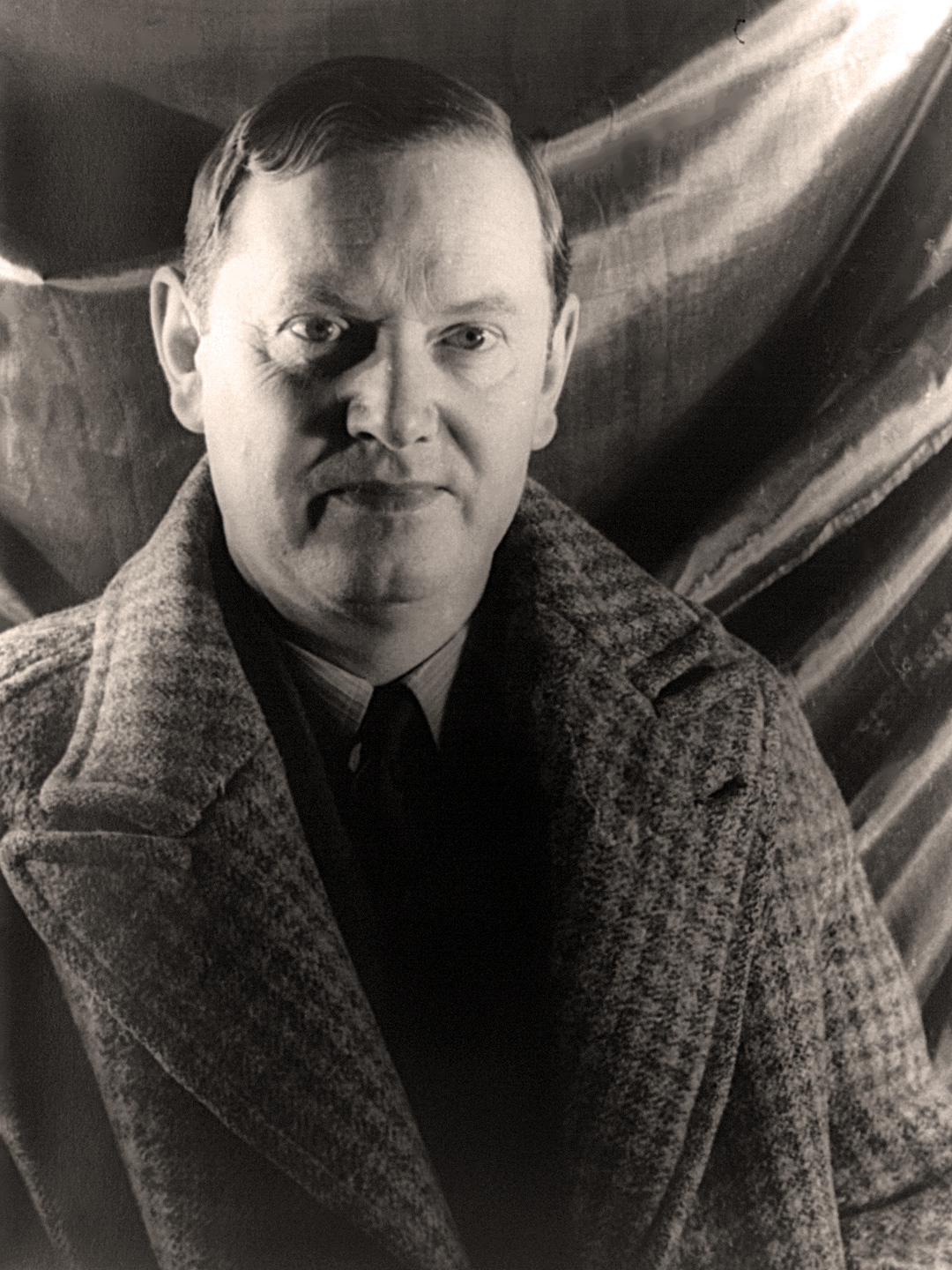
This month makes 60 years since the death of the British author Evelyn Waugh, known both for his superb satires on the modern world and his ability to communicate the beauty and goodness of Catholicism. So, a sharp irony marked his life. Satire is not the most charitable of forms. And it informed his ambiguous attitudes towards the United States of America.
For years after World War II, Britain suffered under severe hardship as rationing not only continued but grew tighter in some respects, even into the 1950s. And Waugh found escape when he was paid handsomely for a 1947 trip to Los Angeles, funded by MGM, to discuss filming Brideshead Revisited.
The Brideshead project did not work out; the producers and writers at the studio had no grasp of the story’s real meaning and wanted to turn it into a more traditional romance. Perhaps that is for the better because Brideshead, arguably one of the 20th century’s greatest Catholic novels, would have needed to be sanitized, ironically owing to a film production code created with a heavy Catholic influence.
On this trip, Waugh tired of studio meetings and found his creative thoughts moving elsewhere after he discovered Forest Lawn Memorial Park and studied it with a morbid fascination. For a writer with the gift of satire, it was perhaps the perfect foil, and his novella The Loved One was born.

Subtitled “An Anglo-American Tragedy,” the book tells the story of Dennis Barlow, a young British poet who failed as a writer in the film industry and, not desiring to return home in shame, takes a job at The Happy Hunting Ground, a funeral home and cemetery for pets.
When his roommate takes his own life, and Barlow is tasked with preparing the funeral arrangements, he becomes smitten with a proto-Valley Girl: “her eyes greenish and remote, with a rich glint of lunacy” – who works as a cosmetician at Whispering Glades, a famous Hollywood mortuary for the wealthy and famous, modeled closely after Forest Lawn.
He hides his humiliating employment from her and offers her love poems easily copied from the classics. They are soon engaged, but her discoveries of Barlow’s plagiarism and true position, and her subsequent rejection of him, catapult the story to a hilarious conclusion – hilarious, that is, for those of us with a dark sense of humor.

At the same time, the little book skewers its many targets broadly and well: Hollywood, pet owners, the British expat enclave, the luxury mortuary business, pulp journalism, and America’s home-grown religions. In essence, Waugh takes his satirical sword to all of modern America as lived in postwar Los Angeles.
It was understandable. For Waugh to travel to America from a country still rationing and rebuilding from the war, and to see how luxuriously even the dead are treated, must have been a shock. In one letter, he noted the story “should not be read as a satire on morticians but as a study of the Anglo-American impasse with the mortuary as a jolly setting.”
Later that year, Waugh’s second trip to America would yield decidedly different fruit, and he rightly avoided California in his return visit. He was traveling for another purpose, researching a long essay for Life magazine on the state of the Catholic Church in America. Waugh’s article, “The American Epoch in the Catholic Church,” would appear in Life in September 1949.
Waugh focused his late 1948 visit on Catholic communities and leaders across the East Coast, the South, and the Midwest. Postwar America experienced a boom for Catholicism, and Waugh did not just capture it but sought to put it in perspective. Given American history, it was ironic that a country so anti-Catholic in certain ways would eventually see the Catholic Church become the largest religious group in the country.
Waugh cited the Founding Fathers’ opposition to the Quebec Act and noted the “individual qualities” that are regarded as peculiarly American: “their endemic revolt against traditional authority, their respect for success and sheer activity, their belief that progress is beneficent, their welcome of novelties, their suspicion of titles and uniforms and ceremonies, their dislike of dogmas that divide good citizens and their love of the generalities which unite them, their resentment of discipline – all these are unsympathetic to the habits of the Church.”

And yet the mid-20th Century, he believed, marked the “American epoch” for the Church, perhaps in the same way that, today, many Catholics look to Africa and Asia to see a place where the Church is alive and expanding.
Waugh was not wrong in his assessment. In America, he saw a Catholic Church in remarkable postwar growth. Waugh visited the University of Notre Dame in Indiana and dined with Dorothy Day in New York City. Of special interest, he met with Thomas Merton at his Kentucky abbey. Waugh edited Merton’s best-selling 1948 autobiography, The Seven Storey Mountain, into a slimmer volume for U.K. readers, and the two corresponded into the 1950s.
Now, a quarter-century into the new millennium, it is easy to be touched with some sadness looking back at Waugh’s essay, for the American Church he celebrated at that time has become greatly reduced in stature, starting with the massive cultural upheaval of the 1960s. The American Trappists whom Waugh esteemed so highly are also in straits. Among the signs of that distress, St. Benedict’s Abbey in Snowmass, Colorado, founded in 1958, is closing and selling its 3,700-acre property to a tech billionaire for $120 million.
We may be thankful that Waugh would not live to see the decimation of the Church in America. As someone who satirized the modern world so effectively and understood its transitory nature, he saw the Church as a bulwark against the insanity he enjoyed mocking. In America, he encountered the best of both worlds for a Catholic writer – much fodder for his satire and some bright rays of hope for the Church he loved.



![Hegseth Demands Fitness Requirements, Says 'Fat Troops' 'Not Who We Are' [WATCH]](https://teamredvictory.com/wp-content/uploads/2025/09/Hegseth-Demands-Fitness-Requirements-Says-Fat-Troops-Not-Who-We-350x250.jpg)