“All these [living] things around us have been seminally and primordially created in the very fabric, as it were, or texture of the elements; but they require the right occasion actually to emerge into being.”—Augustine
This line from the great fourth-century philosopher anticipates a world in which forms unfold over time—an idea that sits surprisingly well with evolutionary theory and Christian faith. In the new book Darwin and Doctrine: The Compatibility of Evolution and Catholicism, biologist and author Daniel Kuebler builds on this Augustinian insight, explaining how Catholics can make sense of evolution and creation by examining questions such as how Genesis should be understood in light of evolution, how chance can be reconciled with divine purpose, and how original justice fits a world marked by death and extinction.
To begin answering these questions, we first must understand what “creation” means. Today people tend to think of creation as referring to the moment when the universe exploded into existence some 13.8 billion years ago. To be sure, that is a kind of creation, but construing “creation” to refer merely to a thing’s temporal beginning flattens the traditional understanding of the term and risks pitting God against science. For example, while theists tend to see the Big Bang (first proposed by Catholic priest and physicist Georges Lemaître) as evidence of a divine act of creation, some critics counter that the Big Bang may itself be the result of a “Big Crunch”—that is, an eternally oscillating universe. Accordingly, as Kuebler explains, “either God is the cause, or some scientific process is the cause.” God and science are thus assumed to operate on the same level of causality, so as scientific understanding progresses, the “gap” assigned to God appears to shrink.
According to traditional thinkers like Thomas Aquinas, however, God and the universe constitute two distinct orders of reality, and thus the causality of the former does not compete with but rather sustains the causality of the latter. God is the “primary cause” while the things science investigates—the universe and the things in it—are “secondary causes.” Thus, “creation” refers not primarily to a thing’s beginning in time but to its very existence here and now. Seen in this way, creation is not a one-time event but an ongoing act, since God keeps the universe and everything in it in being at every moment that it exists. God, as Kuebler states, is not “one cause among many, but rather the source of all existence.” All things are radically dependent on God for their very being.
This sheds light on Genesis and its meaning, especially as it relates to evolution. The creation narratives, Kuebler stresses, do not explain how human beings and the world came into existence. Rather, they explain what our identity and purpose is. “The Genesis creation accounts,” he observes, “are not meant to be taken as historical descriptions that explain how man’s physical body emerged but as articulations of truths regarding the nature of man.” These truths include (1) that we are created in the image and likeness of God; (2) that we are a unity of body and soul; (3) that we have reason and free will; and (4) that we were originally created in a state of harmony with God and free from the corruption of sin.
With these four truths in mind, Kuebler examines what science has uncovered regarding the evolutionary history of human beings. First, he makes clear that there is strong circumstantial evidence that all life forms today are related to a universal common ancestor. “The most ‘universal’ piece of evidence,” he notes, “is the fact that all life forms use basically the same genetic code.” After examining this and other evidence, he explores the fossil record, explaining that “Homo sapiens [human beings] emerged in Africa between 200,000 to 300,000 years ago.”
Now it is important to understand what this does and does not mean. Although human beings may have emerged as a biological species through long evolutionary processes, it does not follow that we are the product of these forces alone. Kuebler expresses this by drawing a distinction between the “theological” and “biological” aspects of human beings. The former refers to having a rational soul, the latter refers to having “a skeletal structure that is similar enough to modern humans.” But before examining the relevance of this distinction, it is important to first consider what a soul is.
A soul is not some ghostly substance inside the body; rather, it is the principle that organizes a body into a living body. Aristotle calls it the “form” of the body. All creatures have souls in this sense. As Kuebler explains, “plants have a vegetative soul, which endows them with the power of nutrition, growth and reproduction. Animals have sentient souls, which endow them with the additional properties of sensation and movement. And humans have rational souls, which endow them with all these properties plus the ability for rational thought [i.e., conceptual thinking, syntactical language use, free will, and love].”
At this point, a further distinction is needed. While all creatures have souls, they also possess a principle called “matter.” Matter here does not refer to the particles science considers (electrons, protons, quarks, etc.). Instead, it refers to the capacity to receive form (to become “ensouled”). Take, for instance, a cat. The “matter” of the cat is the material out of which it is made—say, its bones, muscles, tissues, fur—while the “form” is the principle (the soul) that renders that material a cat and not, say, a dog, a squirrel, or a fish. In short, “matter” is a potential that “form” determines to be one kind of thing (a cat) rather than another (a dog).
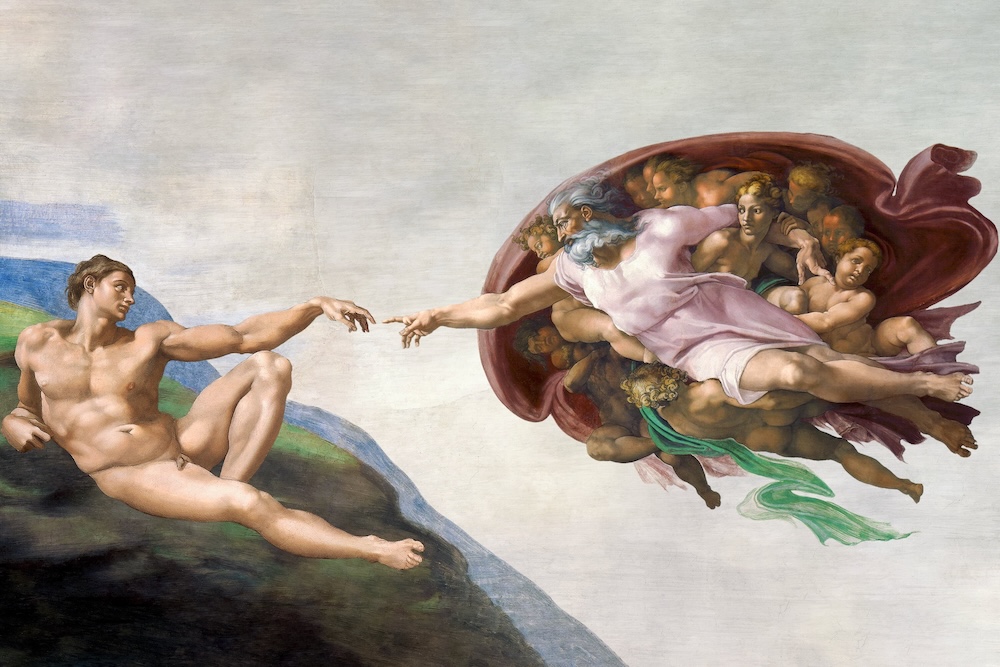
For Aristotle and Aquinas, all creaturely souls with the single exception of the rational soul are material in nature. Although we cannot examine here why they believed this—and there are indeed strong philosophical considerations in favor of their view—the point is this. Even though the biological development of the human being may have unfolded over hundreds of thousands of years ago, the evidence for distinctly human rational activity appears in the archaeological record much later and more suddenly, roughly 50,000 to 100,000 years ago. For instance, according to Kuebler, “sophisticated tool-making techniques, figurative artwork, therianthropic imagery, musical instruments, decorative jewelry, and purposeful burial practices” all emerged during this period. It is therefore not unreasonable to suppose that God created our body through the evolutionary process of secondary causes (living things) over long stretches of time. Once a sophisticated enough anatomical structure emerged, God infused it with a rational soul and thereby created the first “theological” human beings. In this way, God “uses” secondary causes to participate in creation, even though he reserves a special divine act of creation in the case of human beings. Thus, what appear to us as chance mechanisms are, at a deeper level, the unfolding of divine purpose across time. Kuebler puts it thus: “All the magnificent forms [of life] that we see around us have emanated from the mind of God over cosmic time via a spectacularly rich interplay between order and chance, in just the manner he conceived.” Very well, but one question often arises at this point.
If the biblical text holds that we lived in an original state of happiness in which we did not experience death and destruction, how do we square that with the scientific evidence indicating otherwise. After all, fossils dating back millions of years have been discovered, so how should we interpret the scriptural depiction of an irenic prelapsarian state untouched by death?
First, when confronted with questions like this, it is important to keep in mind that God is the author of both nature (which science studies) and revealed doctrine (which theology studies). Thus, the truth of one discipline cannot contradict the truth of another. This means that where there is an apparent contradiction between science and theology, either the former or the latter or both are somehow in error, in which case their conclusions require reconsideration.
Second, the Church does not teach that there was no death in the pre-Fall state, only that there was no human death. And it is not primarily physical but spiritual death that is of central concern to scripture. “While the Church teaches that man became subject to physical death after the fall,” Kuebler writes, “it is the possibility of man’s spiritual death that is of paramount importance.”
Third, the original state of human happiness was achieved by the aid of a primordial grace that rightly ordered our biological drives. Once humans sought to elevate themselves above God—once they tried to become God—they forfeited this gift and therewith the perfect control of their natural drives. Kuebler clarifies this as follows:
This was not a state in which the biological desires we share with other primates did not exist; rather, it was a state in which they were properly controlled. Man could not order these on his own but was dependent upon his Creator for this gift. The fall then represents the loss of this gift, leaving humans in a postlapsarian state with a nature that was then at the mercy of these biological drives without the aid of the original grace God had intended.
In these ways and others explored in the book, Kuebler demonstrates that the supposed conflict between evolution and faith in this case is resolved not only by understanding creation but also by understanding the doctrine of grace and original sin.
Other important questions regarding human origins are addressed by the book as well, including the fittingness of our evolutionary story in light of the Incarnation and the Immaculate Conception, how we can understand the story of Adam and Eve given the scientific data indicating that humans arose as an initial population rather than as a single couple, and the Church’s relationship with science down through the centuries. While some sections may be a little heavy for readers with no philosophical background, overall Kuebler succeeds in making complex scientific and philosophical ideas accessible to a broad audience. Darwin and Doctrine thus serves not only as a helpful introduction to the relationship between evolution and faith but also as a persuasive case that the apparent conflict between them dissolves once the metaphysical underpinnings of creation are properly understood.