As a young man of around fourteen or fifteen, it was an amusement, late at night in my bedroom in England, gently to move the dial on the shortwave section of my radio until it picked up the faint crackling broadcasts of Radio Tirana.
It was the late 1970s and Albania was a mysterious and almost impossible place to visit. The broadcasts, with the signal going in and out, spoke of decayed Western capitalism and the glorious achievements of the Communist regime of Enver Hoxha. Sadly, at that early stage in my life, I did not realize that the humor of listening to this absurd propaganda hid the unutterable horrors of what ordinary Albanians, especially the persecuted Church, was enduring.
Hoxha, the “Supreme Comrade, Sole Force and Great Teacher,” after taking power in 1945, winning the “election” with an implausible 93 percent of the vote – his Communist Front was the only party allowed to stand – began immediately to persecute all religions, but attacked the Catholic Church with particular ferocity, alleging that it was a foreign and disloyal entity.
Priests, bishops, and many laypeople were arrested, sent to work camps and prisons, tortured, and denounced. At one point, it is estimated that a third of Albanians were spied upon by their government, making Albania the world’s first true total surveillance State.
Christ’s warning that children would betray their parents and parents their children came true; the possession of Bibles or religious images, if seen in the house, would lead to arrest and imprisonment.
This persecution was intensified when, in 1967, Hoxha declared Albania to be “the world’s first atheist State.” All religious buildings, of all faiths, including all the churches, were either destroyed or occupied for secular purposes. The cathedral in Shkoder, the most Catholic part of Albania, for example, was turned into a gymnasium.
The tortures and experiences of clergy and laity during this period, until the regime finally fell in 1991, defy belief. St. John Paul II said that “history has never seen before what happened in Albania.” Reading the chapter on Albania in Robert Royal’s magisterial book The Catholic Martyrs of the Twentieth Century, one is dumbfounded by the depravity and demonic cruelty inflicted upon Albanian believers.
Prisoners were tied in sacks with wild animals – one of the beatified Albanian martyrs, a religious novice, Blessed Maria Tucci, was tortured to death in this manner. Along with other equally bizarre tortures and death sentences, prisoners of conscience were forced to work in mines and in other extreme conditions, with thousands dying of starvation, exhaustion, and sickness.
Yet despite this intense persecution, as Communism collapsed between late 1990 and 1991, the underground Church emerged. Secret seminaries had been in operation, and a few of the priests who had been in captivity appeared in public.

One such was Father Ernest Simoni. Ordained in 1956, he had been sentenced to death in 1963 for celebrating a Requiem Mass for President John F. Kennedy. When word reached Hoxha that Father Simoni would only utter words of forgiveness, somehow divine grace touched the heart of the dictator, and his sentence was commuted to life imprisonment.
When arrested, he had told his captors that “we must forgive, love, and pray for our enemies.” Suffering for nearly thirty years in prisons and the copper mines, he finished his sentence working for ten years in a sewage canal.
St. John Paul II visited Albania for one day in 1993 and ordained four bishops: men who had been secret seminarians were ordained shortly afterwards. During his pastoral visit to Albania in 2016, Pope Francis wept as he heard Simoni, then 84-years-old, dispassionately and humbly describe his suffering. To honor all the martyrs, including white martyrs like Fr. Simoni, Pope Francis named Ernest Simoni a Cardinal in 2016.
A martyr, as we know, is a witness, if necessary to the point of death. A witness of the Faith speaks of truth, eternal truth, and that witness is, to a significant degree for others: to inspire, strengthen, and encourage the rest of us. After Father Simoni spoke, the pope said that to “listen to a martyr speak about his own martyrdom is powerful indeed.”
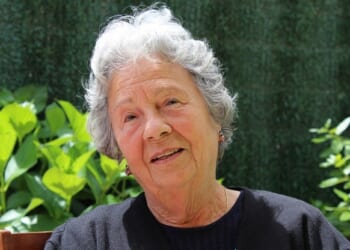
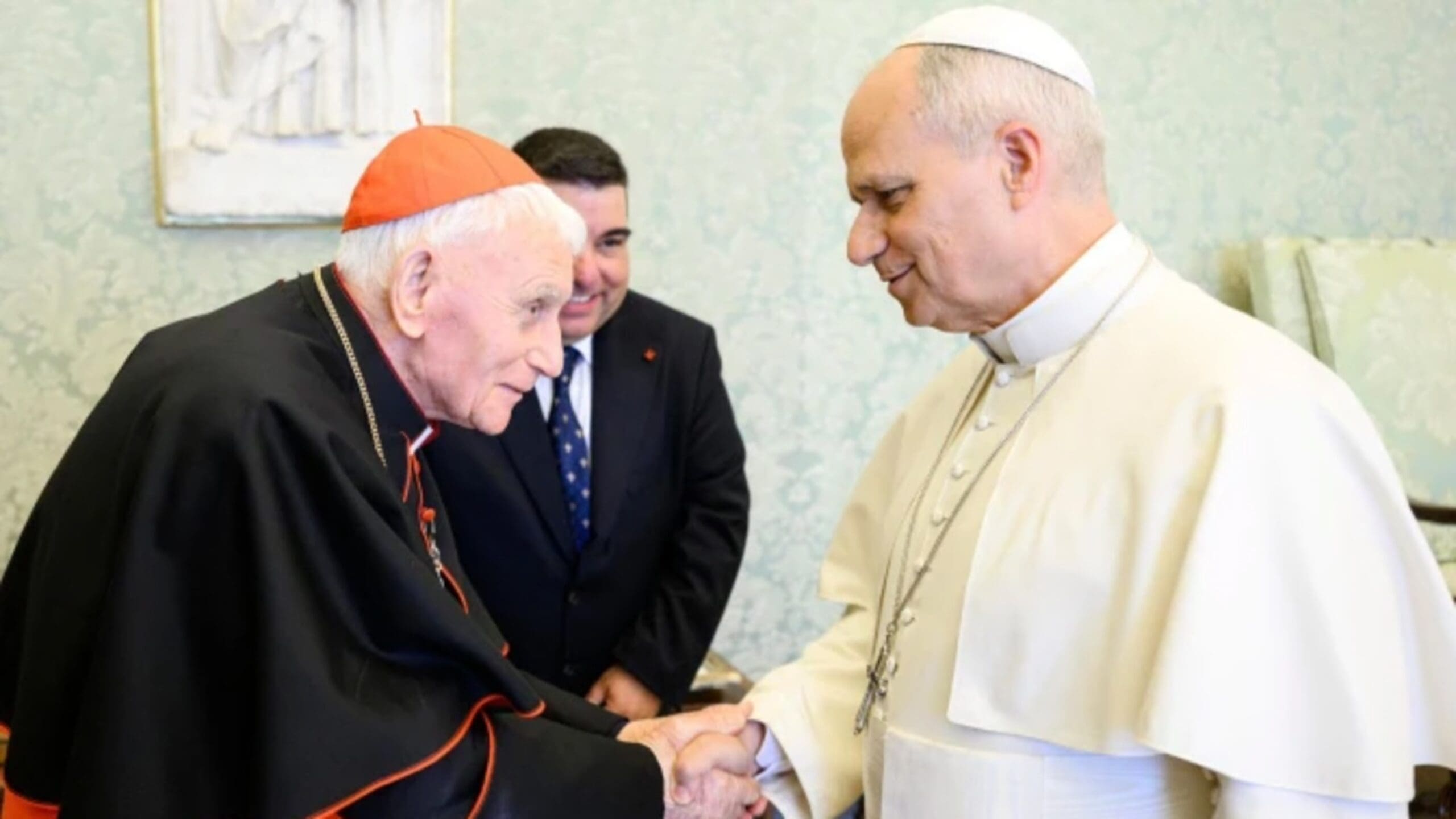
Last week, in Rome, I met Cardinal Simoni, something I had long desired and hoped for. He was celebrating the 70th anniversary of his priesthood and is now 97 years old. Chesterton wrote that the “true saint, or the true hero, only differs from humanity in being, as it were, more ‘human than humanity.”
Asked by a journalist friend who was with me how he had survived the persecution, Cardinal Simoni spoke only of eternity. His witness, and the witness of the Church in Albania, is for a truth many in the Church have forgotten. The intense focus by many on legitimate but transitory concerns denies the profound truth of Cardinal Simoni’s suffering and witness: we are made for eternal life, and the sufferings of this life, if endured for Christ, prepare us for our heavenly home.
The Cardinal speaks very little now of his suffering; his words are of love and forgiveness. This is another sign for an unforgiving world. In the mystery of the divine plan, before the Fall, not only would there have been no need for forgiveness, but also no need for mercy. The “happy fault” of Adam, as the Exultet sings, allows for the inspirational witness “more human than humanity,” in the person of a man transformed by the healing grace of the Crucified Christ.
Surrounded, as Paul tells us, not only by the heavenly “cloud of witnesses” (Hebrews 12:1), but also by the white martyrs like Cardinal Ernest Simoni, and there is one last lesson addressed by St. John Paul II in 1993. As European governments and institutions, in particular the EU, become increasingly hostile to the practice of the Faith, St. John Paul said that Europe “should not forget what happened in Albania,” where the persecution was the work, not of ancient pagan empires, but of government.