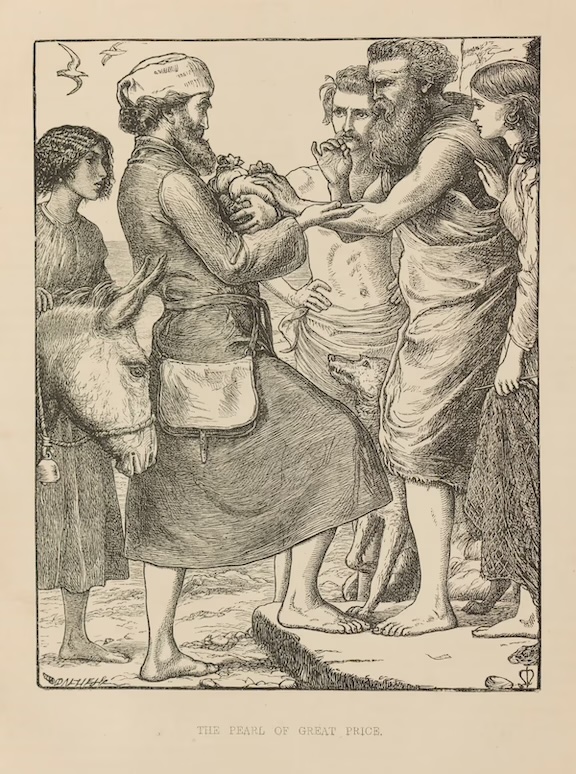
Two of the parables set before us today are traditionally understood as lessons in the cost of discipleship. The treasure buried in the field and the pearl of great price signify the Kingdom of God. (See Matthew 13:44-46) They are worth spending all we have to obtain. Though this interpretation is profoundly true, the great modern scholar and Scripture translator Monsignor Ronald Knox suggests another.
According to Knox, we can understand Christ Himself to be the man who finds a treasure in the field and the merchant who finds the pearl of great price. Fallen man is the treasure. We are the pearl of great price. Christ has found us and sells all He has to purchase us.
Now, this interpretation is not contrary to the traditional. But neither is it merely an alternative. Rather, it is prior. It precedes and enables our own discipleship, our own finding and buying. We cannot bear the cost of discipleship, we cannot sell all we have, until and unless we ourselves are purchased. We must be found before we find, bought before we can buy.
This is the structure of salvation. God takes the initiative; we respond. “In this is love. Not that we loved God but that he loved us and sent his Son to be the expiation for our sins.” (1 John 4:10) The kingdom of God is not only – or even primarily – about our finding and treasuring Jesus Christ. It’s first and foremost about God’s finding, loving, and purchasing us.
So, Jesus found us buried under the dirt and filth of sin. Our sins so cover us that our glory and nobility cannot be seen. But He found us, drew us out of the dirt, and found us to be a treasure. To purchase us, He set aside His heavenly glory, left peaceful Nazareth, suffered torture and humiliation, and died on the Cross. “You were bought with a price.” (1 Corinthians 6:20)
Interestingly, the man in the Gospel buys not the treasure but the whole field. Just so, by His death, Jesus has purchased not only us but also our surroundings, everything about us. There is nothing in our lives that He has not died to redeem and make holy. Our families, friendships, finances, work, rest, play, past, present, and future – all of this is the field around us that He has redeemed, bought for Himself.

Jesus is likewise the merchant in search of fine pearls. We are that pearl of great price. He looks at us and sees beauty, goodness, and infinite worth. He seeks us not because He needs us (nobody needs a pearl), but simply because He desires to have us for Himself.
Notice, He is searching. This is one element that distinguishes Christianity from every other religion. All others are man’s search for God; Christianity is God’s search for man. Just as the Lord God once asked us in the Garden, “Where are you?” (Gen 3:9), so Jesus now comes into this world in search of us, the fine pearl. “For the Son of Man has come to seek and to save what was lost.” (Luke 19:10)
When we understand these parables as first about Christ, then can we more accurately apply them to ourselves. We can seek Him because He has already found us. We can buy the field and purchase the pearl because He has given everything for us.
The treasure and pearl cannot hide. Unfortunately, we can. We can avoid the One Who seeks us. We can seek not to be found. Indeed, the habit is deep within us: “I heard you in the garden; but I was afraid, because I was naked, so I hid.” (Genesis 3:10)
We’re experts in hiding. We hide in our work or family obligations (I’m too busy to pray). We even hide in prayer – when we recite prayers instead of praying, when we skate on the surface of our faith, when we use our structured prayer as a way of keeping Him at arm’s length. (Leave me alone, Lord, I’m saying the Rosary.)
Our salvation is wrapped up in being found – known – by God. Saint Paul reminds the Galatians how they have “come to know God” – and then immediately corrects himself: “or rather to be known by God” (Galatians 4:9). The more important part isn’t knowing, but being known. Likewise, in describing eternal life to the Corinthians, he observes, “At present we see indistinctly, as in a mirror, but then face to face. At present I know partially; then I shall know fully, as I am fully known.” (1 Corinthians 13:12) Heaven includes being fully known. Found.
The first step of discipleship is not finding or buying, but allowing ourselves to be found and bought. It means allowing Him to know us. Yes, He knows us already because He knows all things. But He wants to know us not just as the Creator knows His creatures, but as the Father should know His children and the Christ should know His friends. He wants to know us because we have made ourselves known, because we’ve invited Him into our lives, minds, and hearts. That is what it means to be found.
To be known by Him means to learn our true worth. Only in the confidence of that worth can we then become those who constantly seek Him, the treasure and the pearl, and give all we have to gain Him.