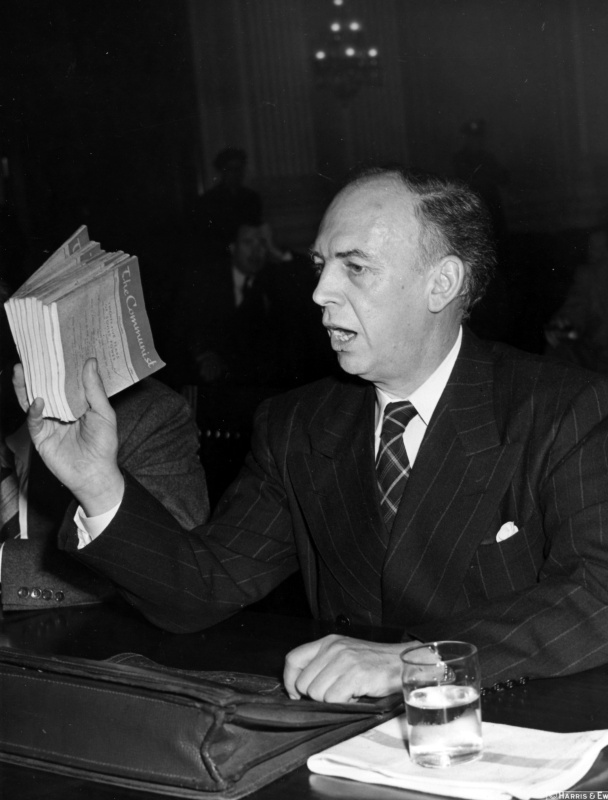
In 1945, Louis Budenz – a Communist activist and managing editor of the party’s newspaper The Daily Worker – was received back into the Catholic Church by Fulton Sheen. The two men had met earlier because Sheen had been publishing devastating critiques of Communism. The Communist Party USA sent Budenz to Sheen to try to turn him – presumably because Sheen had also expressed some criticisms of capitalism, and concerns for workers and the poor. When Budenz asked how Sheen could say that the USSR was not a democracy, Sheen pointed to articles 118 to 124 in the Soviet Constitution. But Sheen pressed on: “I told him I was not interested in discussing Communism; I wanted to talk about his soul.”
Budenz and his whole family converted.
Priests, bishops, lay Catholics – amid all the talk about dialogue, listening, walking together, and other offshoots of synodality – take note: In the end, you have to turn, simply, to what it’s all about.
As Sheen once said: “We are sinking because like Peter we have concentrated our whole attention upon the winds of public opinion, upon the currents of indifference, upon the military, economic, and political opposition from this quarter or from that. We are sinking for the same reason that Peter sank: We have taken our eyes off the Master.”
How was Fulton Sheen able to demolish Communism and other modern idols and religious substitutes, yet at the same time possess the spiritual perceptiveness to know when to turn from the arguments to a direct appeal to the heart of another human being?
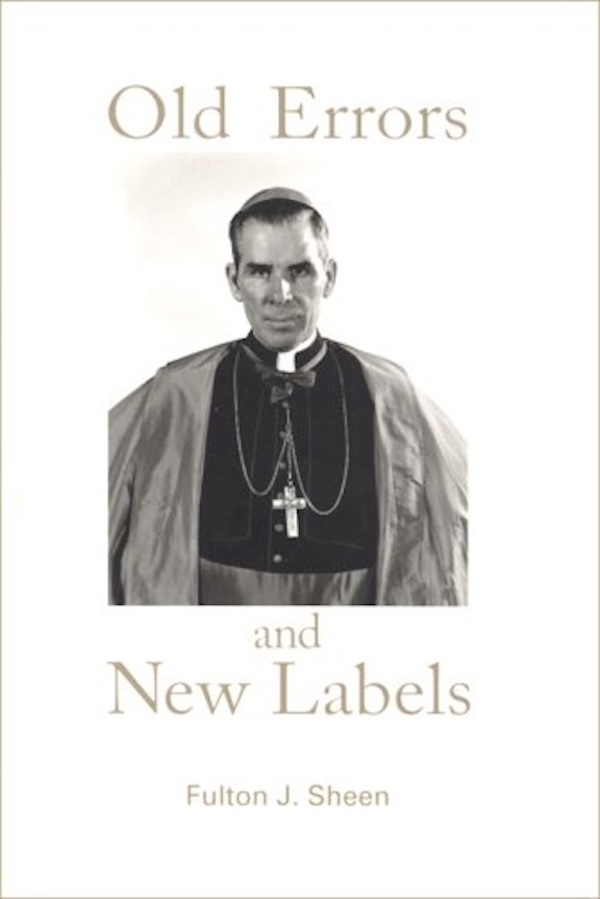
It helped to be a genius, to be sure. The story of his rise from humble beginnings in El Paso, Illinois to world-class academic excellence to global celebrity as a preacher and maker of converts will be told in many places as we approach his beatification in St. Louis next month. But it’s worth touching on a few details of his meteoric rise for what they might tell us about our own moment. (The best introduction to the range of his thinking is his early collections of essays Old Errors and New Labels, which is Chestertonian in cleverness and unfailing in its philosophical incisiveness.)

But the foundation of everything according to Sheen was his vow to make a Holy Hour every day. It’s not easy to sit quietly in the presence of God for anything more than a few minutes. Our minds, let alone our souls, are too restless. Yet Sheen did it despite all his travels and responsibilities. As he confesses in his autobiography, Treasure in Clay, it was always enriching but also at times dry and distracted. Still, putting yourself in the presence of the Creator daily can’t help but make a difference to the creature, even one half-composed of fallible “clay.”
Sheen did not, as many seem to want to do in the “synodal Church” today, rely merely on “conversation in the Spirit.” He trusted God. But he worked. Hard. At the University of Louvain in Belgium, then the most prestigious theological center in the world, his doctoral dissertation won the highest honors and the Cardinal Mercier Prize. (It’s been republished in a handsome edition by Cluny Media as God and Intelligence in Modern Philosophy). Columbia University and Oxford offered him positions teaching scholastic philosophy.
But Sheen’s bishop ordered him to return to Illinois – to see if this academic superstar would still submit to religious obedience. Sheen did and served as a humble parish priest for a year – after which his bishop sent him, as originally planned, to teach at the Catholic University of America.
Sheen did not rest on his laurels there. He became a popular professor and began to be invited to lecture and preach around the country – which, of course, made waves with other faculty. But he took his duties at CUA seriously, claiming that he prepared six hours for every hour of lectures. He also said that he spent about thirty hours of prep time for each episode of his blockbuster television program “Life Is Worth Living” – even though each episode lasted only 27 minutes and 20 seconds.
What seemed effortless and spontaneous was actually the result of serious effort and careful preparation. In this he was doing what many great orators have done, from Cicero to Winston Churchill (Churchill is said to have spent one hour in preparation for each minute of the great speeches he delivered). To put all this in theological terms, Sheen depended on grace but didn’t neglect human work.
It was that combination, along with a ready intelligence and wit, that made him such a formidable presence. And humility. The autobiography of such a man could easily have been a series of self-promoting displays of great things achieved – the celebrity converts (Clare Boothe Luce, Fritz Kreisler, Heywood Broun, Horace Mann, Henry Ford II, Bella Dodd, among others). Or the millions of dollars raised for the Church and charities, especially after he was named head of the U.S. branch of the Society for the Propaganda of the Faith. Or the sales of popular books like Life Is Worth Living, Peace of Soul, or The Life of Christ – to say nothing of the millions of people who followed his radio and television programs.
They’re all present in the autobiography, but held to a high standard: “I enjoyed the prestige of being a university professor, and of appearing on radio and television not only at home, but abroad; I was popular, I was sought after, I was loudly applauded after lectures and banquet talks, I was a friend of both royalty and the masses, my features became so recognizable that I would be identified by a passerby in a revolving door, my face appeared in millions of homes. I made the right kind of enemies, namely, the Communists. But. . .how close was I to the Cross?”
And in the end, he asks himself a question that we all should ask: “Have I cast fire upon the earth as the Lord asked?”