
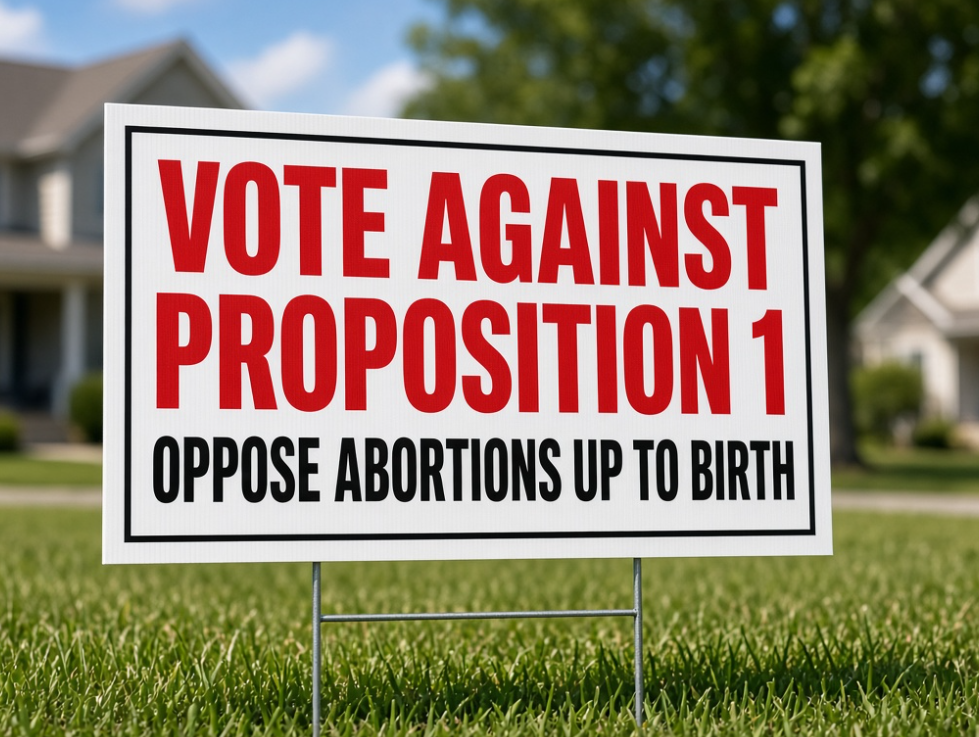
On Sunday, the Idaho Supreme Court finally agreed to the language that will appear on the November general election ballot concerning Proposition 1, formally known as the “Reproductive Freedom and Privacy Act.”
On Friday, the court ruled that the language in the original statements prepared by the Idaho Attorney General’s Office and Secretary of State’s Office “did not comply with state code regarding clear and concise language,” according to Allison Shafter.
In a decision written by Justice Gregory Moeller, the five justices gave the Attorney General’s office and the Secretary of State office until 5:00 p.m. on Saturday to submit the revised statements, a very tight deadline which the two offices met.
Follow LifeNews on the MeWe social media network for the latest pro-life news free from Facebook’s censorship!
The Court then approved the changes on Sunday.
Attorney General Raúl Labrador was not happy with the justices’ initial rejection:
Our duty under the law is straightforward: to provide a clear and concise statement of the effect of a vote on an initiative. We do not tell Idahoans how to vote; we tell them what their vote will do. The Yes statement reflects the sponsors’ own initiative language, and the No statement reflects Idaho law as it stands today. The sponsors are entitled to advocate for their initiative, but they are not entitled to dictate the official ballot language. Idaho voters deserve a fair description of both choices so they can decide for themselves.
The revisions are
“A YES vote would support creating a right to abortion before fetal viability—defined as a fetus’ ability to survive without extraordinary medical measures—and after fetal viability in cases of medical emergency; providing protections against professional discipline and civil and criminal liability for healthcare providers; and codifying a statutory reproductive right to freedom and privacy.”
“A NO vote would support making no change to Idaho’s current law, which preserves the life of preborn children by prohibiting abortion, except when necessary to prevent the death of the pregnant woman, and during the first trimester in documented cases of rape or incest reported to law enforcement.”
Idahoans United for Women and Families originally proposed, drafted, and sponsored Proposition 1. Proposition 1 is a “citizen-initiated statute.” For it to pass, it requires a simple majority vote. By contrast, in Idaho, constitutional amendments require a two-thirds vote of both legislative chambers before reaching the voters.
Proponents would have you believe that the proposal would be a simple rollback to the laws that existed under Roe v. Wade. Despite “assurances,” the initiative is so radical it leaves Roe and Doe in the dust. It adds a right to “reproductive freedom and privacy” to state law.
What does that mean? This “right” is defined as the ability to “make personal decisions about reproductive healthcare that directly impacts the person’s own body.”
Megan M. Wold writes
“Prop 1 is extreme by any measure,”
First, it allows abortion up to fetal viability, which it redefines, allowing abortion for any reason (or no reason) into the eighth month of pregnancy.
Fetal viability is medically understood to mean the point at which a baby can survive outside the womb, albeit with medical assistance. Prop 1 throws that definition out.
Instead, Prop 1 says a baby is not viable until it can survive “without extraordinary medical measures” — no oxygen, no NICU care. That’s because under Prop 1’s definition of viability, survival must occur without medical help — not with it. For most babies, that time doesn’t come until only four weeks before delivery.
That makes Prop 1 far more extreme than Roe v. Wade. Prop 1 guarantees abortion-on-demand well into late-term pregnancy, long after an unborn baby feels pain.
It also attacks parental involvement, Wold writes.
Second, Prop 1 grants the right to abortion to “every person,” regardless of age. That would eliminate Idaho’s parental consent laws. A provider could perform an abortion on a teenage girl without her parents ever knowing.
Proposition 1 also tracks the Abortion Industry’s dream scenario:
Third, Prop 1 replaces the requirement that a “physician” perform an abortion with only the requirement that any “health care provider” do so, which Prop 1 then defines so broadly that it includes non-doctors. That would actually strip women of a crucial medical protection and would increase their risk of medical complications.
Proposition 1 would create a pro-abortionist’s trifecta: open-season on babies; keep those pesky parents out of their minor daughter’s abortion decision; and allow everyone but the janitor to perform abortions.
As Wold, an Idaho-based partner with Cooper & Kirk, PLLC, wrote
Recognizing how out-of-step these policies are with most Idahoans, some supporters are now suggesting that voters should approve Prop 1 and assume that someone might come along later and moderate the extreme policies it would enact. To voters who might be tempted by this logic, Prop 1 was written by those campaigning for it. They didn’t have to write it this way, but they did. And they did it because that’s what they want.
As a “smokescreen for abortion on demand,” Proposition 1 must be defeated.
LifeNews.com Note: Dave Andrusko is the editor of National Right to Life News and an author and editor of several books on abortion topics. He frequently writes Today’s News and Views — an online opinion column on pro-life issues.








![WHAT POLICY? Crockett Trips Through MS NOW Softball Question on Her Agenda if Elected to Senate [WATCH]](https://teamredvictory.com/wp-content/uploads/2025/12/WHAT-POLICY-Crockett-Trips-Through-MS-NOW-Softball-Question-on-350x250.png)