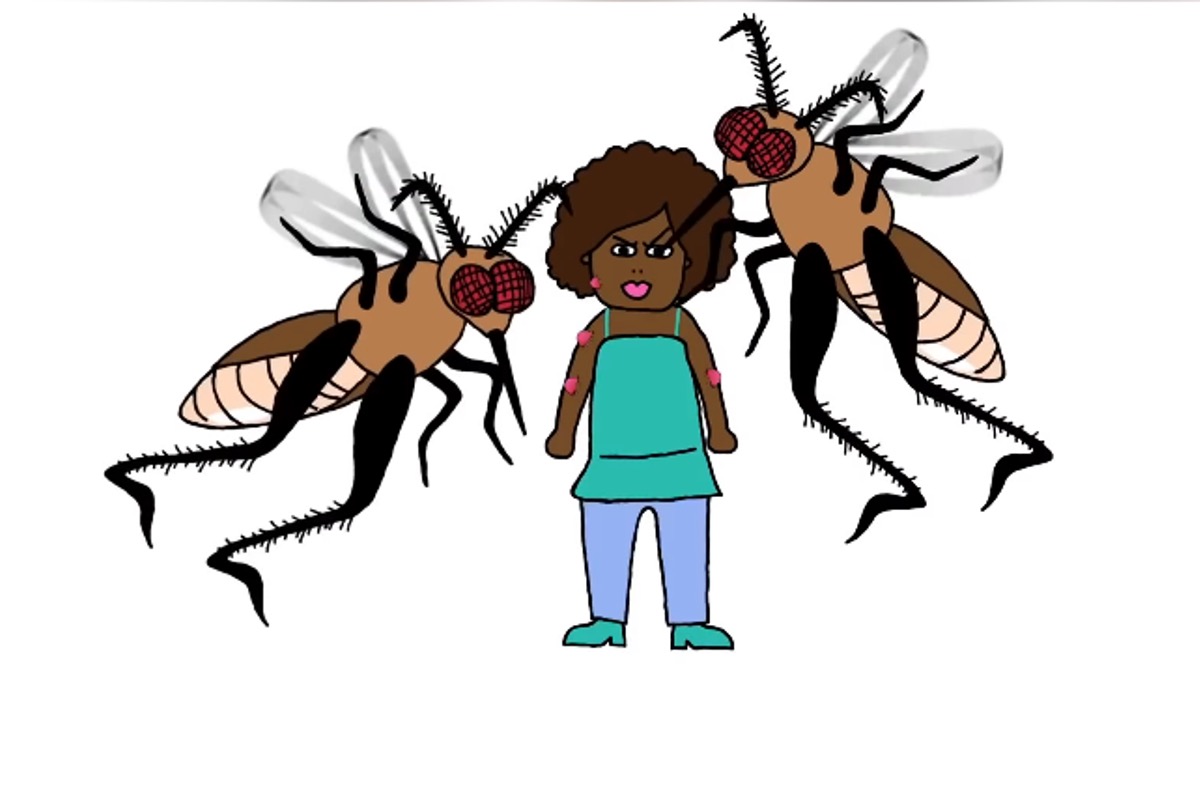
If you want to know why there will be more Karmelo Anthonys — angry black youth all too willing to kill whites — look no further than diversity, equity, and inclusion (DEI) training offered by the Illinois government. It portrays white people and police as mosquitoes inflicting “microaggression” bites that maddeningly accumulate over time. Don’t worry, though, there is a remedy.
The training also shows a black woman using a flamethrower to incinerate the whites and cops mosquitoes.
(Such propaganda may help explain why so many believe Anthony was justified in killing white teen Austin Metcalf.)
You can, however, avoid this fiery fate by refraining from making certain comments. “When I look at you, I don’t see color” and “My best friend is Black” are forbidden. “Your English is so good” is, too. For these are all microaggressions — and who knows what else could be fancied so? So you just have to walk on eggshells with ballerina-like skill.
The Washington Free Beacon recently reported on the story:
Illinois governor J.B. Pritzker’s (D.) administration offers a taxpayer-funded training on “microaggressions” and other “exclusionary behaviors” that depicts white people and police officers as mosquitoes who suck blood from people of color.
The training — which Pritzker’s Department of Human Rights offers to “private-sector, government, and public participants” and which the Washington Free Beacon attended [on May 15] — is meant to “increase knowledge, awareness and prevention of discrimination and harassment issues and offer solutions to employers and employees on how to appropriately respond to situations as they arise.” It defines “microaggressions” as “the everyday verbal, nonverbal, and environmental slights, snubs, or insults, whether intentional or unintentional, that communicate hostile, derogatory, or negative messages to target persons solely based upon their marginalized group membership.”
The Content Tells the Tale
The irony here is that the Illinois “microaggression” training is itself a macroaggression, as its content evidences. As Red Right Daily (RRD) informs:
One training slide reportedly classified the phrase “When I look at you, I don’t see color” as a racial microaggression because it allegedly “denies a person of color’s racial/ethnic experience.” Another example listed “My best friend is Black” as evidence of “denial of individual racism.”
Then came the now-infamous mosquito analogy.
The training video asks participants to imagine microaggressions not as “stupid comments” but as mosquito bites that accumulate over time. In one example, a white woman tells a Black woman she is “so well spoken” before transforming into a mosquito and biting her. Other examples include comments like “Where are you really from?” and “Your English is so good.”
Now, I’ve been told many times over the years that I’m well spoken. Would it be less true were I black? And were I, should I have taken offense at the innocuous comment? But it gets worse. RRD continues:
But the video escalates far beyond awkward social interactions.
“Beyond just being annoying, some mosquitoes carry truly threatening diseases that can mess up your life for years,” the narrator says before transitioning into references to policing.
“And other mosquitoes carry strains that can even kill you. He looked like he was up to trouble. Okay, I felt threatened.”
The implication is not subtle. Police officers and racially insensitive individuals are folded into the same metaphorical category as dangerous, disease-carrying insects capable of killing people.
Besides being obviously ridiculous, it’s hard identifying an aspect of this “training” that isn’t based on a falsehood or fallacy. The idea that police unfairly target blacks, for example, has been repeatedly refuted.
Just consider 2016 research by black Ivy League professor Roland Fryer. Much to his own surprise, he learned cops were less likely to shoot black and Hispanic suspects than white ones. Other studies have drawn the same conclusion. But, hey, can’t let the facts get in the way of a good narrative.
The DEI training video also shows a white person mosquito asking a black woman, “Can I touch your hair?” Now, I’ve heard this lament from “sensitivity training” sources before, as if it’s some pervasive phenomenon. I’ve never actually witnessed it occurring, though. So I’ll ask my fellow whites: Do any of you have a burning desire to feel a black person’s hair? Is this something I’ve missed?
The Illinois DEI training video is below.
Cultivating Weakness — and Sin
Yet as bad as the DEI training is, there’s something worse: that the Illinois government is standing by it. In fact, Michael Patrick, a public service administrator at the Illinois Department of Human Rights, who led the May 15 training, even defended the flamethrower scene. According to the Daily Presser, he said that
“I had somebody in one of my classes that thought the woman with the flamethrower was overreacting,” and [added] that this reaction could indicate the person had not been on the receiving end of repeated microaggressions.
In reality, “microaggression” theory is nonsense. Yes, people can be and occasionally are passive-aggressive. It’s not just, however, that the DEI training’s cited comments are explicitly innocuous and often complimentary. It’s also this: Patrick acknowledges that people often have good intent when making the comments. Yet he claims this doesn’t matter if the “impact” is negative. (This is odd coming from liberals, who typically value good intentions over outcome.)
But of course intent matters. Hence the saying, “It’s the thought that counts.” In the cases here, good intent means the explicitly innocuous/complimentary remarks are also implicitly so. The problem lies with what’s being inferred — with the hearer.
This training does, too, cultivate weakness and a lack of virtue by conditioning people to be snowflakes who infer negativity. It trains them to look for and imagine slights. It conditions black people to be paranoid of whites’ intent and whites to be paranoid about offending blacks. It essentially places whites in a subordinate role, too, pressuring them to kowtow to non-whites’ whimsy. It is dangerously divisive.
It also encourages sin, as the microaggression mentality involves what theologians may call rash judgment. We have a moral obligation to judge others kindly, charitably, and fairly. Seeking to read sinfulness into what they do is a sin itself.
A Dark History
As for likening people to insects or other pests, this has a long history. In the 1990s in Rwanda, Hutu propagandists began calling a different tribal group, the Tutsis, “cockroaches.”
The genocidal killing of the Tutsis followed.
In fact, such name-calling reflects genocide’s Stage IV — dehumanization — where target-group members are “equated with animals, vermin, insects or diseases.”
And it’s happening now, too, in the United States — all funded with our tax money and billed as “sensitivity.”