In a few weeks (as I write this) the Jewish Holy Days will be here – Rosh Hashanah, the Jewish New Year, and Yom Kippur, the Day of Atonement. [Editor’s note: today, September 21] And again I wonder, am I a Jewish Catholic or a Catholic Jew? There is a difference. The noun, the second word, conveys the fundamental identity; the adjective is a modifier.
An Irish Catholic is not the same as a Catholic Irishman. Until 32 years ago, I would not have entertained any thoughts about what the two phrases in the title signified. I was an agnostic Jew who fasted on Yom Kippur and celebrated Passover with a family Seder, but otherwise – no religion.
My wife, a cradle Catholic who loved all things Jewish (including me), could cook kugel, matzo ball soup, etc., better than my mother or grandmother ever could, so the ethnic yearnings I might have had (primarily culinary) were satisfied.
After my conversion, the place of Jews and Jewish history started to matter. Studying Catholic teaching, I discovered that Judaism was the foundation of the Catholic faith. And I began to wonder: what was my identity – Jew or Catholic?
At the first Mass I thought: This is like a Seder, the wine, the washing of hands, all the phrases. I concluded I was like an Irish Catholic, an Italian Catholic, not like the group I associated with in the first years of my Catholic life, the Hebrew Catholics who insisted on retaining a Jewish identity and some Jewish religious practices.
I was uncomfortable trying to be both Jewish and Catholic. Didn’t I refuse to be Bar Mitzvah’d because, in my adolescent intellectual arrogance, I felt the fur-coated ladies at the Reform Temple were hypocrites?
As a child I had suffered bullying and unkind remarks because I was Jewish. And I could not, at 65 (when I was converted), focus on Hebrew, the Torah, Friday candles; they were as unfamiliar to me as if I had been raised a Baptist.
I wonder now whether that childhood experience was, in fact, the actual reason I rejected the religion of my rabbinical great-grandfathers. Perhaps trying not to be a Jew runs in the family. My maternal grandfather ran away from his Russian shtetl to Paris because his father, the village rabbi, would not let him study calculus instead of the Torah.

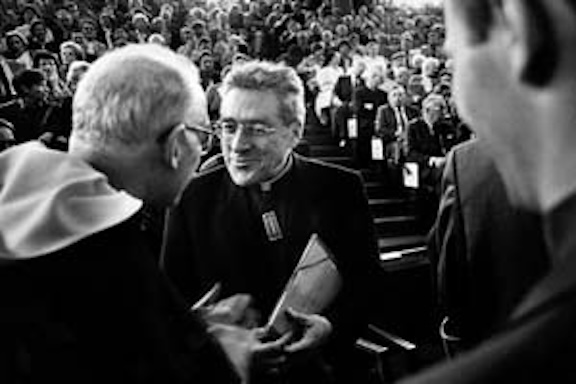
My grandfather went to Paris, lost his religious faith, but remained Jewish. Another Jew came to France as a child, converted to the faith as a teenager while being sheltered from the Nazi invaders, became a priest and rose, as a friend of Pope St. John Paul II, to the rank of Cardinal.
This was Jean-Marie (born “Aaron”), Cardinal Lustiger. He maintained his Jewish identity to the end of his life and after – he requested that Kaddish, the ceremonial Jewish prayer for the dead, be said outside the church before his Catholic funeral Mass. Responding to criticism from French Jews that he should not claim a Jewish identity, he said, “I was born Jewish, and so I remain.”
Both my grandfather and Cardinal Lustiger agreed: a Jew remains a Jew. Would that I had their certainty about who I was and who I am.
If my fundamental identity is not that of a Jew, why do I fast? Let’s first examine that phrase “fundamental identity.” Fundamental means primary, before any other quality. Cardinal Lustiger said, “I was born Jewish, and so I remain.” Did that mean his fundamental identity was that of a Jew, that being a Jew in all things took priority? I don’t think so.
My Jewishness is my family background, third-generation Ashkenazi Jews from Eastern Europe – a background that is formative, but not determinative.
The Church itself has said in a Declaration of Vatican II (Nostra aetate) that the covenant between Israel and God has never been revoked. Indeed, Cardinal Lustiger went further, to assert that Israel’s vocation was to bring light to the nations and that Christianity was the means to do that. His Catholic faith defined his Jewishness.
So, what about fasting? I claim it is a means to demonstrate and to strengthen faith. For example, before the Temple was destroyed, the priest would send the scapegoat out into the wilderness with the sins of the people enclosed in the red ribbon tied to its horns.
Did penance and forgiveness of sins disappear when that was no longer possible? No. For me, the Sacrament of Reconciliation is the true replacement for the Temple ceremony.
As an agnostic Jew I fasted, believing in Spinoza’s God, Einstein’s God, “Der Alte” (the Old One, immanent in the laws of nature). From the garage sale of my Jewish heritage, I picked a means to purify myself before a God that might exist. It was not a declaration of Jewish faith.
Fasting as a Catholic is different for me. Although fasting is a matter of discipline, not dogma, it is important that I give up something, do penance; important, not for making myself cleaner or better, but to take part in a very minor way in Christ’s Passion.
I fast on Yom Kippur as Italian Catholics in Wilmington carry St. Anthony through the streets of Little Italy each June – a day of my people, kept within the Church. They feast; I fast. But my Yom Kippur fast is a Catholic fast, not the stricter Jewish fast, which is no water, no food, from sundown to sundown.
So, in the end: Jewish Catholic, not a Catholic Jew.