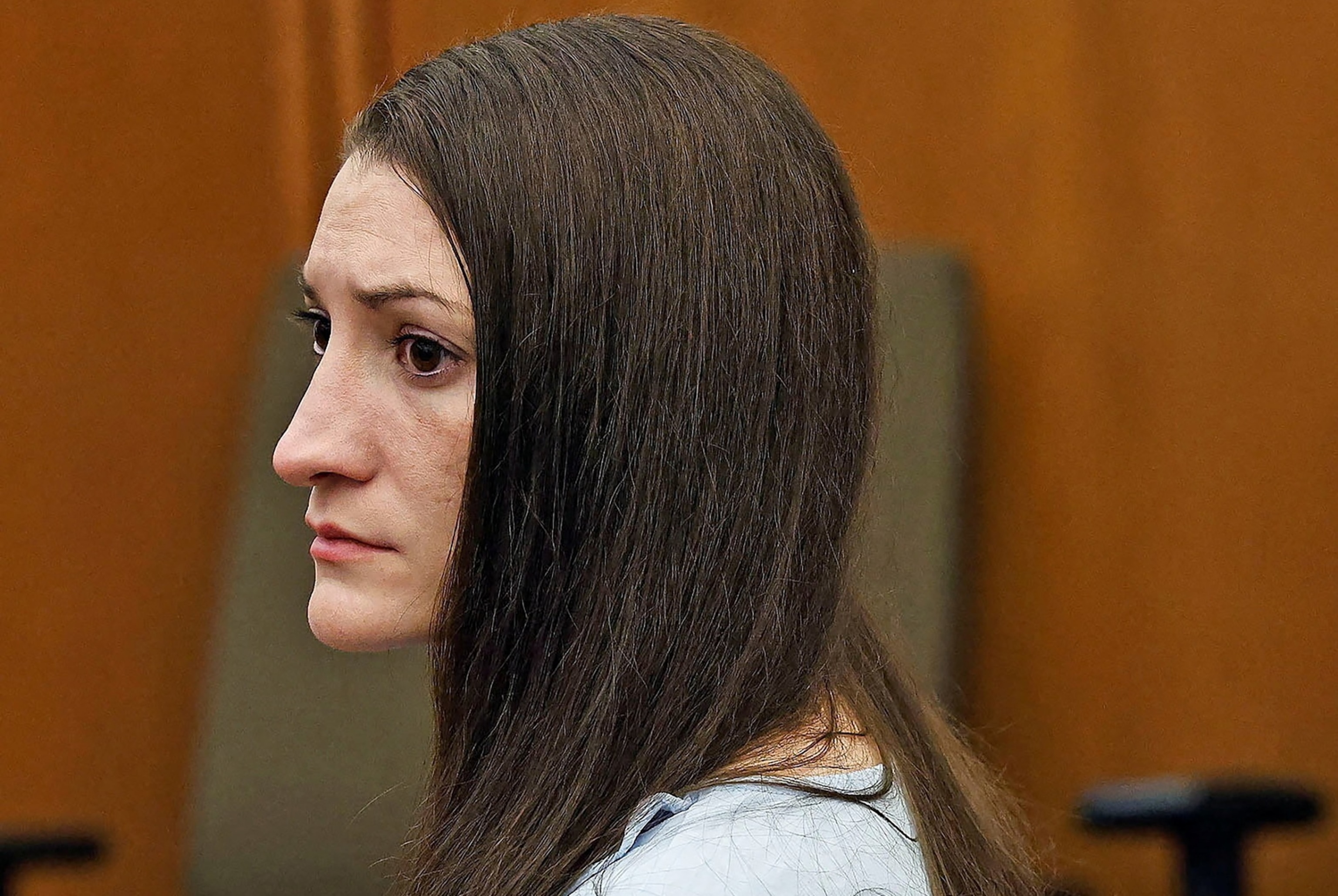
A Massachusetts judge has officially declared a mistrial Friday in the murder trial of Lindsay Clancy after jurors reported they could not reach a unanimous verdict on whether the former labor and delivery nurse was criminally responsible for strangling her three young children to death.
The judge initially halted his move to declare a mistrial so the defense could take their case to the Massachusetts Supreme Court.
But the Massachusetts Supreme Judicial Court denied the emergency request from Lindsay Clancy’s defense team, paving the way for the trial judge to declare a mistrial.
SJC Associate Justice Dalila Argaez Wendlandt held a virtual hearing on the emergency stay request. Following the denial of the motion, Plymouth Superior Court Judge William Sullivan proceeded with plans to declare a mistrial due to the deadlocked jury.
The hung jury ends nearly six weeks of testimony without a conviction or an acquittal. It does not clear Clancy of the killings of Cora, 5; Dawson, 3; and 8-month-old Callan, and it does not erase the undisputed fact that three children are dead.
SUPPORT LIFENEWS! If you want to help fight abortion, please donate to LifeNews.com!
Clancy, 36, has pleaded not guilty to three counts of first-degree murder. She has not disputed that she killed the children on January 24, 2023, in the basement of the family’s Duxbury home with exercise bands after sending her then-husband, Patrick Clancy, out to pick up takeout and medicine.
When he called 911, he told the dispatcher, “She killed the kids.” Callan died three days later.
Clancy then cut her wrists and neck and jumped from a second-story window. She remains paralyzed from the waist down and has been held without bail at Tewksbury Hospital, a forensic psychiatric facility.
The legal fight was never about whether the children were killed. It was about whether Clancy could be held accountable.
Defense attorney Kevin Reddington argued that postpartum psychosis left her unable to appreciate the wrongfulness of her conduct or to conform her behavior to the law. Prosecutors said she acted intentionally and with planning, arranging for her husband to leave the house and killing the oldest child first because she was most likely to resist. They told jurors Clancy remained capable of ordinary tasks that day, including taking the children to the doctor and playing with them in the snow.
Plymouth Superior Court Judge William Sullivan instructed the jury of nine women and three men that a person is not criminally responsible “if she has a mental disease or defect” and, as a result, “lacks the substantial capacity either to appreciate the criminality or wrongfulness of her conduct or to conform her conduct to the requirements of the law.”
He also reminded them that mental illness alone does not erase criminal responsibility.
Deliberations began August27 after a trial that included more than 80 witnesses and more than 300 exhibits. Jurors repeatedly told the court they were deadlocked. Sullivan then gave the panel a Tuey-Rodriguez instruction — often called a “dynamite charge” — telling them it was desirable that the case be decided and sending them back to work.
On Thursday, the foreman sent a note saying one juror disagree with the rest of the panel.
Reddington said the note showed an 11-1 split and claimed that the holdout “refuses to listen to the law.” He asked that the juror be removed, telling the judge, “If we come back in a half hour with a mistrial because of a juror that has just spurned the instructions of this court, it’s a shame. It’s a real shame.” Sullivan refused, saying, “I don’t feel it’s appropriate to say I agree with one juror or 11.”
The court has not independently confirmed how the panel was divided.
A mistrial is not a finding of innocence. Under Massachusetts law, Clancy remains charged with murder and is expected to stay at Tewksbury Hospital while Plymouth County District Attorney Timothy Cruz decides whether to retry the case, seek a plea or drop the charges.
Legal observers have said Cruz, who charged the case as first-degree murder, is likely to try again.
Reddington has said the same, telling reporters, “Tim Cruz will never drop it, that’s for sure.” Asked earlier about a second trial, he said, “Bring it.” On Thursday he also said he did not want a mistrial, adding, “Why would I want a mistrial? I kicked the s— out of their case.”
Outside the courthouse, some spectators have dressed in pink in support of Clancy. Reddington has said she received enough letters to fill three boxes and that “she knows that there are people out there that have not judged her and know that she is a wonderful, wonderful person.”
Pro-life writers have called that reaction a moral inversion: compassion for a mother who killed her children, with far less public focus on Cora, Dawson and Callan themselves.
Journalist Caitlin Flanagan wrote that “what began as admirable compassion for a woman who says she was driven by mental illness to commit the world’s greatest form of evil has turned into something strange: an almost exultant, fan-like celebration of Lindsay Clancy.”
Paul Batura of Focus on the Family argued that a culture already trained to treat a child’s death as secondary to a mother’s distress — first in abortion, then in cases like this one — struggles to say plainly that killing children is wrong even when the mother is ill. Postpartum mental illness is real, he wrote, but “an individual can be mentally ill and still criminally responsible.”
Abby Johnson, CEO and founder of And Then There Were None and ProLove Ministries, who herself experienced postpartum psychosis after the birth of one of her children, said the intense identification with Clancy reveals a deeper moral distortion long cultivated by abortion advocacy.
“I am not arguing that compassion for Lindsay is wrong…What concerns me is something different. We have become extraordinarily practiced at looking at a dead child and asking first what his or her mother was going through. And abortion taught us how to do that. For decades, the defense of abortion has depended on shifting the moral center of the story away from the human being who dies and toward the human being experiencing the crisis. The mother’s suffering becomes the justification. But suffering does not make killing good,” Johnson wrote.
Johnson stressed that mental illness may affect legal culpability without changing the moral nature of the act.
“Mental illness may affect a person’s culpability for an act. It does not change the moral nature of the act itself,” she said. “Cora was five years old. Dawson was three. Callan was eight months old. Their mother killed them.”
Johnson argued that culture has spent more than 50 years training itself to begin with a mother’s fear, financial stress, lack of support or depression until the child’s humanity nearly disappears—first in abortion and now in cases like this one.
“We can demand better postpartum mental-health care in their names. We can acknowledge that their mother may have been gravely ill. We can pray for Lindsay,” Johnson wrote. “None of that requires us to forget where the greatest irreversible harm occurred. Three children went to bed on January 24, 2023, in the home where they were supposed to be safest. They will never get to grow up.”
Cora, Dawson and Callan cannot be allowed to become peripheral to their own story.