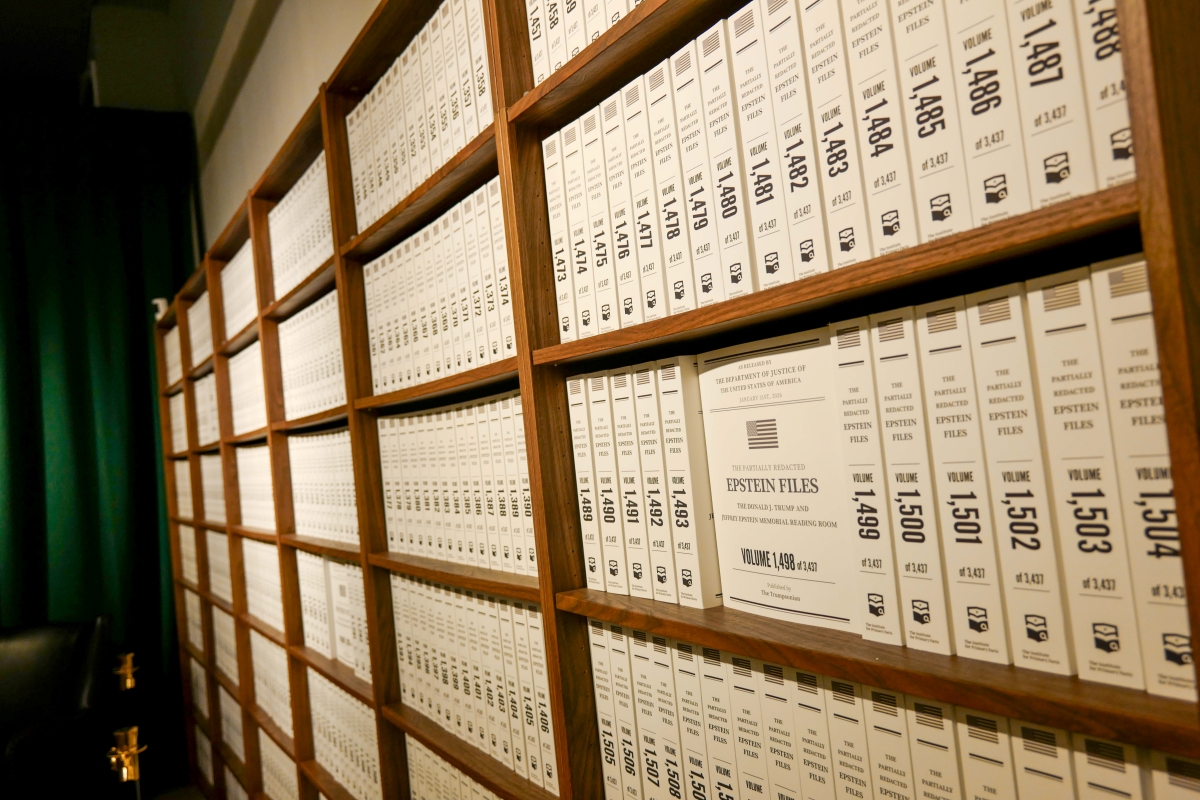
A federal judge just ordered the Justice Department to release a number of Jeffrey Epstein-related documents the department is still concealing.
The judge’s order is part of a lawsuit independent journalist and former MSNBC analyst Katie Phang filed against Acting U.S. Attorney Todd Blanche. Phang is suing because, by holding on to millions of files and illegally redacting many of the ones released, the DOJ is violating the Epstein Files Transparency Act.
One of the files Blanche must release is an FBI interview with someone who accused Donald Trump of sexually assaulting her in the 1980s. In her lawsuit, Phang said the FBI interviewed this alleged victim four times and that the DOJ wrote up 15 documents about her, only seven of which were published under the Epstein Act.
The judge also said that America’s top law-enforcement official admitted to violating the Epstein Act. U.S. District Judge Emmet Sullivan, a Clinton appointee, said in the opinion filed Thursday that “the Attorney General conceded that he is in violation of the [Epstein] Act.” The judge’s statement is based on comments Blanche made during an interview on December 19, 2025, when he said the DOJ released several hundred thousand files and that it intended to release more over the next few weeks, which it did. The deadline for all the files, however, was that day.
So Blanche admitted he broke the law by not releasing everything by that day. Blanche’s defense has been that the scope of work necessary to release so many documents was simply too large to complete in 30 days.
The Lawsuit
The DOJ published about 3.5 million files between December 19 and January 30. But the government is still holding on to more than 2 million. In April, Phang, who is also an attorney who hosts her own online show, sued Blanche over the DOJ’s refusal to obey the Epstein Act. “Blanche — the former Deputy Attorney General and current Acting Attorney General of the United States — has failed to comply with the law,” says Phang’s complaint. She sued to get all the files illegally held by the DOJ, have the illegally redacted files unredacted, force the DOJ to explain the reason for the legal redactions, and appoint a special master to make sure the AG’s office is complying with the law. She made these points in her lawsuit, saying:
The Department of Justice failed to comply with the law. It did so by ignoring the Act’s deadlines, by failing to redact sensitive information, by redacting information it should have disclosed, by failing to explain its redactions, and by redacting, retracting, or withholding entirely materials about Donald Trump and others.
In May, Phang got more specific. She asked the Court to compell the DOJ to explain why it redacted the sender and recipient names in at least eight files that include mention of a tourture video and/or sex with young women; why it’s witholding FBI interview reports with alleged victims, including “notes from FBI interviews with a victim who has alleged that in the 1980s, when she was about 13 years old, Epstein introduced her to Trump, who in turn assaulted her”; why it redacted the names of potential co-conpsirators in other files; to produce foreign language files; and to publish explanations for the legal redactions.
Blanche Refuses
In June, Blanche responded with a motion opposing Phang’s requests. He argued that the Epstein Act doesn’t allow for private citizens to file lawsuits and that Phang has recourse through the Freedom of Information Act (“FOIA”). It is worth noting that the government regularly flouts FOIA requests.
Blanche also disagreed with Phang’s argument that providing this information is in the public interest. Public interest, he said, is“not served by compelling the Department to redirect personnel and resources away from competing public interest and safety priorities to address [Ms. Phang’s] preference for expedited treatment.”
Without Merit
The judge found all of Blanche’s arguments “without merit” and “unpersuasive.” Sullivan used each of those terms multiple times.
Regarding Blanche’s argument that Phang should just FOIA the information she wants, the judge said she would get nowhere because a lot of the information she wants would be FOIA-exempt. For example, the judge said, “Phang likely would not be able to obtain the unredacted names of senders and recipients in email exchanges with Mr. Epstein because such information would likely be redacted under FOIA Exemption 6—information that, if disclosed, would invade another individual’s personal privacy.”
FOIA would also not help with her demand that the DOJ follow the law and create a log of explanations for its redactions, because the media transparency law doesn’t “require agencies to create new records that do not yet exist.” The judge even used two prior FOIA requests denied by the DOJ to show that the agency itself has illustrated that FOIA requests wouldn’t work.
As for Blanche’s argument that Phang’s request is not in the public interest, the judge said the exact opposite is true. He said it is in the public interest that “governmental agencies abide by the federal laws that govern their existence and operations.” The judge highlighted this point, saying:
The Epstein Act requires the Attorney General to publicly disclose the documents that are covered by it; complying with the law does not harm the Attorney General.… The Act required the production of the covered documents and the redaction log by December 19, 2025.
What’s in the Files?
The judge summarized everything the people should’ve received. In addition to all investigations and prosecutions related to Epstein barring legal allowed exemptions, that includes flight logs; “individuals, including government officials, named or referenced in connection with Epstein’s criminal activities”; any organizations, government or private, linked to “Epstein’s trafficking or financial networks”; internal DOJ communication discussing decisions to “charge, not charge, investigate, or decline to investigate Epstein or his associates”; and any documentation that explains why any communications were destroyed or hidden.
He also reiterated the only excuses for withholding documents. That includes anything that identifies victims, shows child abuse or assault, jeopardizes a federal investigation, or would interfere with national security or foreign policy. The judge also noted that the Epstein Act does not consider reputational harm or embarrassment as lawful reasons to withhold any files. As for anything that can’t be declassified, the DOJ is required to release an unclassified summary.
Blanche has until Thursday of next week to release the files Phang requested.


![Hegseth Demands Fitness Requirements, Says 'Fat Troops' 'Not Who We Are' [WATCH]](https://teamredvictory.com/wp-content/uploads/2025/09/Hegseth-Demands-Fitness-Requirements-Says-Fat-Troops-Not-Who-We-350x250.jpg)