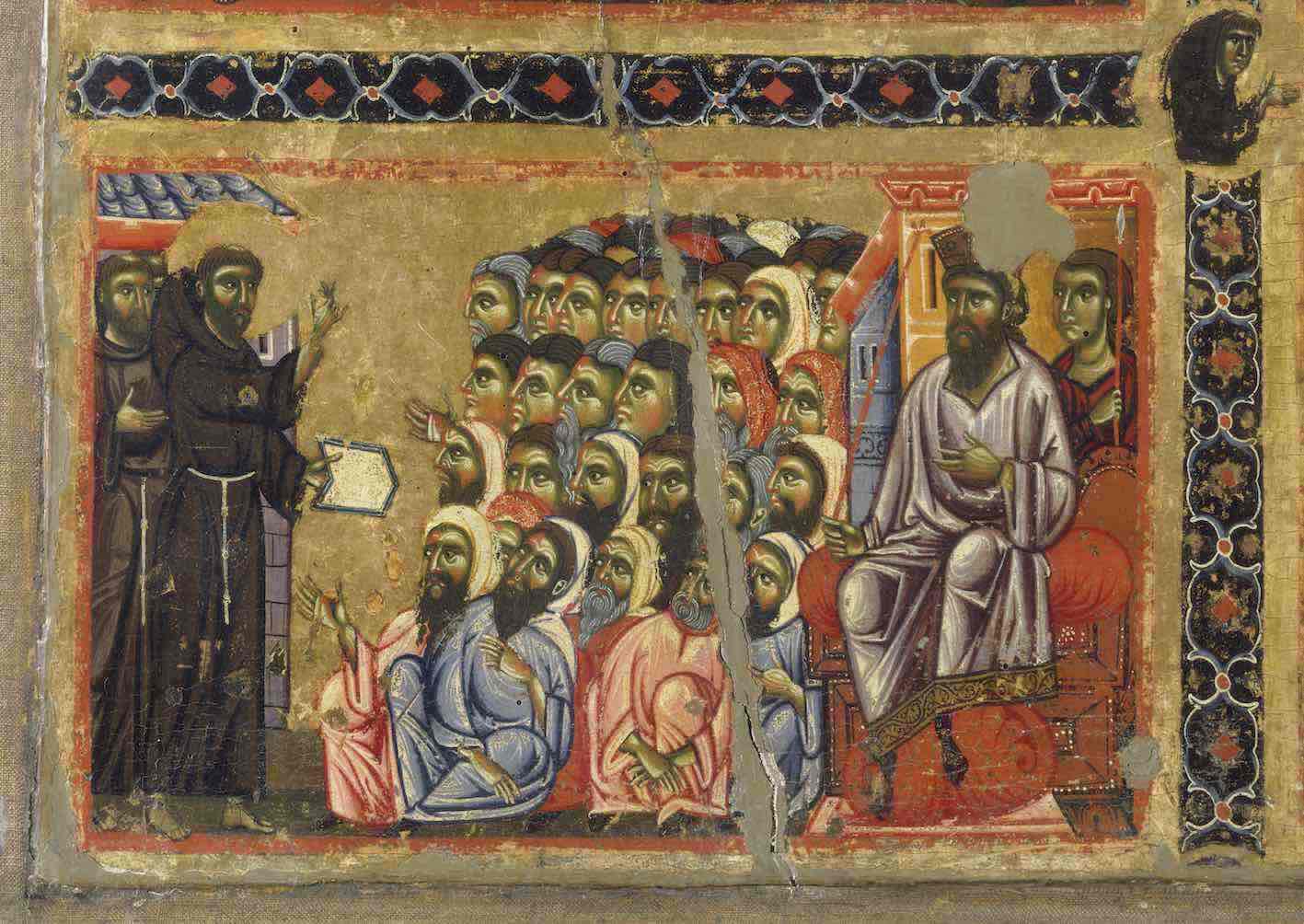
Last week, King Charles III of England declined to issue an Easter greeting to the people of the church he is supposed to lead, as Defensor fidei. He does, however, make sure to mark Islamic holidays, which has led some to speculate that he is a secret convert to Islam. The speculation is not as absurd as it sounds, since Charles has studied Arabic and has written about Islamic theology.
Be that as it may, it fits into a pattern we see in the western churches generally, among “liberals” – I use the term for want of a better word; among those who have lost their grasp on the claim, made by the Lord Himself, that he is “the way, the truth, and the life,” and that no one comes to the Father but through Him.
Liberals are also strongly represented among those embarrassed by the directive the risen Lord gives to all believers, to “go and make disciples of all nations, baptizing them in the name of the Father, and of the Son, and of the Holy Spirit”; among those who assist in the social animus against Christians who hold what have become deeply unpopular beliefs, particularly regarding sexual sins. Paul tells the Corinthians to “flee fornication,” but Paul, the liberal says, was an unreliable fellow.
The pattern is simply that the Muslim faith is to be honored, its reductive theology is to be overlooked, and its historical record, continuing into the present and remarkably bloody even by human standards, is to be whitewashed.
Christians, of course, should hold themselves to the Lord’s high standards. That they have not reliably done so is no surprise. We are a fallen race, quick to anger, slow to forgive, and apt to see specks in other people’s eyes and miss the planks in our own. But when Christians have accepted the grace of God to raise them above the mire, we see real and astonishing transformations, extending also to the social world.
Where is the Islamic counterpart to Matteo Ricci, spending years studying Chinese language, customs, philosophy, literature, and music, so that he could go to the Imperial City and bring to the mandarins themselves the priceless gift of the faith – of Christ crucified, for the sins of all mankind? Or the Islamic counterpart to Father Damian, who stowed away in a ship so he could get to Molokai and minister to the bodies and the souls of the lepers abandoned there?
I am aware that when I say that Christians have the truth, and Muslims do not, I must immediately qualify the statement, since God has left no people utterly in darkness. Indonesia, who have never been contacted by the outside world, and whatever they believe about divinity is not going to be found entirely wrong, though I think I would rather not be present at their sacred feasting.

But the call to evangelization can be urgent only if you believe that you do possess the truth, and that darkness about the ultimate matters of human existence, about death, judgment, Heaven, and Hell, is a dreadful thing.
There is the key. The liberal is confident about his political beliefs, but not so confident about his religious beliefs. Things should be the other way around. He will speak much about providing state care for unwed mothers, but very little about the virtues that make marriage almost universal and unwed motherhood rare, and nothing at all about those virtues as being enjoined by God Himself.
He will speak much about the state’s duty to relieve suffering in the flesh; rather less about suffering as a gift when it is united to the suffering of Christ; next to nothing about the Church’s duty to minister to hearts and minds and souls corrupted by irreligion, ignorance, and licentiousness, and suffering the inexorable spiritual consequences.
Thus he wants to believe everything nice about Islam, while practicing an animus against Christians that rub his conscience the wrong way. He has not the confidence of his own faith, and he detests Christians who do have that confidence.
So he kowtows to Muslims, trusting that if he is nice to them, they will be nice to him, and no doubt many of them will, at least for a time. There is nothing so immediately reassuring when you meet someone, as to learn that you have the same enemies. Nor is there anything so immediately perceived as contemptible, as when someone who ought to know better and who is in a nominal position of authority behaves like an underling, praising you for virtues you do not have.
Among Christian liberals, that is exacerbated by embarrassment or envy, when they curry favor by issuing apologies for the men of old who put a halt to Muslim encroachment upon the West, at Tours, Lepanto, or Vienna. Those men had some fight in them. They did not practice fawning and flattery.
To kowtow, in the literal sense of the Chinese verb, meant to kneel before your superior and, bowing, to knock your head against the ground: k’o for knock or bump, and t’ou for head.
I am not making fun of the custom. I admire the Chinese veneration of the elderly, and their sense of a hierarchical social order. But an old man is old, and the head of the monastery is your superior. Those are realities. The gesture of humble submission is the inferior’s way of participating in his chief’s authority, the young man’s wise acknowledgment of the wisdom of his elder.
But where is the authority when a Christian prince or prelate, having lost confidence in the Church, bows before those who have made a practice not just of knocking other people’s heads, but of lopping them clean off?
Ah, but everyone, especially the weak, huddles in the shadow of a winner.