Posted on | April 29, 2026 | No Comments
Welcome to J-School, boys and girls, and before we start today’s lesson, somebody needs to hit the tip jar for $16.04, for reasons to be explained later. This morning I had an online colloquy with my friend Ladd Ehlinger over the merits of When Harry Met Sally. It was Ladd’s contention that, as a director, Rob Reiner had never produced a masterpiece, to which my rejoinder was that he needed to rewatch that movie, which is certainly one of the best romantic comedies of all time. As much as we all despise Reiner’s left-wing politics, it seems to me wrong to deny him credit for that. Ehlinger shot back with some argle-bargle technical/artistic stuff, to which I replied, “Film school.”
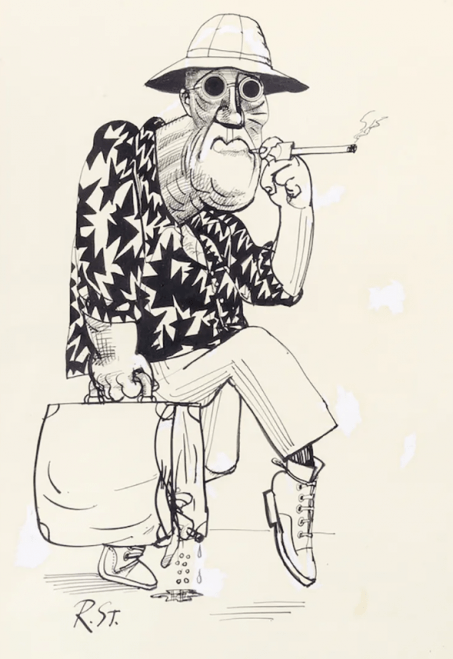
What you have just witnessed, class, was my attempt at what Hunter S. Thompson called the Symbiotic Trapezoid Quote — the lead being a bizarre digression apparently irrelevant to the actual subject , ending with an admission of failure before continuing onward to compile your notes into some semblance of an article. Advanced technique, you see, and not for entry-level students of the craft. Having been in this racket for 40 years, I can make some claim to knowing what I’m doing, and the fact that you’re still reading this post after that (deliberately) botched lead is testimony to this advanced skill. What made Hunter S. Thompson great, at least in the years before chronic substance abuse wrecked him, was that he knew how to grab the reader by the eyeballs and drag him along with vivid phrasing, the reader/victim always wondering, “What’s this crazy son of a bitch going to do next?” Among other things, he accused the editor of the Columbia Journalism Review of being afflicted with “brain syphilis,” and given that the CJR editor did not sue for libel, we can assume that Dr. Thompson’s diagnosis was correct.
So as I was arguing with Ehlinger about the merits of When Harry Met Sally, the analogy occurred to me that Ladd’s film school standards of assessing what constitutes a movie masterpiece is sort of like the CJR editor’s version of what constitutes “quality journalism.” The real test of a movie is whether audiences like it — never mind the artistic quibbles — and the test of journalism is whether people actually read it.
Getting the facts right kind of counts, too, but even a beginner knows that. Learning how to tell the story in such a way that people feel compelled to read all the way to the end? That’s the trick.
BREAKING: In a 6-3 decision, the Supreme Court rules that racial gerrymandering, which has been used to create majority black congressional districts for decades, is unconstitutional. Justice Samuel Alito wrote the opinion for the majority. pic.twitter.com/AtPjtfo4cR
— Sean Davis (@seanmdav) April 29, 2026
OK, there’s your daily quota of Important News, but you didn’t need me to tell you that story, did you? Social media and 24/7 cable news have changed the game in ways that could not have been imagined back in the day when most people got their news from the daily paper, or the 30-minute nightly broadcasts on ABC/NBC/CBS. Now any random son of a bitch with a WiFi hookup can be a “journalist,” which means that I have to find a way to do something different, something valuable, something that might inspire you to hit the tip jar for $16.04. And it so happens that getting a WiFi hookup is relevant to the real reason I wrote this post:
One afternoon in August 2011, I set up my laptop in a restaurant in Omaha, Nebraska, ready to write a column for The American Spectator. It was the week before the Iowa Straw Poll, and I’d spent the day following Herman Cain’s presidential campaign bus, ending the day with a rally at a park in Council Bluffs. My friend Dave Weigel was there, and when he said he was going to have dinner at a German restaurant in Omaha, just across the river, I sort of invited myself to join him.
When I set up my laptop, however, I kept having trouble getting a WiFi connection. After an hour of fruitless effort — and a couple of cold beers — I gave up, telling Dave that it was obvious that I’d fallen afoul of The Gods of Dateline Integrity. . . .
Read my latest Substack article, which among other things includes the explanation for why I’m so specific about that $16.04.