How many of these can you identify? Marcionites, Montanists, Sabellians, Donatists, Quartodecimans, Pneumatomachians, Apollonarians, Monophysites, Nestorians, Waldensians. These are all groups that broke from the Church, insisting that they were the true Church while others were somehow less pure or less faithful. Even if you could identify some or all of them, where are they now? At one point, they welcomed thousands. Now, they’re just names almost no one knows.
Many of them had interesting arguments and complaints. The Donatists, for example, had a rigorous moral code and were understandably opposed to bishops who had been traditores, “traitors,” who had handed holy things over to the Roman authorities during the persecutions. The Monophysites rejected the notion that in Christ there were two natures, divine and human, believing that they were defending the teaching of the Council of Ephesus that Christ was not two persons, but “one physis of the incarnate Word.” So too, Martin Luther was right to complain about the corruption in the Church, the misuse of indulgences (many of them to build St. Peter’s in Rome), and he was right to defend the priority of grace.
The great irony of history is not only that the number of Lutherans is decreasing, but even those who continue to attend Lutheran services have scarce regard for the writings of Luther. Plenty of Protestant groups that left the Catholic fold proclaiming sola Scriptura, “Scripture alone,” have no more regard today for the moral authority of the Scriptures than secularists. Christ insists on no divorce? No problem. St. Paul condemns same-sex sexual acts. Well, that was then; this is now. For some groups, all that’s left is their hatred of Catholics. These things don’t always follow an obvious logic.
So too, for example, here is an odd group. They proclaim fidelity to the pope, and then grievously disobey him. They put a great deal of emphasis on a narrow interpretation of “No salvation outside the Church,” and then shrug off excommunication.
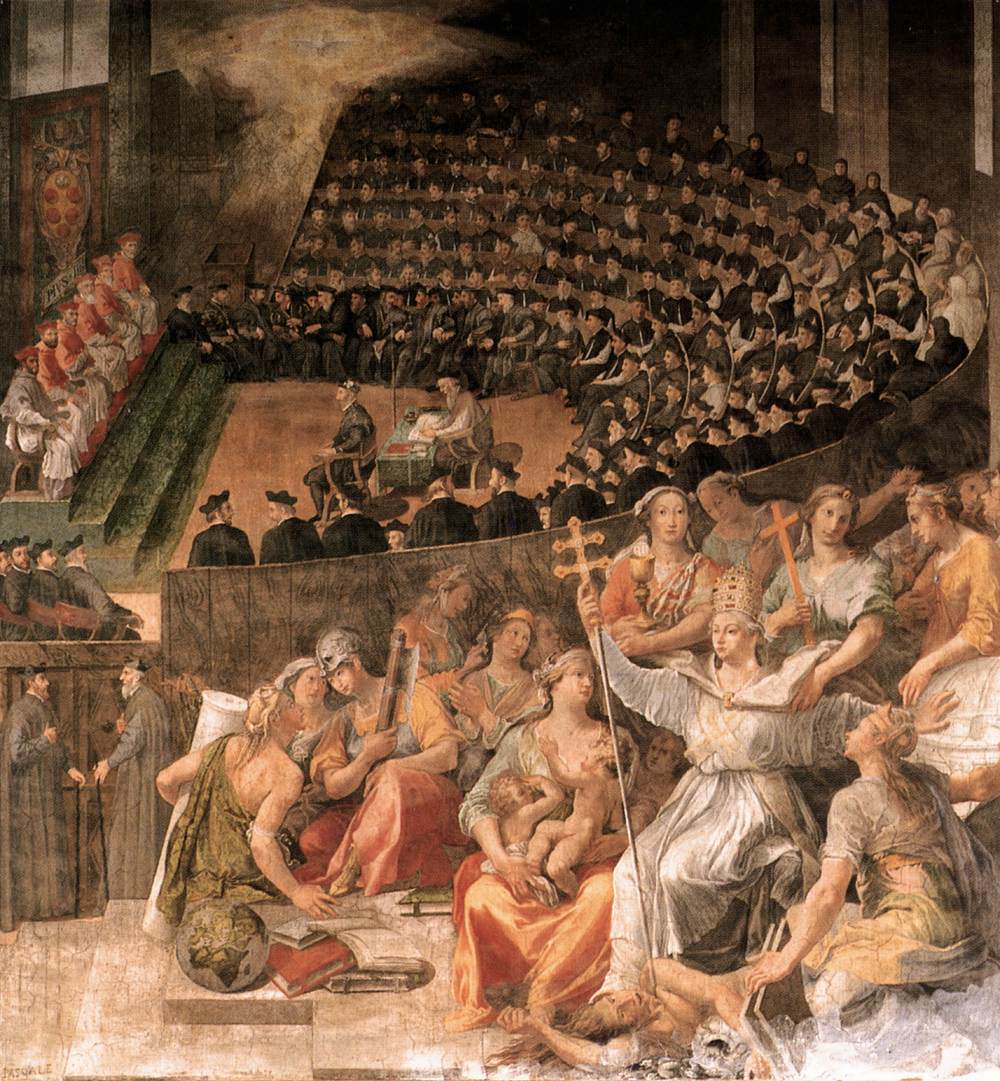
This group says they are uncomfortable with certain teachings of the Second Vatican Council. The history of the Church is littered with groups that accepted all the Church councils up to the one they didn’t like, after which they decided to go their own way. Some accept the first four ecumenical councils (even Lutherans and Calvinists do), some the first seven, others the first thirteen. Dropping out after a council has been pretty standard fare.
But for those who think the Second Vatican Council was unfaithful to the teaching “no salvation outside the Church,” there is this:
This Sacred Council wishes to turn its attention firstly to the Catholic faithful. Basing itself upon Sacred Scripture and Tradition, it teaches that the Church, now sojourning on earth as an exile, is necessary for salvation. Christ, present to us in His Body, which is the Church, is the one Mediator and the unique way of salvation. In explicit terms He Himself affirmed the necessity of faith and baptism and thereby affirmed also the necessity of the Church, for through baptism as through a door men enter the Church. (Lumen Gentium 14)

Yes, the Council also taught (as I think most people have long believed) that there are various ways of being “incorporated” into “the Body of Christ.” Catechumens, for example, “who, moved by the Holy Spirit, seek with explicit intention to be incorporated into the Church are by that very intention joined with her.” So too, “the Church recognizes that in many ways she is linked with those who, being baptized, are honored with the name of Christian.” And even “those who have not yet received the Gospel are related in various ways to the people of God.”
But the Council was also very clear about this: “Whosoever, therefore, knowing that the Catholic Church was made necessary by Christ, would refuse to enter or to remain in it, could not be saved.” So, knowing and affirming that the Catholic Church is necessary but refusing to enter or remain in it endangers the salvation of souls?
You would think that a group that accepts the principle “no salvation outside the Church” and justifies its actions because it is concerned for the salvation of souls would, according to its own principles, be very uncomfortable encouraging those souls to remain outside the Church. At a certain point, we might have to conclude that this has less to do with reasoned theological arguments and more to do with “I want what I want” and “my tribe is better than your tribe!”
The SSPX bishops have appealed their excommunication. But appealed to whom? To Pope Leo, who already decided the case? This would be like appealing a decision of the Supreme Court to the Supreme Court and then saying: I don’t have to pay the fine because my case is on appeal.
This is not a legalistic game. The salvation of souls is at stake. And I wouldn’t trust mine to clerics who brush off excommunication as though brushing off a fly. No one is excusing the problems in the Church. Is this an emergency situation? At least we don’t have three claimants to be pope like they did between 1409 and 1414. At least the papacy isn’t under the political control of France as it was during the Avignon papacy.
I could go on. There are always problems in the Church, many worse than now. Throughout history, groups that have remained faithful when silenced or disciplined by ecclesial superiors have eventually been validated for their witness and fidelity. Groups that choose disobedience and schism rarely survive more than a generation or two.
Renaissance scholars such as Erasmus and More saw the problems in the Church as clearly as Luther and Calvin. But they remained faithful. They did not presume in their arrogance to start their own church. St. Thomas More was martyred for that fidelity. They knew better than others that the road to Hell was paved with good intentions and self-righteous causes.


![Hegseth Demands Fitness Requirements, Says 'Fat Troops' 'Not Who We Are' [WATCH]](https://teamredvictory.com/wp-content/uploads/2025/09/Hegseth-Demands-Fitness-Requirements-Says-Fat-Troops-Not-Who-We-350x250.jpg)