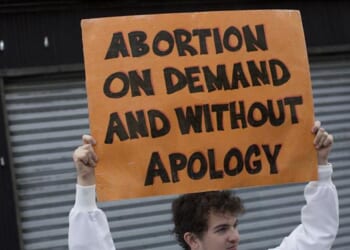
The Planned Parenthood abortion business didn’t waste any time fundraising off the Lindsay Clancy controversy.
While many Americans are horrified that Clancy used a postpartum depression defense and wasn’t held accountable for killing her three children, America’s biggest killer of children is fundraising off of exactly that.
Planned Parenthood of Northern California is raising money with a concert about postpartum depression days after a Massachusetts jury deadlocked in the trial of Lindsay Clancy, the mother charged with killing her three children while her defense cited postpartum psychosis.
Click here to sign up for pro-life news alerts from LifeNews.com
The event, “Night-Time in the Fourth Trimester: Planned Parenthood Benefit Concert,” is set for Oct. 24 at the Unity Center of Walnut Creek, California. Organizers describe it as the world premiere of a song cycle by Jodi Goble and Caitlin Vincent “about the postpartum experiences that have gone unsung … until now.”
The listing says the concert benefits Planned Parenthood of Northern California and “its 90,000 annual patients, whose access to reproductive healthcare is currently at risk.”
The page says new mothers in the United States are “critically underserved” in the three months after childbirth, a period it calls the “fourth trimester.”
“One in 7 women reports suffering from postpartum depression, while as many as 3 in 4 experience milder symptoms, often called ‘the baby blues,’” the listing says. It calls the work “the first-ever song cycle written to give voice to the struggles of the postpartum period.”
The listing does not mention Clancy, but the timing of such an event is in extremely poor taste.
The timing still places a Planned Parenthood fundraiser built around a mother’s postpartum struggle in the same stretch of news as a case that has forced a national argument over whether postpartum depression is an excuse for killing one’s children.
Clancy, 36, a former labor and delivery nurse, is charged with three counts of first-degree murder in the Jan. 24, 2023, deaths of 5-year-old Cora, 3-year-old Dawson and 8-month-old Callan in Duxbury, Massachusetts. She has not disputed that she killed the children.
Plymouth Superior Court Judge William Sullivan declared a mistrial Sept. 4 after the jury deadlocked. Clancy remains charged while Plymouth County District Attorney Timothy Cruz decides whether to retry the case.
Defense attorney Kevin Reddington argued that postpartum psychosis and prescribed medication left Clancy unable to appreciate the wrongfulness of her conduct or to conform her behavior to the law. Prosecutors said she acted intentionally and with planning, cutting how she got her husband to leave the house sand Googled how much time she would have to kill the children.
In response to Reddington’s request for a pardon, President Donald Trump said Sunday the case is a “state situation” and called it “very sad.”
“There’s no winner there. There’s no win no matter what you do. Three children are dead,” Trump said.
A president cannot pardon state murder charges. A pardon would not restore Cora, Dawson and Callan.
Pro-life writers have called that reaction a moral inversion: compassion for a mother who killed her children, with far less public focus on Cora, Dawson and Callan themselves.
Journalist Caitlin Flanagan wrote that “what began as admirable compassion for a woman who says she was driven by mental illness to commit the world’s greatest form of evil has turned into something strange: an almost exultant, fan-like celebration of Lindsay Clancy.”
Paul Batura of Focus on the Family argued that a culture already trained to treat a child’s death as secondary to a mother’s distress — first in abortion, then in cases like this one — struggles to say plainly that killing children is wrong even when the mother is ill. Postpartum mental illness is real, he wrote, but “an individual can be mentally ill and still criminally responsible.”
Abby Johnson, CEO and founder of And Then There Were None and ProLove Ministries, who herself experienced postpartum psychosis after the birth of one of her children, said the intense identification with Clancy reveals a deeper moral distortion long cultivated by abortion advocacy.
“I am not arguing that compassion for Lindsay is wrong…What concerns me is something different. We have become extraordinarily practiced at looking at a dead child and asking first what his or her mother was going through. And abortion taught us how to do that. For decades, the defense of abortion has depended on shifting the moral center of the story away from the human being who dies and toward the human being experiencing the crisis. The mother’s suffering becomes the justification. But suffering does not make killing good,” Johnson wrote.
Johnson stressed that mental illness may affect legal culpability without changing the moral nature of the act.
“Mental illness may affect a person’s culpability for an act. It does not change the moral nature of the act itself,” she said. “Cora was five years old. Dawson was three. Callan was eight months old. Their mother killed them.”
Johnson argued that culture has spent more than 50 years training itself to begin with a mother’s fear, financial stress, lack of support or depression until the child’s humanity nearly disappears—first in abortion and now in cases like this one.
“We can demand better postpartum mental-health care in their names. We can acknowledge that their mother may have been gravely ill. We can pray for Lindsay,” Johnson wrote. “None of that requires us to forget where the greatest irreversible harm occurred. Three children went to bed on January 24, 2023, in the home where they were supposed to be safest. They will never get to grow up.”
Cora, Dawson and Callan cannot be allowed to become peripheral to their own story.