
Kraków, Poland – Poland is a nation that has endured by memory, a land therefore where anniversaries are marked with extra care. It’s where I learned how to observe anniversaries as a means of keeping vital the lessons of history. The anniversary, with its annual recurrence, has chronos (“time”) as its referent, but it makes present anew past moments of kairos (the “right” moment). The liturgy itself has an anniversary character.
For more than thirty years, George Weigel has been leading a three-week seminar in Kraków on the free society, founded in 1992 together with his late colleagues Michael Novak, Father Richard John Neuhaus, and Father Maciej Zięba, OP. Since Fr. Richard’s death in 2009, I have been part of the faculty here, though I certainly cannot take his place.
St. John Paul the Great, a son of Poland, deepened the Church’s ancient intuition about anniversaries, declaring in the first words of his first encyclical that his pontificate would be oriented toward the Great Jubilee of the Year 2000. He had lived the millennium of Poland’s baptism in 1966 as a time of spiritual renewal, national unity, and cultural resistance to Communism.
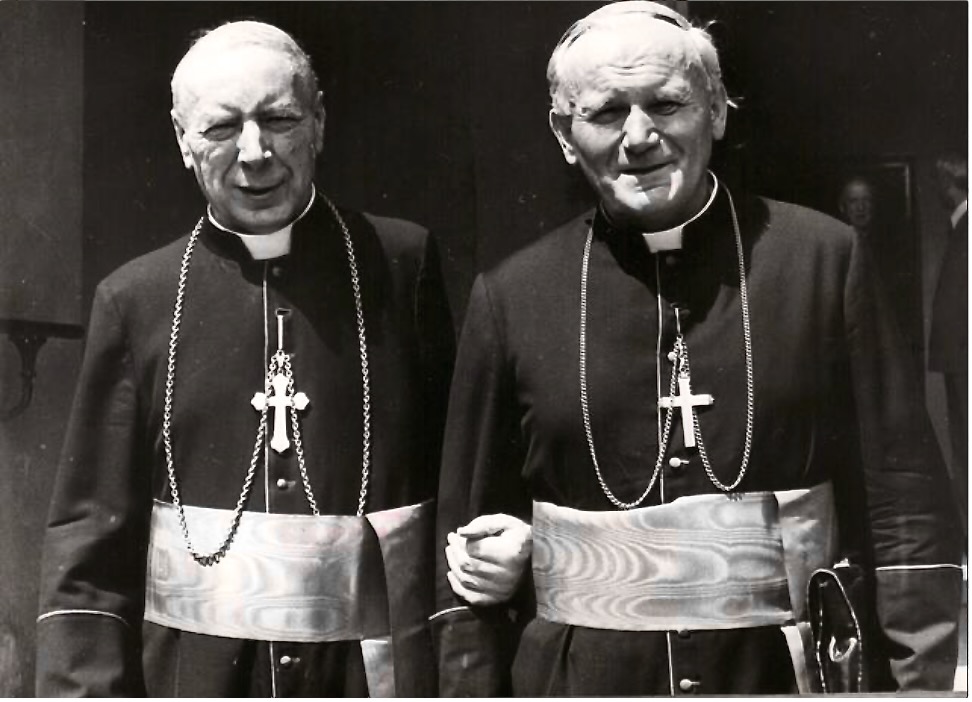
In Poland, anniversaries come to mind more easily. This year I have been thinking about four Polish cardinals who shaped the life and ministry of the Polish pope.
August 3rd marks the 125th anniversary (“quasquicentennial”) of the birth of Cardinal Stefan Wyszyński, the Primate of Poland for thirty-three years, 1948-1981. He was, in Weigel’s estimation, “the undisputed leader of a Church that became the safe deposit box of Poland’s national identity during four decades of Communist efforts to create New Soviet Man.”
Beatified in 2021, Wyszyński is known widely as the “Primate of the Millennium.” He was arrested at his residence in Warsaw and confined in rural Poland for three years, 1953-1956. Upon release he announced the Great Novena, nine years of preparation for the thousandth anniversary of Poland becoming a Christian nation with the baptism of Mieszko I on Holy Saturday, 966.
The millennium celebrations demonstrated definitively that Polish Catholicism was stronger than Soviet Communism. Karol Wojtyła would be ordained a bishop and be appointed archbishop of Kraków during the Great Novena; from Wyszyński, he would learn something of how to deal with tyrants.
Wyszyński’s approach earned him suspicion in Rome. Under Pope Pius XII he was thought to be too accommodating toward the new Stalinist regime by seeking room to maneuver; under St. Paul VI, he was too resistant to the (more accommodating) papal Ostpolitik.
The dominant figure in Wojtyła’s formation was the bishop who ordained him a priest in 1946, Adam Sapieha, the prince-archbishop of Kraków. The longest-serving successor of St. Stanisław, Sapieha for forty years (1911-1951) endured the greatest carnage imaginable – two world wars, the invasion of Poland by Nazi Germany (Auschwitz was within his diocese), and the Soviets, who would “liberate” Poland after the war.
While the Polish primate, Cardinal August Hlond, went into exile during World War II, Sapieha remained. His cathedral sat across the square on Wawel Hill from the royal palace where Nazi governor Hans Frank had taken up residence. Sapieha, a nobleman by birth, was the “unbroken prince” of Polish resistance, hiding his clandestine seminarians in his residence. Amongst them was Wojtyła, whom he would ordain in his own private chapel.

Seventy-five years after his death this July 23rd, Sapieha is not as well known as Wyszyński, but he was the more important figure in John Paul’s life.
Wyszyński and Sapieha were created Cardinals by Pope Pius XII; Sapieha after a long delay due to being in disfavor with Pope Pius XI. Cardinal Marian Jaworski, whose centennial of birth falls on August 21st, was first made a cardinal in pectore by his friend, John Paul, in 1998 and subsequently revealed in 2001.
Jaworski was born in Lviv, now Ukraine, in 1926 when it was part of Poland. Lviv is a spiritual sister to Kraków; even their physical architecture is similar. It was for a long time the seat of the head of the Ukrainian Greek Catholic Church, now transferred to Kiev. It is the center too of Roman Catholicism in Ukraine. Sapieha himself was ordained a priest of Lviv in 1893.
In 1945, with Soviet brutalization being visited upon Ukrainian Catholics, the Latin archbishop of Lviv, Eugeniusz Baziak, fled west into Poland with his seminarians, including Jaworski. They resided first at the shrine of Kalwaria Zebrzydowska, nearby to Wojtyła’s hometown of Wadowice. Baziak would ordain Jaworski a priest there.
Baziak later moved to Kraków, succeeding Sapieha as archbishop. He would ordain Wojtyła an auxiliary bishop in 1958. Meanwhile, Jaworski was entrusted with teaching philosophy and theology in seminaries, living for a time with Bishop Wojtyła in the same residence in the shadow of Wawel.
In 1967, Jaworski replaced his friend in giving a lecture. The train he took crashed, and part of his left arm had to be amputated. Wojtyła considered that his friend had suffered for his ministry.
John Paul appointed Jaworski archbishop of Lviv in 1984, though the Soviets prevented him from entering Ukraine until 1991. It fell to him to rebuild the Ukrainian Church of the Latins after independence returned. He remained a dear friend of John Paul’s to the end. At his deathbed in 2005, he administered the Viaticum to the dying pope. Jaworski died in 2020, and is buried at Kalwaria, the shrine that John Paul visited countless times.
Cardinal Andrzej Maria Deskur does not have a milestone anniversary this year, but I include him, for he was ordained a priest the same year as Jaworski in 1950. The senior Polish bishop in the Roman Curia in the 1970s, he befriended Wojtyła when he had work in Rome. The day before the second conclave of 1978, Deskur suffered a serious stroke.
Cardinal Wojtyła visited him in the hospital and then went directly to the conclave. He returned to the hospital after his election, whereupon Deskur told him that he would offer his sufferings for the new pope and his ministry. He was paralyzed, confined to a wheelchair for the rest of his life. He outlived John Paul, dying in 2011, and is buried at the John Paul shrine in Kraków near the Basilica of Divine Mercy. On his tomb is not his episcopal motto, but “Salvifici doloris,” the title of John Paul’s letter on redemptive suffering.
John Paul considered Poland a land of “especially responsible witness.” The Polish Cardinals of his lifetime included four noble ones.





![WHAT POLICY? Crockett Trips Through MS NOW Softball Question on Her Agenda if Elected to Senate [WATCH]](https://teamredvictory.com/wp-content/uploads/2025/12/WHAT-POLICY-Crockett-Trips-Through-MS-NOW-Softball-Question-on-350x250.png)