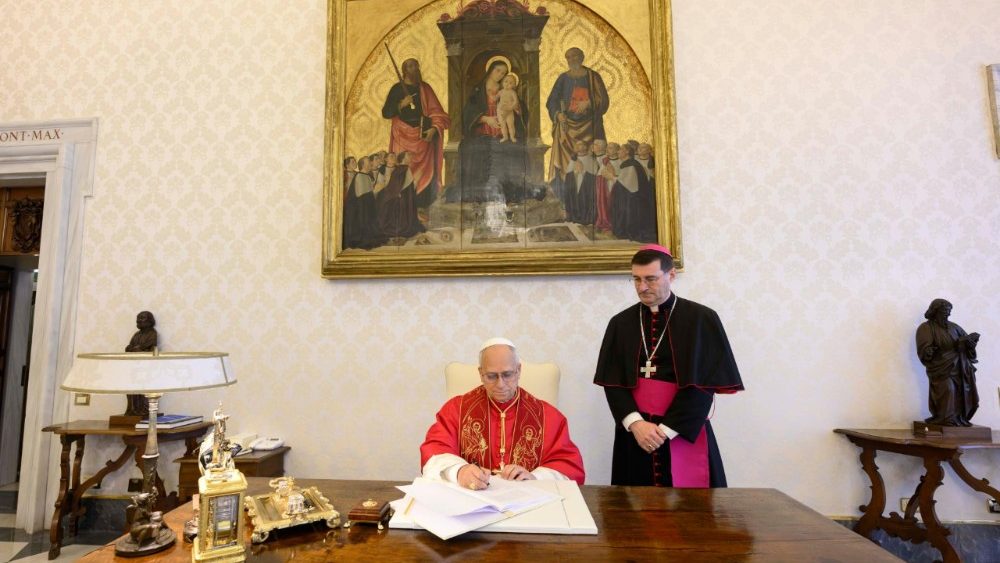
Magnifica humanitas has been widely discussed for its approach to artificial intelligence. Pope Leo emphasizes the importance of the schools for training people to retain their humanity in the face of these challenges. If we took the encyclical as a guide to education, what sort of education would that be?
An essential goal would be to educate students about the dignity of the human person and what is required for the integral development: body, soul, and spirit. It would teach students that, “elevating any single dimension of human existence to an absolute is always a mistake.” The university would have to model this respect for dignity in its own actions and in the rules governing the community. A Catholic university would teach its students not only about rights, but also about their responsibilities and duties. Such an education would consider the nature of the common good and our obligations to it.
Given the pope’s comments, an authentic education would be one in which “a love for truth” is fostered. “When people come to believe that nothing is genuinely true and that principles are hollow,” he writes, “when questions about what is true lose their appeal, and a pragmatism takes hold that is content with what appears useful or effective,” the bonds of trust needed for democratic life are weakened.
And so, “we are in need of a healthy realism that avoids both political idealism and cynicism,” and avoids any ideology that, “in order to preserve its own worldview, tends to choose facts selectively, distorting and renaming them,” whose proponents “eventually, inhabit a reality constructed to fit their own convictions.”
But in addition to avoiding the error of assuming there is no truth, or that there is just “my” truth and “your” truth, students should also be taught to avoid the error of assuming that reaching truth is relatively easy. Students should learn, writes the pope, that authentic education is “a long journey requiring patience and therefore needs time for development and for engagement with reality beyond appearances.” They should be taught how “truth is often distorted in order to serve particular interests and communication strategies.”
Students should learn the value of technology, but also how “technology shapes those who use it.” And they should be taught to avoid succumbing to the dominance of the pervasive “technocratic paradigm.” Computers and cell phones would not be a ubiquitous presence. A “genuinely healthy” community would integrate “rhythms that incorporate silence, in-depth study, reading and judicious analysis, for without these elements inner freedom may be compromised.”
Universities should take care that a “culture fostered on the internet does not become an instrument of excessive distraction, homogenization or dominance.” Rather, they should establish settings “in which inner freedom and critical thought can mature.” Attaining such “inner freedom” and the ability for “critical thought” require the virtues, intellectual and moral, and a university fails if it does not inculcate them.

So too, the pope speaks repeatedly of the importance of dialogue “to establish a set of basic agreements that enable the creation of a shared vision, upon which everyone can move forward together.” Dialogue of this sort is not easy; it requires patience, discipline, and skill and “an attitude that seeks to forge bonds of fraternity built on listening, an open demeanor, making time for each other and even wasting time together.”
“As knowledge becomes increasingly fragmented,” he warns, “it becomes difficult to grasp reality as a whole, to ask profound questions about meaning, or to develop authentic, critical and creative thought.” Thus, a “principal challenge” for universities “lies in the integration of knowledge,” hence they must cultivate in their students “both the capacity to connect and synthesize knowledge in order to grasp complexity, and the skills necessary to verify facts.”
“Many educators,” notes the pope, “already report signs of dehumanization, where students may ‘know many things’ but struggle to find direction in their lives, partly due to an inability to connect information with deeper knowledge or maintain a sense of purpose.” So, an education that inspires a “love for the truth” must also inculcate “the ability to connect information with deeper knowledge and a sense of purpose; one that fosters in-depth study, reading, and judicious analysis.”
Universities should also establish “places and times where physical presence remains crucial, such as shared meals.” How many universities still have shared meals? The pope encourages cultivating relationships of “genuine closeness” in communities where the members “receive care and recognition from attentive minds” and “kind words.” He also speaks of the need to “disarm words.” The “way we communicate is of fundamental importance, so “we must teach students to communicate effectively but to “say ‘no’ to the war of words and images.”
An authentic education would also teach students to respect our human limitations, not indulge them in the illusion that life always follows a steep trajectory upward. Rather, it would teach them how to deal with “failure, loss, and suffering” – how “not to deny or suppress them, but to integrate them.” It would teach them that “over the years, we carry within us lessons that leave their mark like scars, the memories of a journey shaped by freedom and failure, dreams and disappointments,” and that “to renounce this adventure, both tragic and splendid, in the name of a presumed transcendence of all limits, could mean many things, but it would no longer be human.”
And finally, if they followed the guidance of Pope Leo, universities would teach their students that, “when we embrace the possibility of transcending ourselves through God’s grace, we do not deny our nature, nor do we become less human”; on the contrary, “we become fully human” when “we let God bring us beyond ourselves in order to attain the fullest truth of our being.”
It’s a good list. No college or university is doing all of it. Someone should try.



![Hegseth Demands Fitness Requirements, Says 'Fat Troops' 'Not Who We Are' [WATCH]](https://teamredvictory.com/wp-content/uploads/2025/09/Hegseth-Demands-Fitness-Requirements-Says-Fat-Troops-Not-Who-We-350x250.jpg)