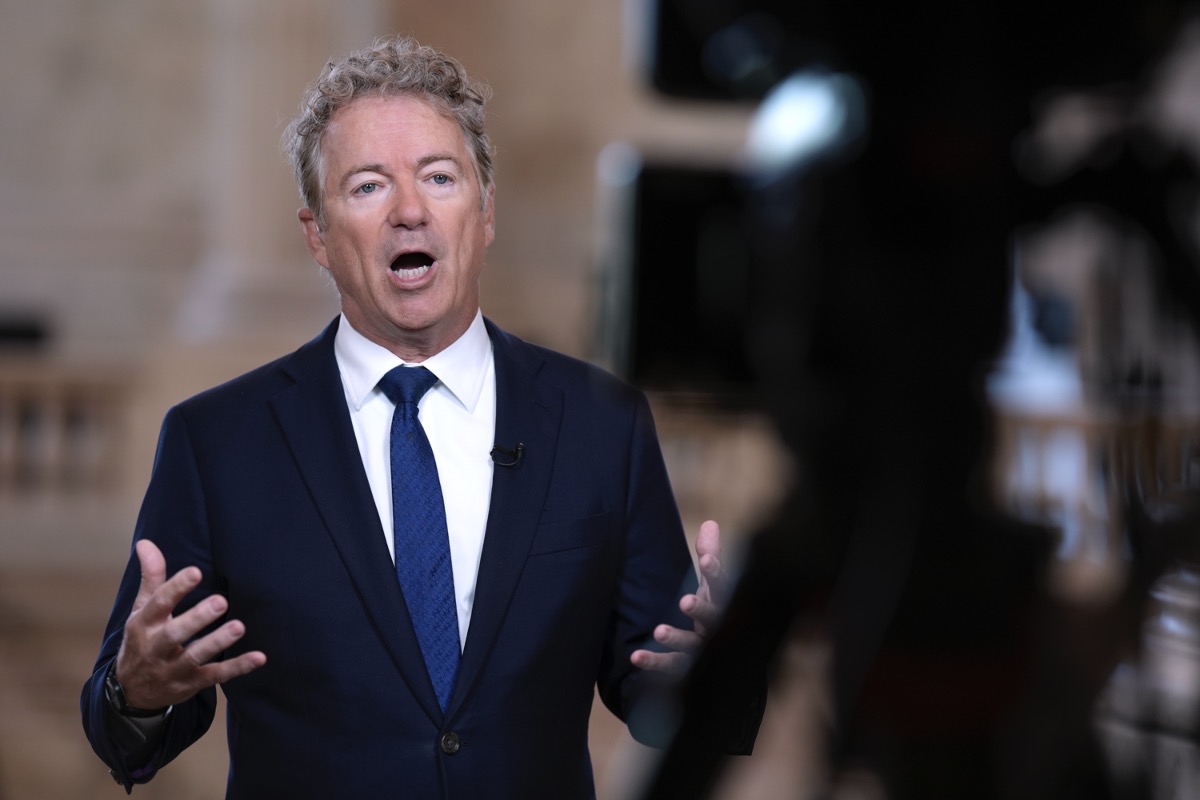
The most constitutionally obedient U.S. senator is mulling over a 2028 presidential run. But first, Senator Rand Paul (R-Ky.) wants to see how the midterms shake out.
Economic Views
“I think there needs to be a candidate that is a free-market conservative, somebody who believes that the debt is wrong, Big Government is bad, but also that we get richer through international trade and that capitalism on an international scale is a good thing, not a bad thing,” Paul told Newsmax this week.
Paul has repeatedly said that the gravest threat to the country is the national debt, which recently crossed the $40 trillion mark. He, along with his libertarian counterpart in the U.S. House, Kentucky’s Thomas Massie, have been the two most vocal debt alarmists.
Economic education appears to be a primary driver for Paul’s consideration. “I think the populism of the party now is teaching something that’s an economic fallacy,” he told Newsmax. “And so I think it would be a robust debate to have a free market, libertarian-leaning conservative like myself, who doesn’t think the government should own businesses, shouldn’t be involved, that capitalism should reign.”
Paul’s comments come at a time when a Republican White House has entangled the government in areas of commerce that government has no business meddling in, at least according to conventional conservative philosophy. Last month, the White House announced that the Defense Department took a 35-percent equity stake in the oil company North American Blue Energy Partners. The administration has also involved the government in the mining, tech, and defense sectors. As Politico summarized last month:
Starting with Trump’s surprise moves to take a “golden share” in U.S. Steel and then a 10 percent share in Intel more than a year ago, the administration is approaching $30 billion in equity stakes, warrants or similar plans in U.S. companies by most estimates, a fairly radical departure from orthodoxy outside of times of financial crisis — like the massive government bailouts of 2008-2009 — or world war.
Against Foreign Intervention
Unlike most people in the U.S. government, Paul is an noninterventionist. He holds foreign policy positions more in line with those of George Washington, John Q. Adams, and other early American statesman than with those of most current politicians. Modern U.S. foreign policy aligns with a neoconservative philosophy designed for empire building and globalization. Paul has consistently opposed the Iran War and U.S. involvement in the Ukraine War. His warnings have proven prescient and practically unfortunate for the millions of Americans struggling to gas up their vehicles, pay for their groceries, and heat and cool their homes. Both wars have squeezed global energy supplies and spiked prices for virtually everything.
Anthony Fauci
Paul has focused a lot of his legislative energy on going after Anthony Fauci, the face of America’s disastrous Covid-19 response. It’s fair to say that were it not for Paul’s doggedness, Fauci would’ve ridden off into the sunset without any further scrutiny. Instead, Paul and his staff have made the most of a Health and Human Services leader who wrote a book on Fauci’s decades-long track record of corruption. Secretary Robert F. Kennedy, Jr. has provided Paul’s office with Fauci’s diaries and phone messages. Fauci has been dragged in front of Congress, and is potentially facing state charges. And although he has incurred no real consequences yet, Paul’s efforts have at least shown the world that Fauci knowingly and repeatedly lied to the American people.
Free Trade & Tariffs
However, when it comes to Paul’s “free trade” absolutist positions, which he appears to allude to in his comments to Newsmax, this magazine disagrees. As we’ve previously said, “a country wishing to remain free and independent cannot afford to become dangerously dependent on foreign suppliers, particularly potentially hostile powers, for essential commodities from oil to steel.”
Free-trade agreements erode national sovereignty while contributing to the buildup of a world government. Globalist and Council on Foreign Relations member Henry Kissinger admitted outright in 1993 in a Los Angeles Times op-ed that the point of NAFTA — the North American Free Trade Agreement — was to create a New World Order. He wrote that NAFTA would
represent the most creative step toward a new world order taken by any group of countries since the end of the Cold War, and the first step toward the even larger vision of a free-trade zone for the entire Western Hemisphere.
Kissinger also wrote that what Congress faced was “not a conventional trade agreement, but the architecture of a new international system.”
As we’ve pointed out, “trade agreements integrate countries economically and politically by ceding sovereignty to international bureaucracy built above these countries.” An example is the European Union.
In trying to go back to tariffs, the Trump administration has the right idea but the wrong approach. Tariffs should be approved by Congress, not executive orders. We encourage readers to visit The John Birch Society’s action page on free trade for an in-depth look at this pressing issue.
Still a Good Choice
Paul’s faulty views on free trade notwithstanding, he would be a significant upgrade from any president this country has had since Calvin Coolidge. Paul has earned Freedom Scores of 100 in the last three Congresses, according The New American’s Freedom Index. His cumulative score is 96 percent. If Congress had more members like Paul as opposed to the other Bluegrass senator, Mitch McConnell, the country would be in much better shape. McConnell’s cumulative score, for those who are wondering, is a dismal 56 percent.
But we’re a long way from 2028, and as we’ve seen over the last two years, a lot can change in 24 months. For now, the assumed GOP front-runner for 2028 is Vice President JD Vance, who happens to be not so bullish on “free” trade. But Secretary of State Marco Rubio has also been viewed as a potential successor. Rubio is considered more hawkish on foreign policy, which is more appealing to the donor class.
Then there’s the matter of who best represents the paleoconservative-libertarian wing of the GOP. Massie, a fellow Kentuckian and friend of Paul’s, created a large following during his unsuccessful reelection bid this year. There have been many calls for Massie to run for president, and as far as we know he hasn’t completely ruled that out yet. If Paul is considering a run, could this be a sign that Massie has told him privately that he won’t run?
Major Change Needed
Either way, the GOP needs not just a shake-up, but party leaders who understand and respect the Constitution. The nation’s existence depends on it. Whether Paul, Massie, or someone else who comes close to adhering to the principles that made this country great runs, the citizens of the United States would benefit greatly from having a sensible Americanist voice on the debate stage in 2028.