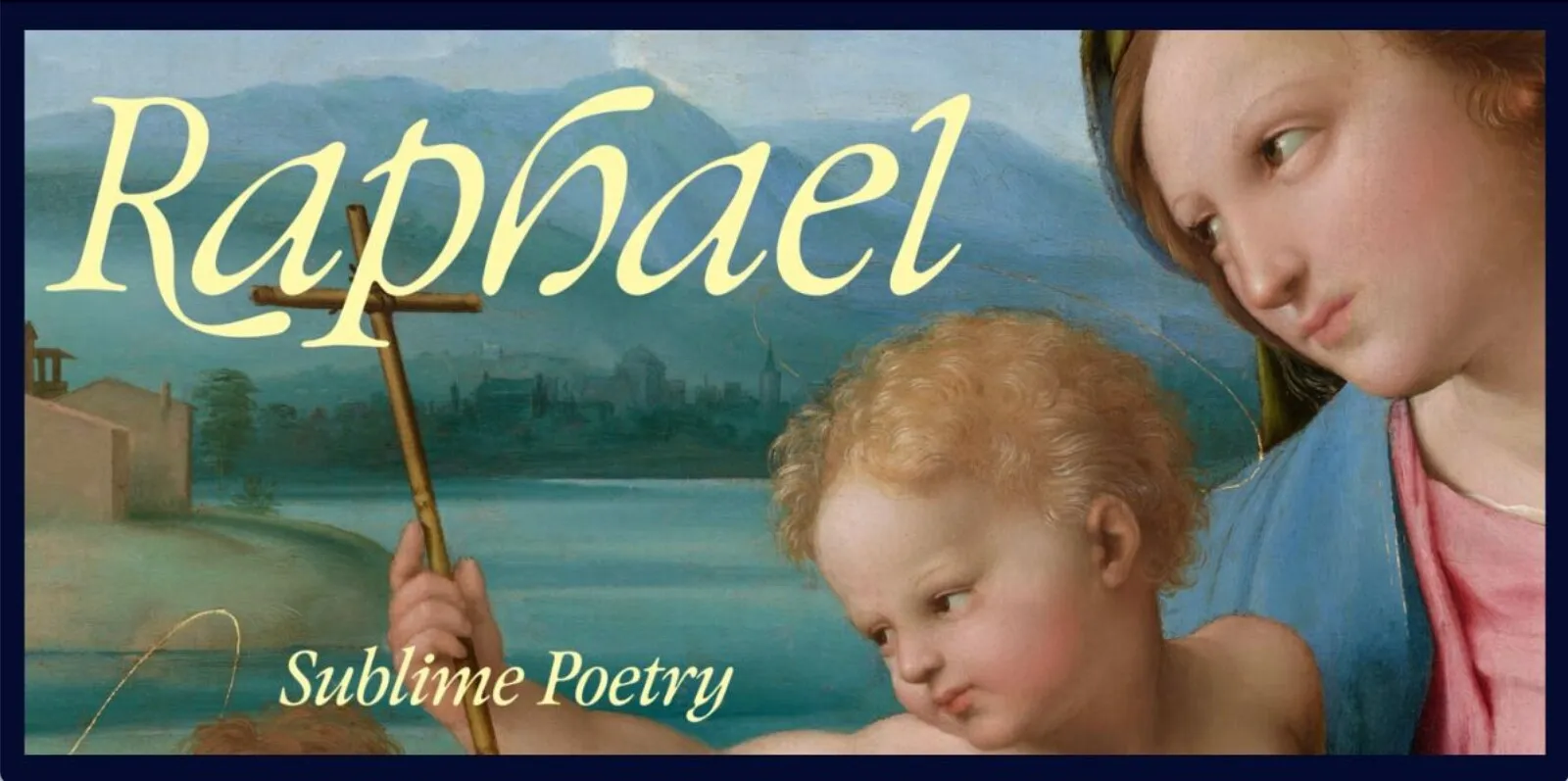
The current show at America’s greatest museum, Raphael: Sublime Poetry, will run through June 28th of this year. As with most major exhibits at the Metropolitan Museum of Art, curators have gathered works by the artist from museums around the world – and in this case, not just by Raphael. There are 237 works in total, including 33 paintings, 142 drawings, some monumental tapestries, and some sculptural work, too.
In remarks before the show’s opening, principal curator Carmen Bambach said that, whereas many consider him third on the list of Renaissance masters, she “could make the argument that Raphael is every bit the equal of Leonardo and Michelangelo.” After spending eight years pulling together the exhibit, I doubt she could say anything else. In any case, Raphael was a superb artist, and the show is stunning.
I wonder, though, if most people could name a Raphael painting. Asked about da Vinci, many could name “The Last Supper” and certainly the “Mona Lisa.” And about Michelangelo, the Sistine Chapel ceiling or one of his sculptures, the “David” or “Pietà” perhaps. Of course, visitors who’ve toured the Vatican Museum and seen the Raphael Rooms would certainly remember those extraordinary frescoes.
But Ms. Bambach is among the best in the business when it comes to Renaissance art. When Robert and Veronica Royal were in Manhattan in 2017, my wife, Sydny, and I joined them at another of Bambach’s MET curations, Michelangelo: Divine Draftsman and Designer. And even if I’d visited the Raphael show not knowing Bambach is its curator, I would likely have assumed it must be her handiwork.

Raffaello Sanzio da Urbino (1483-1520) was a kind of shooting star: He came to Rome from Umbria in northeast-central Italy at the age of 23 and died there at 37. In his Lives of the Most Excellent Painters, Sculptors, and Architects, the first true art historian, Giorgio Vasari (who was born in 1511, so did not know Raphael personally) wrote of him:
How generous and kind Heaven sometimes proves to be when it brings together in a single person the boundless riches of its treasures and all those graces and rare gifts that over a period of time are usually divided among many individuals can clearly be seen in the no less excellent than gracious Raphael.
Vasari did know the great Michelangelo, and it’s probably not an exaggeration to say he idolized him. And he definitely knew that the older man (Michelangelo was eight years Raphael’s senior) frankly detested the upstart from the east, which enmity may have begun when Michelangelo saw himself portrayed in Raphael’s Vatican fresco, The School of Athens, as an isolated, brooding, tormented Heraclitus.
Michelangelo was neither a schemer nor a debaucher, and Raphael had a reputation for being both. Maybe yes, maybe no – it doesn’t matter, because it’s clearly what Michelangelo believed.
But Vasari does write that when the sculptor Donato Bramante, keeper of the keys, let Raphael into the Sistine Chapel for the first time (Michelangelo was away in Florence), the young man was so stunned by the majesty and muscularity of Michelangelo’s prophets and patriarchs, that “after he had already finished it, Raphael immediately repainted the figure of. . .Isaiah in Rome’s Sant’Agostino.”
This may have been why Michelangelo said, “Everything he knew about art he got from me.” In some versions of the quote, “got” is “stole.” Whether or not Raphael was a plagiarist is debatable. After all, everybody who has mastered anything has had teachers along the way.

The MET’s show is comprehensive. It even includes a room in which all the frescoes from the aforementioned Vatican Raphael Rooms are projected by video onto the walls in rotation. (The same was true at that Michelangelo show, with the Sistine Chapel illuminated overhead in the gallery.)
It is fine and fitting to see featured in the exhibit paintings by Pietro Perugino, a superb painter and one of Raphael’s teachers, as well as bas-relief sculptures by Raphael.
For me, though, there were three highlights. First (and this comes more from Sydny), is the remarkable number of drawings by Raphael (as above). There may be no better way to gauge the pure technique of an artist than such sketches, and it’s rare to see them because of their fragility.

Second, and my own personal favorite, is Raphael’s portrait of the writer-statesman Baldassare Catiglione, about whom I wrote in my first-ever The Catholic Thing column (“In Praise of Sprezzatura,” June 18, 2008). It belongs to the Louvre, and I was planning to see it there in September; now I can focus on elbowing my way up to Mona Lisa. Castiglione and Raphael were friends, and it shows. And the painter managed to create the effect whereby Castiglione’s eyes follow you at every angle of viewing, which happens to be called the “Mona Lisa Effect.”
And third, the tapestries.

As you may assume from the dates in the image above, Raphael, who died in 1520, did not weave the tapestry himself, nor would he have had he been alive. He created “cartoons” that were provided to Jan van Tieghem and Frans Gheteels in Belgium, who made copies of Raphael’s paintings and cut them into strips, which were laid beneath the loom to guide the weavers in their work.
Finally, as a kind of coda to both this wonderful exhibit and this modest review, there is a sublime black chalk self-portrait from about 1500 when Raphael was a teenager. It was drawn on laid paper (made in a laborious process of straining pulp through a sieve, then pressing, cutting, and drying). Raphael used white chalk to create highlights, but those have faded and flaked and are lost. And here the artist is: