Pope Leo XIV is traveling to Rimini today for the annual cultural festival organized by Communion and Liberation (CL). Few use its formal name, the “Meeting for Friendship Amongst Peoples.” It’s simply “Rimini.” It might be the only thing many know about the Italian coastal town, which draws major figures from the worlds of religion, the arts, and even Italian politics for its summer gathering. Some 80,000 participants attend, with three-quarters of a million more following online.
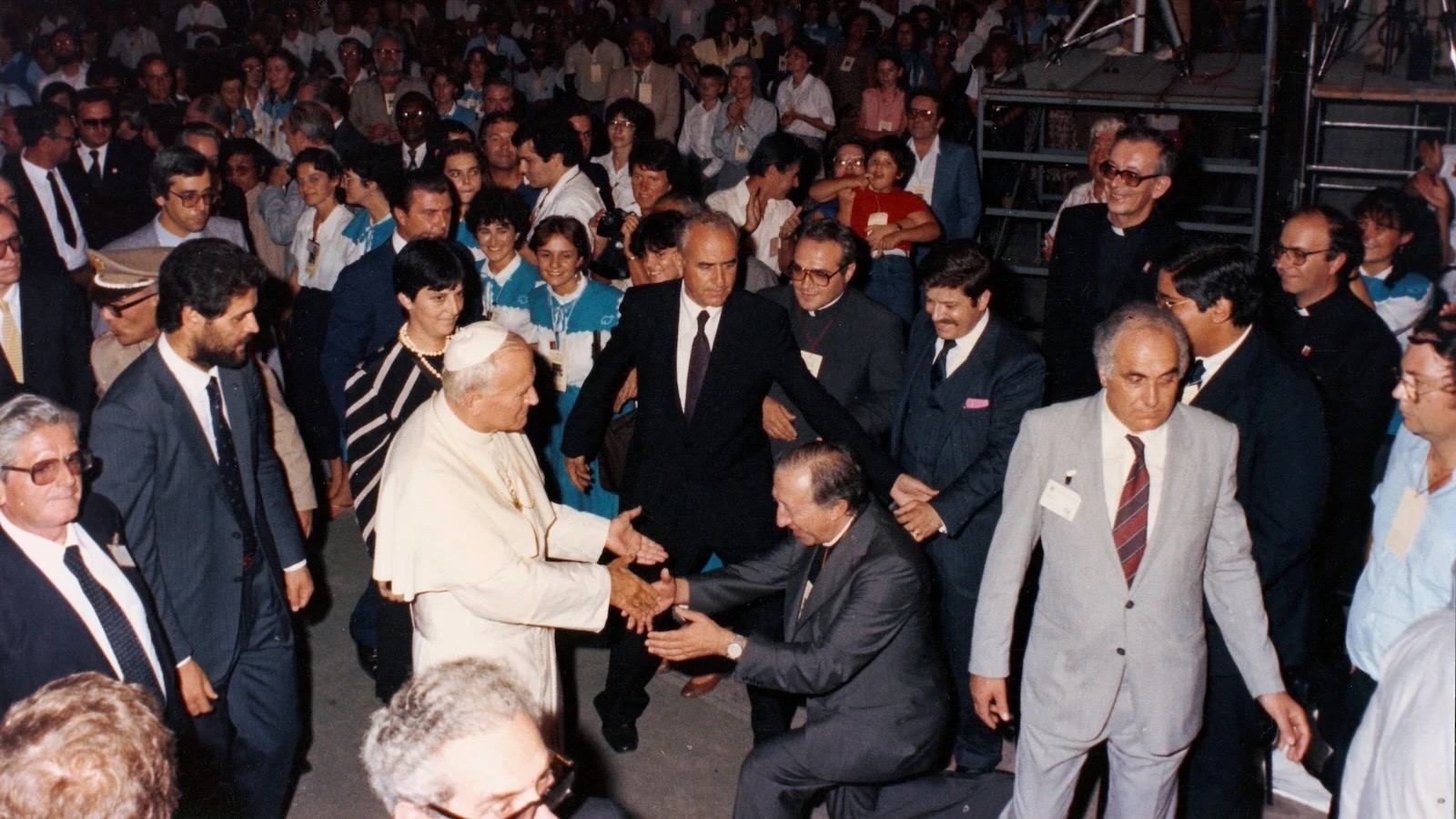
Communion and Liberation inaugurated the Rimini meeting in 1980, and already in 1982 St. John Paul the Great visited. Pope Leo will be the second pope to visit and what he says about culture, art, and beauty will be noted carefully. Just this week at his general audience, the Holy Father spoke of music and the worship of God.
This year’s Rimini theme is taken from the final line of Dante’s Inferno: “The Love which moves the Sun and the other stars.”
It’s perfect for Rimini, where devout Catholics speak in a language that they hope will engage even nonbelievers. Thus the “love” of this year’s theme is explained as “the dynamic principle of the cosmos, the energy that holds everything together and drives it toward fulfillment.”
That sounds a bit like “The Force” in Star Wars, but that’s the CL way. They are clearly intended to offer an opening to the Holy Father and his recent teachings on artificial intelligence.
“We live fragmented within digital bubbles that isolate rather than connect us,” CL’s introduction continues. “In a world where algorithms decide what we see and whom we meet, rediscovering love as a force that moves and transforms becomes a radical challenge. It means recognizing that reality is not static chaos, but carries within itself a direction, a dynamism that pushes us beyond ourselves.”
That there is a dynamic that takes us beyond ourselves was articulated at Rimini in two memorable addresses that were not given by a pope, but a future one: Cardinal Joseph Ratzinger, in 1990 and 2002. How does that love dynamic manifest itself? In beauty and sanctity, which is what Ratzinger said the Church offers the world as her ultimate testimony.
Ratzinger was close to the CL movement and its founder, Msgr. Luigi Giussani, so much so that he preached at Giussani’s funeral Mass just months before his own election as pope in 2005:
Father Giussani had grown up in a house – as he himself said – poor in bread, but rich in music. . . .And so, from the beginning he was touched, indeed wounded, by the desire for beauty; he was not satisfied with just any beauty, a banal beauty: he sought Beauty itself, infinite Beauty; thus he found Christ, in Christ the true beauty, the path of life, the true joy.

Ratzinger was thus applying to Giussanni a longstanding claim of his, articulated most famously at Rimini in 2002:
I have often already stated my conviction that the true apologia of Christian faith, the most convincing demonstration of its truth, against any denial, is on the one hand the saints and on the other the beauty that faith has generated.
Earlier in the same address, Ratzinger recalled “an unforgettable experience for me was the Bach concert conducted by Leonard Bernstein in Munich after Karl Richter’s untimely death.”
“I was seated next to the Evangelical Bishop Hanselmann,” he said. “When the last note triumphantly faded away, we spontaneously looked at each other, and just as spontaneously said, ‘Whoever has listened to this knows that faith is true.’”
Ratzinger too grew up rich in music; he described his hometown as belonging to the “Mozart region of Bavaria.”
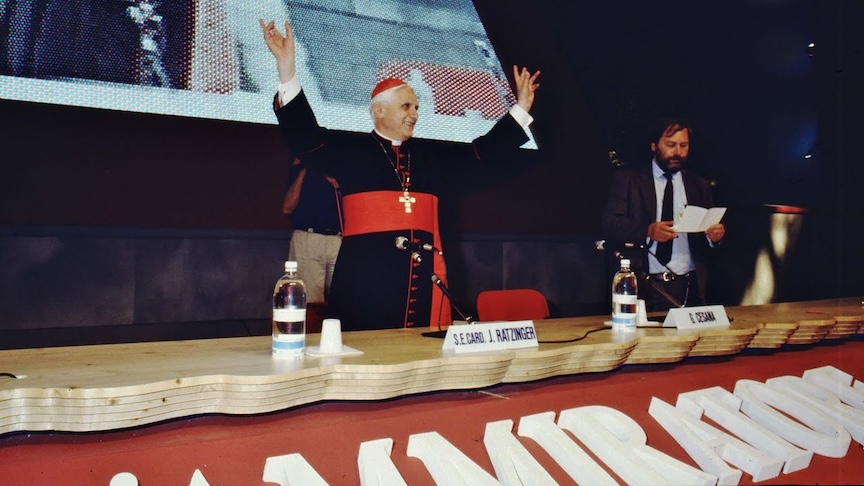
In the truly magisterial lecture that he gave at Rimini in 1990, Ratzinger addressed the question of authentic reform in the Church. Some twenty-five years after Vatican II, he explored what true and false reform meant. What needed to change so that what doesn’t change – the Gospels, the deposit of the faith, the tradition of holiness – can be discovered anew?
He reached for an artistic image in 1990, one of the most famous from the most celebrated artist in history.
“With his artist’s vision, Michelangelo saw in the stone before him the image hidden beneath, waiting to be liberated and brought to light,” Ratzinger said. “The task of the artist, in his view, was simply to take away that which still covered that image. Michelangelo thought of authentic artistic activity as bringing something to light, releasing it, not ‘making’ it.”
The artist releases, or reveals, a beauty that is already there. Revelation is very much the Christian understanding of reality. Having turned to the artist, Ratzinger then turned to one of his favorite saints.
“The same idea applied to anthropology was already evident in Saint Bonaventure, who explained the journey through which man becomes authentically himself by using the image of the sculptor,” Ratzinger explained. “Thus it is for man: so that the image of God may shine in him, he must above all, and first of all, welcome that purification through which the sculptor, namely God, frees him from all the debris that obscures the authentic aspect of his being, that makes him appear as nothing more than a gross block of stone, when really the divine image dwells in him.”
The artist reveals the figure in the marble. The Divine Artist reveals the holiness lying within the dust of the earth. The dynamic of revelation is love; love of the artist for his subject, love of God for man.
The Divine Comedy reveals what it means that it is love which moves the sun and the other stars. For CL, Rimini is a collective profession that beauty is a principal means of that revelation. That certainly resonates with Pope Leo, a son of St. Augustine, who came belatedly to love beauty, “ever ancient, ever new.” No doubt Leo will have read Ratzinger at Rimini ahead of his visit and will offer his own reading of the dynamic force of Love in a digital age.


![Hegseth Demands Fitness Requirements, Says 'Fat Troops' 'Not Who We Are' [WATCH]](https://teamredvictory.com/wp-content/uploads/2025/09/Hegseth-Demands-Fitness-Requirements-Says-Fat-Troops-Not-Who-We-350x250.jpg)