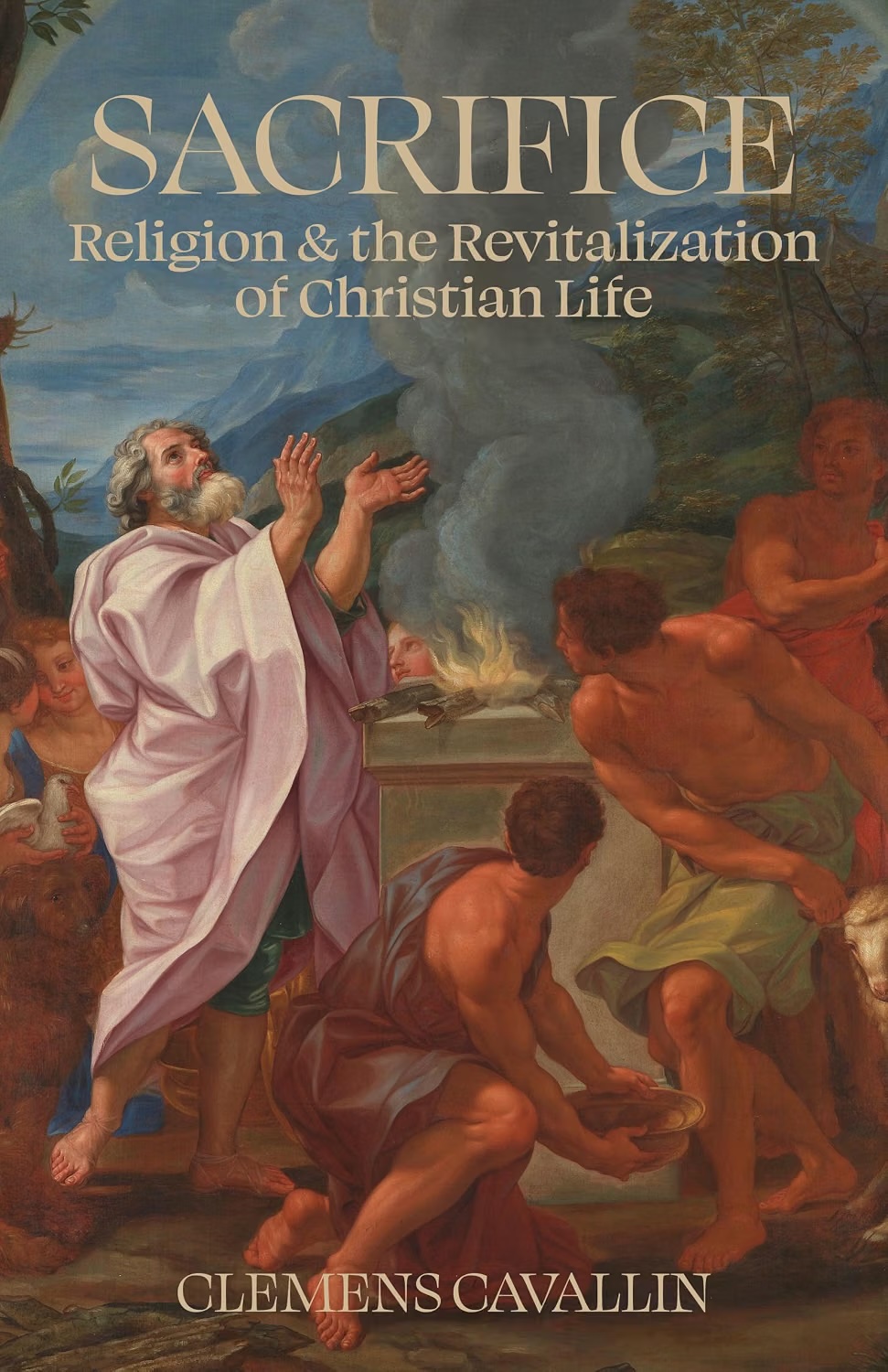
Sacrifice is a paradox. A compelling paradox. In his new book, Sacrifice: Religion and the Revitalization of Christian Life, Clemens Cavallin dives headfirst into the historical, theological, and salvific nature of sacrifice throughout the human and divine story, calling his readers to a renewed embrace of the true nature of God’s redemptive plan.
This compelling book is a reflection on the reality of sacrifice, both secular and religious, and its lamentable absence from modernity. Cavallin examines the modern world’s attempt to eliminate sacrifice, and the consequent attempt by some within the Church to reconstruct Christianity without sacrifice. This endeavor, Cavallin argues, must ultimately prove futile because there is a fundamental human need for sacrifice, and hence for a priestly office and mediation with the supernatural.
Cavallin contends that our non-sacrificial, modern civilization has shaped the Christian churches themselves, weakening their understanding of sacrifice as a fundamental reality. Modern culture fosters the illusion that peace is possible without a serious reckoning with evil. When catastrophic violence erupts, many modern Christians are therefore left bewildered.
The secular narrative assumes that history should keep moving steadily upward: materially, socially, and psychologically. Yet when that promise fails – when suffering, violence, and disorder persist – dismay naturally follows.
For Cavallin, this confusion points to a deeper loss. To understand civilization honestly, Christians must recover the centrality of sacrifice. Only then can Christian life regain its vigor and renew its capacity to direct civilization beyond itself, toward the supernatural.
Evil, Cavallin observes, involves the sacrifice of others as one pursues one’s own selfish interests. The gas chambers of the Third Reich, the Soviet Gulags, or the ubiquitous abortion mills of the West are just a few salient examples.
But the reality of violent evil, of course, is nothing new – it’s as old as Cain and Abel. This is why all the ancient religions contained some form of sacrifice. Indeed, as Cavallin posits, the need for sacrifice, in response to evil and as a means of communion with the supernatural, is inherent in what it means to be human. Cavallin presents an informative study of comparative religion, seeing sacrificial religion as a general human phenomenon present throughout human history, a phenomenon that is indeed even prehistoric.
Cavallin builds all this on a solidly Thomist foundation, finding much that is positive in natural religion, even while acknowledging the effects of the Fall on the human intellect and will. The human heart has a natural religious inclination which is ultimately fulfilled in the sacrifice of Christ on the Cross, but the Christian can undertake careful discernment and find elements of profound truth in other religious traditions on the philosophical, theological, and spiritual level.

Cavallin leads the reader through such a careful discernment, examining themes of sacrifice present in natural religion; the distinction between what is sacred and profane; the relationship between violence and sacrifice; and the ultimate fulfillment of natural sacrifice and its transformation by Christ on the Cross.
Ritual sacrifice, Cavallin observes, requires a sacred place and time in which the sacrifice is accomplished. The ritual unites humans with the gods. At the center of the ritual is the offering of the victim, an action which requires violence because the victim must be slain. The victim being slain may serve as a scapegoat, a substitute that offers redemption and fellowship with the gods as a result of its sacrifice.
This is why the sacrifice necessarily also includes a meal, a meal to which the gods are also invited. Even when the prophets critiqued the sacrifices of ancient Israel, pointing out that they did not correspond to the necessary interior conversion and obedience to God, they did not call for the abolishment of the external ritual inherent in public sacrifice.
Rather, the interior attitude of sacrifice is mediated through the sacralization and ritualization of human action, in accord with man’s nature as a social animal. All of these insights contribute to Cavallin’s ultimate argument that Christianity must rediscover the centrality of sacrifice if it wishes to remain culturally relevant.
These various aspects of sacrifice in its interior and exterior dimensions find their ultimate fulfillment in the sacrifice of Christ on the Cross. This sacrifice was accomplished once and for all on Calvary but is now made present under the form of bread and wine in the liturgical sacrifice that is central to Christian worship.
As Cavallin aptly observes, Christian ritual becomes “a privileged meeting point for matter and spirit, earth and heaven, interior and exterior, and the individual and the community. And in the middle of this nexus stands sacrifice as an expression of love.”
He concludes with both a warning and a promise. If the Christian life neglects sacrifice, striving merely to make earthly existence better and better, it will ultimately only exhaust and disappoint. But if the Christian life can recover sacrifice as its central purpose and indeed its defining element, it will recover the centrality of love, the love of the immortal and eternal Godhead who placed Himself in the lowest place and offered Himself as the price of our redemption. His sacrifice then invites every Christian to make of themselves similar offerings, transforming their lives into sacrificial gifts for their fellow human beings, and indeed for God Himself. Such an understanding of sacrifice requires one to be ready for martyrdom.
Cavallin’s study will reward the persevering reader with a renewed understanding of and appreciation for the fundamental role of sacrifice in the Christian life. It is this Sacrifice, this Great Love, Who calls us to become one with Him in offering Himself in Love to the Father. Cavallin’s book provides insight and motivation for the Christian struggling to make sense of our contemporary chaos, dispelling the darkness with a ray of Divine Light: the sacrificial and salvific Love of Jesus Christ.