The federal courts have handed Americans two victories in the battle for voting integrity.
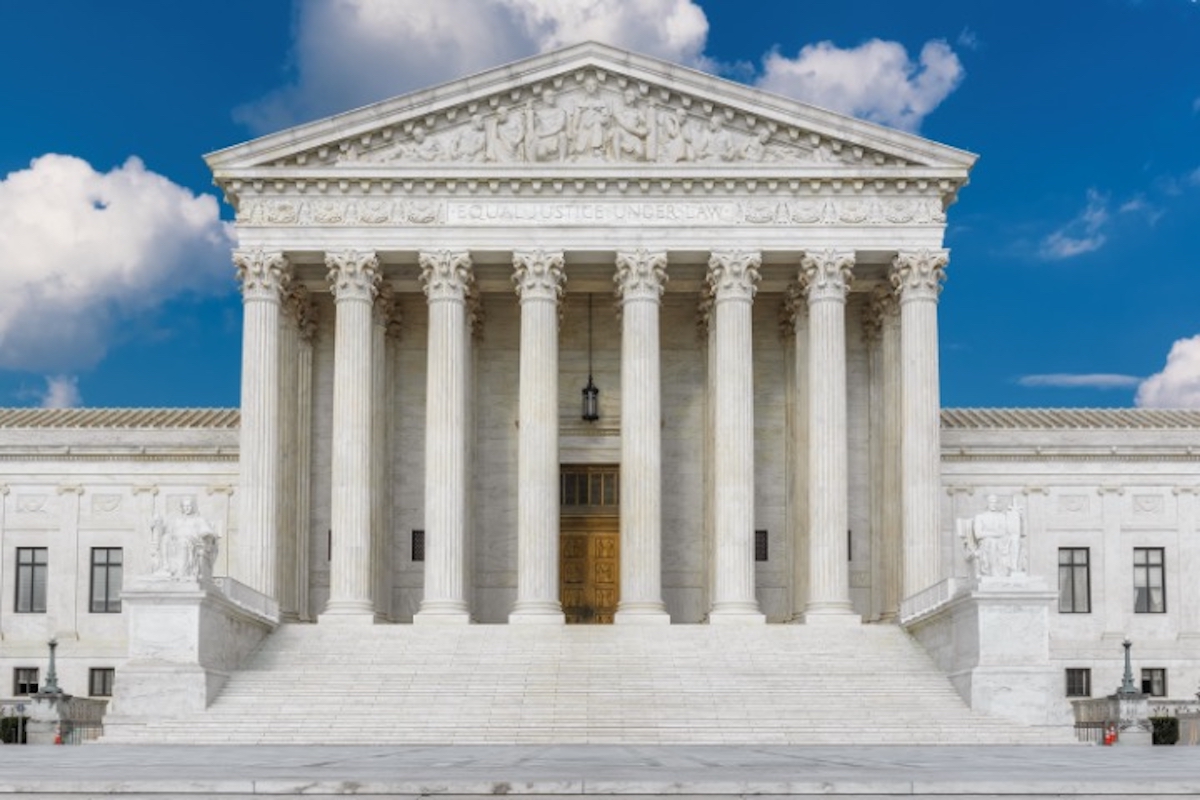
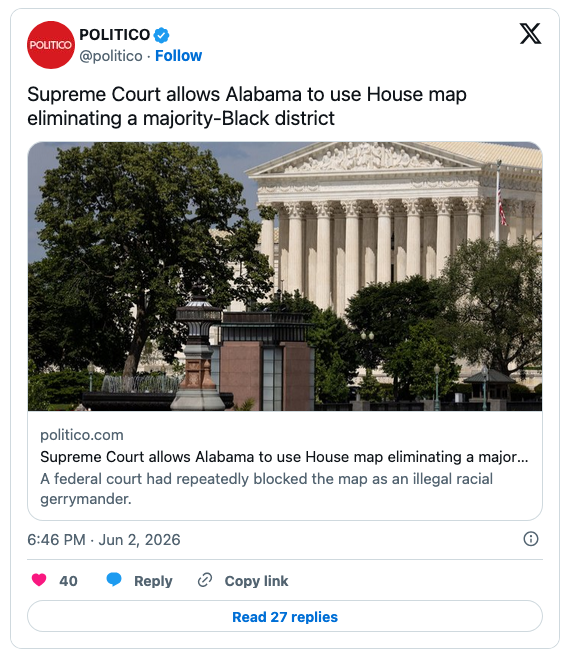
The U.S. Supreme Court has ruled that Alabama’s new electoral map, which eliminates two majority black congressional districts, is constitutional. It can be used in not only August’s primary elections, but also November’s midterms
And last week, a U.S. District Court judge let stand President Donald Trump’s executive order that directs the secretary of Homeland Security to provide states with lists of verified citizens eligible to vote, and the U.S. Postal Service to draft new rules for mail-in ballots.
SCOTUS Ruling
The legal contretemps in the Yellowhammer State concerned redistricting in 2023. The state’s GOP majority redrew its electoral map to eliminate two majority black districts.
The 6-3, four-page ruling, with majority ruling per curiam, overturned an injunction from the U.S. District Court for the Northern District of Alabama, which had blocked the redistricting. SCOTUS ruled that federal courts must not tinker with soon-to-be-held elections.
“We have repeatedly cautioned that lower federal courts should not ‘alter the election rules on the eve of an election,” the majority ruled, citing precedent:
Here, the District Court interposed itself into Alabama’s ongoing efforts to conduct its imminent 2026 congressional elections under maps that its elected representatives selected. Its view that conducting the elections under court-imposed maps would be more convenient for the State was not a valid justification for that intervention. While federal courts should not impose changes close to an election … States are free to decide for themselves whether last-minute changes to an election are in their best interests.
The lower court’s ruling is stayed until plaintiffs appeal to SCOTUS.
Politico detailed the practical effect of the ruling.
“The plan is likely to give Republicans a 6-1 advantage over Democrats in Alabama’s House delegation, compared to the current 5-2 split, by dramatically altering the district held by Rep. Shomari Figures (D-Ala.),” the website explained:
With the court greenlighting the 6-1 map, primaries in four of the seven districts will take place on Aug. 11, after GOP Gov. Kay Ivey delayed them in order to account for a new map. The three districts that did not change under the 2023 map have already voted.
It’s the court’s first major ruling on racial discrimination in redistricting since it drastically narrowed a key provision of the Voting Rights Act in April, prompting Republicans across the South to begin the process of dismantling majority-Black districts to create GOP seats.
Since that ruling, Louisiana Republicans eliminated one of the state’s two majority-Black districts, and Tennessee’s GOP-led legislature dismantled its lone-remaining Black district last month.
The Court’s far-left sisterhood, Elena Kagan, Sonia Sotomayor, and Ketanji Brown Jackson, dissented.
District Court Ruling
The ruling from Trump appointee Carl Nichols of the U.S. District Court in Washington, D.C., involves Trump’s executive order of March 31, 2026, “Ensuring Citizenship Verification and Integrity in Federal Elections.” That order followed another, issued March 25, 2025, “Preserving and Protecting the Integrity of American Elections.”
The first order mandated the enforcement of federal election laws that define the date and time of elections and when ballots are to be counted. Officials cannot count them after Election Day. It also requires that only U.S. citizens be permitted to vote in federal elections. The order requires a paper record for votes and forbids voting by barcode only. It also withholds federal funding from states that refuse to comply with federal statutes that regulate voting. Proof of citizenship will be required to vote.
Radical leftists, of course, are fighting that order in the courts.
The order of March 31, 2026, however, stands for now. It commands the Department of Homeland Security, through U.S. Citizenship and Immigration Services and in coordination with the Social Security Administration, to “compile and transmit to the chief election official of each State a list of individuals confirmed to be United States citizens who will be above the age of 18 at the time of an upcoming Federal election and who maintain a residence in the subject State (State Citizenship List).”
That list will come from federal records, and must be updated and sent to state election officials at their request or 60 days or more before the election.
Role of USPS
Importantly, however, the order requires the USPS to ensure that all mail-in ballots are “marked as Official Election Mail, including through designated markings provided by USPS for this purpose, such as the Official Election Mail logo.” As well, ballot envelopes must be “automation-compatible and bear a unique Intelligent Mail barcode.”
Plus, “no fewer than 90 days prior to a Federal election, any State may choose to notify the USPS if it intends to allow for mail-in or absentee ballots to be transmitted by the USPS,” the order says:
As part of that notification, any notifying State should further indicate whether it intends to submit to the USPS, no fewer than 60 days before the election, a list of voters eligible to vote in a Federal election in such State to whom the State intends to provide a mail-in or absentee ballot to be transmitted via the USPS.
Ballots from those not on that list will not be transmitted.
After the states provide the list to USPS, it will compile a list of such voters and return it to the states.
USPS published its proposed rules in the Federal Register on June 2.
Plaintiffs Do Not Have Standing
Ruling on a motion to block the order, Nichols simply told the plaintiffs — a coalition of the usual anti-American, hate-Trump leftists — they had not yet suffered any harm that required relief from a federal court.
“The plaintiffs argued that the order exceeds presidential authority, intrudes on states’ constitutional role in administering elections, and could violate federal privacy protections by consolidating sensitive personal information,” explained Just the News:
They also contended that the policy could disenfranchise eligible voters, particularly in states that expanded mail voting during and after the COVID-19 pandemic.
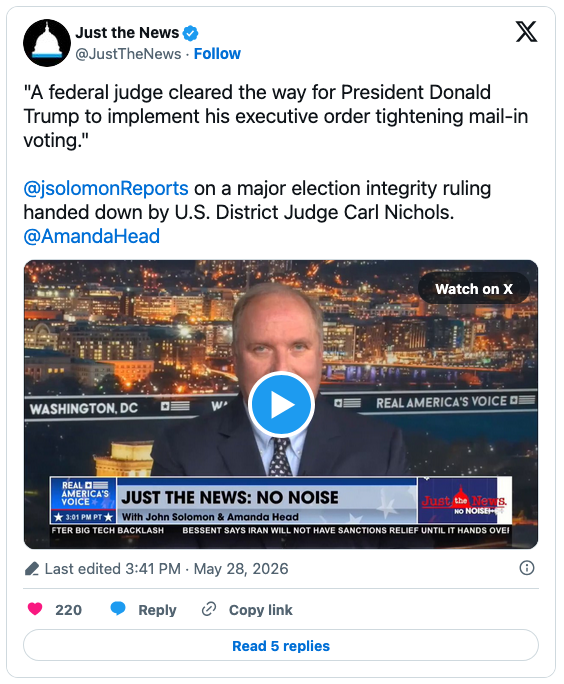
Nichols ruled that the plaintiffs do not have standing to sue, notably to challenge the requirement that USPS compile lists of eligible mail-in voters, i.e., the State Citizenship Lists.
A second problem, Nichols wrote, is plaintiffs’ argument that citizens will be denied the right to vote because of inaccuracies in the lists. But that claim is only speculative.
Another challenge to the order is not “ripe,” Nichols ruled, because plaintiffs “cannot establish that they would suffer harm that is both imminent and irreparable absent preliminary injunctive relief.”
“Because Plaintiffs ‘have failed to carry their burden with respect to establishing that they have a substantial likelihood of standing based on [their alleged] injur[ies],’ they have also failed to show that those injuries are ‘certain enough and great enough to warrant preliminary injunctive relief,’” Nichols concluded, citing precedent:
In any event, given that the Executive Order does not command Plaintiffs to do anything, and that no agency has yet acted pursuant to the Order in a way that could harm Plaintiffs, they have not suffered any harm at present, much less harm that is “certain,” “great,” and imminent.
Still, “the Court recognizes that the Postal Service may ultimately issue a final rule that directly affects Plaintiffs or their members, or that the Government may develop State Citizenship Lists that omit specific individuals due to particularized flaws,” Nichols wrote at the beginning of his ruling:
Plaintiffs may, of course, renew their motions if and when those future actions occur. Until then, however, Plaintiffs cannot show that preliminary injunctive relief is warranted.