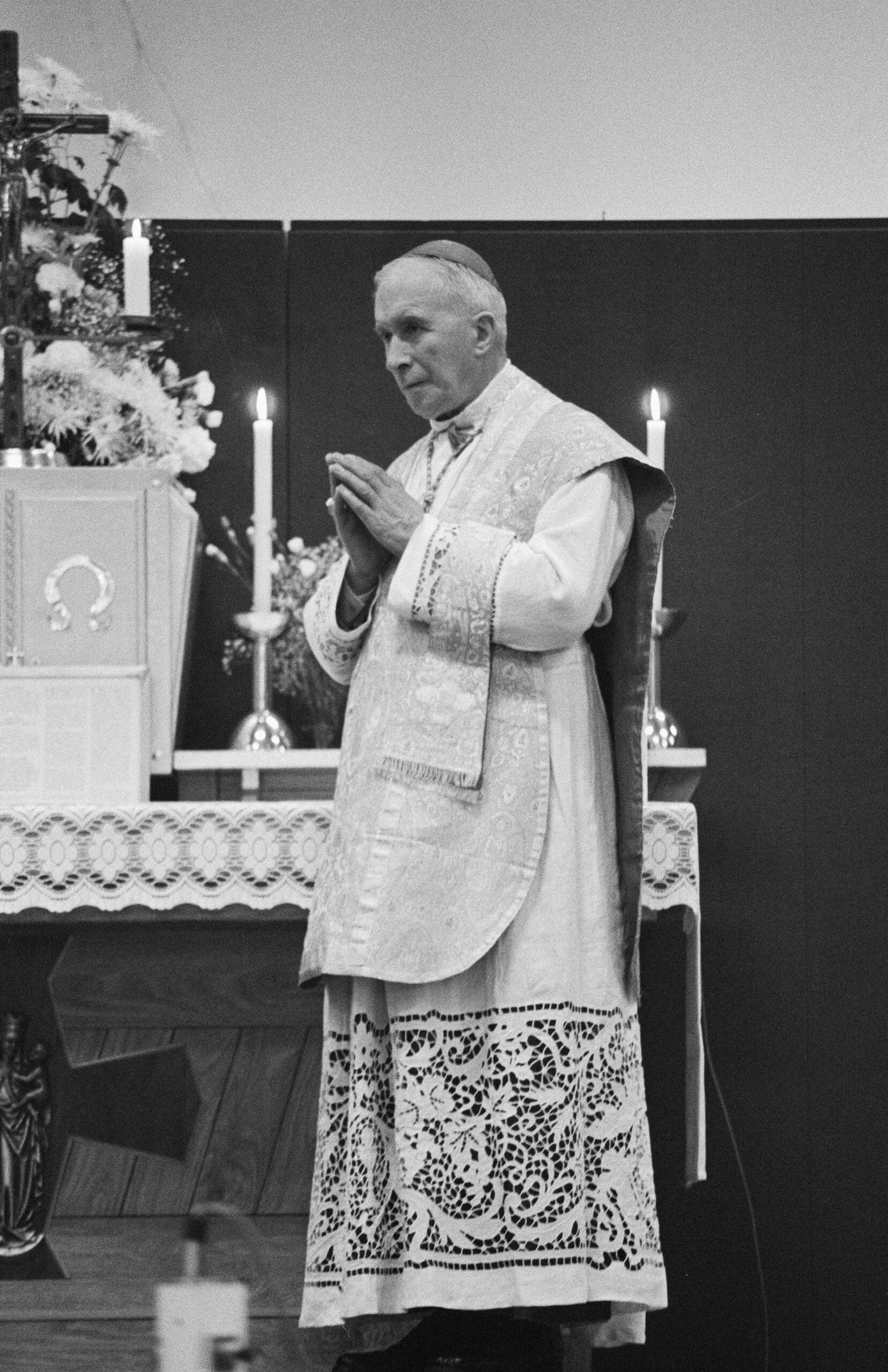
The canonically illegal consecration/ordination (the terms are interchangeable) of four new bishops by two Society of St. Pius X (SSPX) bishops who were themselves illegally ordained by Archbishop Marcel Lefebvre 38 years ago is a renewed wound upon the Mystical Body of Christ. This schismatic act of disobedience carried out in direct defiance of Pope Leo XIV’s public warning has resulted in the incurring by the six bishops of latae sententiae (automatic) excommunication.
While claiming to uphold the traditional faith of the Catholic Church, the newly excommunicated bishops boldly cast aside what the Catholic Church has always taught her children, namely that the hierarchical nature of Catholicism includes the dogmatic teaching that the pope is the Supreme Authority to whom all Catholics owe obedience. That obedience, needless to say, includes not ordaining bishops when the pope forbids such ordinations.
Simply stated, the pope is the successor of Peter, the Vicar of Christ. He governs the Church. Obedience to his decision about who may or may not receive episcopal ordination is necessary if one is to remain a faithful Catholic.
The Holy See instructed the SSPX earlier this year to desist from carrying out on July 1 the illegal ordination of any new bishops. The SSPX rejected this instruction. This defiance of Pope Leo is an act of grave disobedience that the Holy See judges to be a schismatic act that involves “the refusal of submission to the Supreme Pontiff” (canon 751) by carrying out an act forbidden by canon law, namely the ordaining of bishops without a papal mandate (canon 1387). These episcopal ordinations involve not simply the absence of a papal mandate, but clear disobedience in direct defiance of Pope Leo.
On the eve of the illegal consecrations, Pope Leo wrote to the Superior General of the SSPX, Fr. Davide Pagliarani:
With a paternal heart, and aware of the responsibility entrusted to me by the Lord as the Successor of the Apostle Peter, I address you and, through you, the bishops, priests, seminarians and faithful connected to the Priestly Fraternity of Saint Pius X. . . .[F]illed with Christian affection, I plead with you and ask you with all my heart: please turn back! I urge you to consider carefully the spiritual good of the faithful, because the schismatic act you are about to undertake would deprive them of the licit and, in some cases, even valid reception of the Sacraments, which they love and seek for their sanctification.
The pope has the authority to determine what constitutes a schismatic act, and he has done so. The SSPX has no authority to gainsay or ignore this papal judgment.
Fr. Pagliarani responded: “Paradoxically, in the present circumstances, we believe it to be our very duty to do everything possible to mend Christ’s seamless garment, torn by forces and pressures incompatible with a truly Catholic spirit.” Paradoxical indeed! The SSPX Superior General incredibly claims that the SSPX will “mend Christ’s seamless garment.”
No, it tears that garment by committing what he knows the Holy See has deemed a schismatic act. This is akin to an army claiming it has to destroy an enemy-held village in order to save it.

Why did this happen? The SSPX wants to continue ordaining priests who celebrate the Traditional Latin Mass (TLM) while refusing to return to full communion with the pope and the Church. The Society claims that a state of necessity in the Church permits them to ordain new bishops blamelessly. They need some younger bishops, they say, to allow them to continue ordaining new priests in the years to come.
If it were in full communion with the Church, any number of bishops would be willing to ordain the seminarians of the SSPX. Instead, the SSPX has deepened its embrace of a dangerous separatist spirit. Ordaining new bishops against the will of the pope is a necessary action for providing new priests for the SSPX only if it plans to continue operating apart from the Holy See. They apparently do not foresee themselves returning to full communion anytime soon.
In the wake of the 1988 schismatic episcopal ordinations by Archbishop Lefebvre, the Holy See provided for the ordination of priests for the Priestly Fraternity of St. Peter, the Institute of Christ the King, and the Institute of the Good Shepherd – all of whom celebrate the Traditional Latin Mass. Full communion with, and obedience to, the Roman Pontiff is not a discretionary practice that can be set aside by any group in the Church, especially a group that publicly asserts, as the SSPX does, that it is fully Catholic and submits to the Supreme Authority of the Church.
The SSPX, in my judgment, used the February 2 announcement of episcopal ordinations on July 1 as a tactic, trying to compel the Holy See to agree to allow the ordinations in the hope that the Holy See would want to avoid a schism at all costs. The Holy See offered to continue doctrinal discussions with the SSPX but only if the threat of episcopal ordinations were withdrawn. The SSPX would not agree to this. To demand a hearing from the Holy See without agreeing to a very reasonable condition – “stop threatening an act of grave disobedience if Pope Leo does not give you what you want” – is plainly not a manifestation of filial submission to the successor of Peter.
Where will all this lead? The longer the SSPX operates in defiance of the Holy See, the deeper a separatist spirit will become embedded among the SSPX and the religious and laity who attend their Masses. This will lead to greater antagonism towards Catholics who fulfill their duty to submit to papal authority.
The excommunicated SSPX bishops will be considered by many sympathizers as the only reliably Catholic bishops. The pope and bishops in full communion with him will likely be considered as obstacles to promoting the mission of the Church. This is the danger that flows from removing oneself from the due submission owed by every Catholic to the Successor of Peter. Catholics are called to live sub Petro, not contra Petro.
The SSPX claims that doctrinal disorders in the Church justify its defiance of the authority of the Roman Pontiff. I am reminded of something my college professor said in a course on the Constitutional History of Medieval Europe: “It all comes down to this question: who the hell is in charge here?” The SSPX needs to ask itself: who did Christ put in charge of the Church? Peter and his successors, or someone else?
An essential aspect of this story is the manifest lack of trust in Divine Providence on the part of Archbishop Lefebvre and his followers. Recall that in 1988, the Holy See offered to ordain as bishop a member of the SSPX if Archbishop Lefebvre would agree to a reconciliation with the Holy See. This was an unusual accommodation, given that a society of priests such as the SSPX does not require having a bishop member to carry out ordinations.
Archbishop Lefebvre signed an agreement but reneged on it the next day. He later said he was troubled that the Holy See had asked him to submit more names of candidates for episcopal ordination after he had already informed the Holy See who he thought should be ordained bishop. He wanted to control who would be the bishop who would replace him. It doesn’t work like that in the Catholic Church. The pope makes the choice because he is the Supreme Authority in the Church.
We must all trust in God’s Providence. Dom Hubert van Zeller wrote: “The word providence. . .means ‘seeing beforehand.’ [God] sees beforehand what is best for us, and we accept what he sends.” The SSPX has manifested a woeful lack of trust in God’s providential favor shown to those who fulfill His will, which includes submitting to the divinely established authority of the Successor of Peter.
May the Lord bring the straying shepherds back to full communion with full obedience to the Vicar of Christ.
![Hegseth Demands Fitness Requirements, Says 'Fat Troops' 'Not Who We Are' [WATCH]](https://teamredvictory.com/wp-content/uploads/2025/09/Hegseth-Demands-Fitness-Requirements-Says-Fat-Troops-Not-Who-We-350x250.jpg)