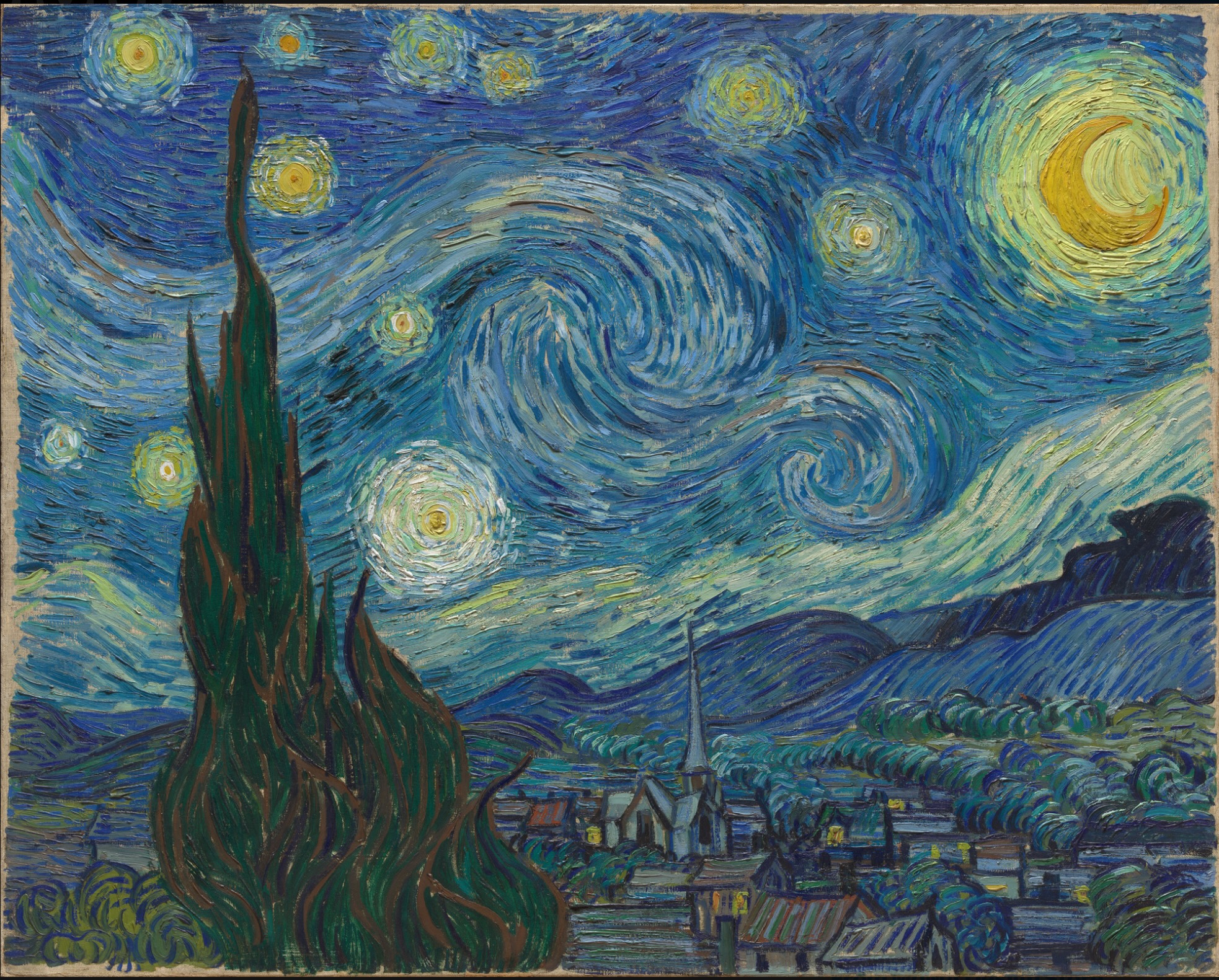
I remember a moonless summer night at a campsite in North Dakota, almost forty years ago now, when the stars were so innumerable and bright, it was difficult to pick out the familiar constellations. The night was so black that I could barely see my own hand in front of my face, but the stars hung so thick and low I thought I could reach out and pluck them from the firmament like bunches of grapes. Billions of stars. It was, in an older and truer sense of an abused and overused word, awesome.
My late father loved astronomy. He knew a great many constellations and most of the names of the brightest stars. I remember on dark nights at home in the Midwest, he would point them out. Straight above us there were Vega, Altair, and Deneb. They make up the Summer Triangle. There was Cassiopeia. And the Corona Borealis. Over there, in the South, was Scorpio with the great red giant, Antares. As autumn comes on, Scorpio will sink below the horizon, and Orion will rise; the great hunter chasing a quarry he will never catch.
He taught me that our eyes see color best in the center of our focus, but light sensitivity is slightly better just beyond the edge of the center of sight. The dim star you might not see if you gazed at it directly might be just visible if you looked just to one side or the other. That’s how he taught me to find the Andromeda Galaxy – the most distant object visible with the naked eye. I have only seen it once. But I have seen it.
Dad eventually got a telescope – a quality amateur instrument with a mirror eight or nine inches in diameter – and he would bring it out on clear nights to look at the nebula in Orion’s belt, or to see the rings and moons of Saturn, or to gaze at the crescent of Venus following the sinking sun. The telescope was really overkill for inspecting the craters of the moon; binoculars were best for that.
We used to talk about the most amazing night skies we had ever seen. There was that night in North Dakota – never seen anything like it or since – where we could see the Milky Way clear overhead, the aurora to the north, and lightning crawling over thunderheads, like luminescent cauliflowers, to the south.
Over the years I realized that those nights with Dad, staring up at all those pinpoints of ancient light and wandering planets, were a kind of theodicy.
Dad was a family doctor. He spent his days around people who were sick and suffering. He helped many of them get well and even thrive, but he also knew that everything he did was ultimately a stall. He fought a losing battle against mortality every day. We all do, of course; he just saw that more clearly than most of us.

Dad’s fascination with the stars wasn’t merely therapeutic – though it was that, I suppose – it was closer to contemplation in gratitude. It was an exercise in wonder. See what unfathomable glory the Lord has made? What greater remedy to the problem of suffering, the problem of human frailty, than to gaze with wonder upon God’s own handiwork?
Wonder is not, strictly speaking, a virtue. But it does inoculate the soul against cynicism. Wonder begets humility and gratitude – which are virtues – both of which go a long way to transforming the suffering of this life from something one hopes to avoid or at least endure into something that opens into redemption.
And I find that looking up is a remarkably effective way to inculcate a sense of wonder.
For most of human history, the wonder of a night sky was an ordinary thing to encounter, even in towns and cities. “Light pollution” is a relative novelty. It would be simplistic to suggest that our modern world has forgotten its Creator because the stars don’t shine so clearly as they once did through the skyglow of our cities. But the fact that many people in this world will live and die without ever having seen a clear night sky certainly doesn’t help.
My pastor once suggested to a classroom full of parents that their children, who were soon to make their First Communion, ought to be taken out of the city to see the stars on a clear, dark night. That, he insisted, would be as important a preparation for the reception of that gratuitous and wondrous Sacrament as any the kids would be taught in the classroom. He was in earnest. And I think he was right, too.
This past week I have been away in western Michigan, one of Dad’s favorite places for stargazing. It gets dark here at night. Not North Dakota dark, perhaps, but much darker than the Virginia suburbs of Washington where I live. My eldest daughter and I went out to see the stars the other night. I wish I could remember half of what my Dad taught me, but I can still work my way around the northern sky with something like competence. I pointed out Scorpio and Cassiopeia and the Little Dipper. The Milky Way was spread across it all.
Standing beside my daughter, staring up at those brilliant stars, I couldn’t help but marvel at what love the Father has for his children. And what a marvel it is to be invited to receive and share that same love. Dante spoke of the love that moves the sun and stars. His love moves even more than that.


![Hegseth Demands Fitness Requirements, Says 'Fat Troops' 'Not Who We Are' [WATCH]](https://teamredvictory.com/wp-content/uploads/2025/09/Hegseth-Demands-Fitness-Requirements-Says-Fat-Troops-Not-Who-We-350x250.jpg)